

Configuration of Charge Waves in Polymethine Linear Dye Systems
193
I − =
e
M
N
(1 − τ ν ⊥ ) sin( p) −
g
2 cos
4
(φ) sin( p)
8(1 − τ ν ⊥ ) cos 2 ( p)
.
(2.10)
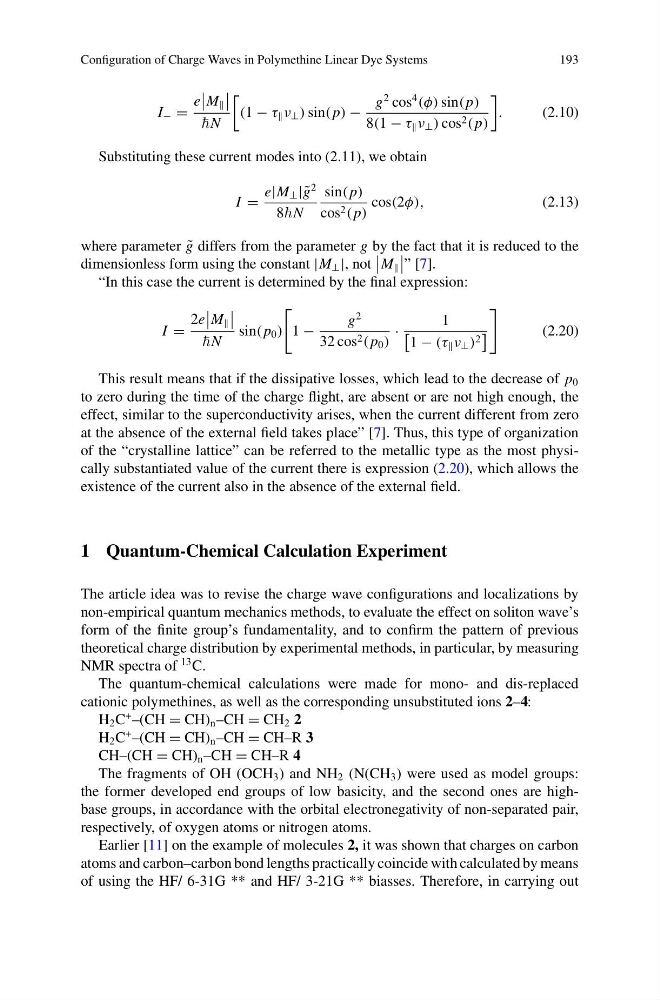
Substituting these current modes into (2.11), we obtain
I =
e|M ⊥ | ˜
g
2
8N
sin( p)
cos 2 ( p)
cos(2φ),
(2.13)
where parameter ˜
g differs from the parameter g by the fact that it is reduced to the
dimensionless form using the constant |M ⊥ |, not
M
” [7].
“In this case the current is determined by the final expression:
I =
2e
M
N
sin( p 0 )
1 −
g
2
32 cos 2 ( p 0 )
·
1
1 − (τ ν ⊥ ) 2
(2.20)
This result means that if the dissipative losses, which lead to the decrease of p 0
to zero during the time of the charge flight, are absent or are not high enough, the
effect, similar to the superconductivity arises, when the current different from zero
at the absence of the external field takes place” [7]. Thus, this type of organization
of the “crystalline lattice” can be referred to the metallic type as the most physically substantiated value of the current there is expression (2.20), which allows the
existence of the current also in the absence of the external field.
1 Quantum-Chemical Calculation Experiment
The article idea was to revise the charge wave configurations and localizations by
non-empirical quantum mechanics methods, to evaluate the effect on soliton wave’s
form of the finite group’s fundamentality, and to confirm the pattern of previous
theoretical charge distribution by experimental methods, in particular, by measuring
NMR spectra of
13 C.
The quantum-chemical calculations were made for mono- and dis-replaced
cationic polymethines, as well as the corresponding unsubstituted ions 2–4:
H 2 C
+ –(CH = CH) n –CH = CH 2 2
H 2 C
+ –(CH = CH) n –CH = CH–R 3
CH–(CH = CH) n –CH = CH–R 4
The fragments of OH (OCH 3 ) and NH 2 (N(CH 3 ) were used as model groups:
the former developed end groups of low basicity, and the second ones are highbase groups, in accordance with the orbital electronegativity of non-separated pair,
respectively, of oxygen atoms or nitrogen atoms.
Earlier [11] on the example of molecules 2, it was shown that charges on carbon
atoms and carbon–carbon bond lengths practically coincide with calculated by means
of using the HF/ 6-31G ** and HF/ 3-21G ** biasses. Therefore, in carrying out
193
I − =
e
M
N
(1 − τ ν ⊥ ) sin( p) −
g
2 cos
4
(φ) sin( p)
8(1 − τ ν ⊥ ) cos 2 ( p)
.
(2.10)
Substituting these current modes into (2.11), we obtain
I =
e|M ⊥ | ˜
g
2
8N
sin( p)
cos 2 ( p)
cos(2φ),
(2.13)
where parameter ˜
g differs from the parameter g by the fact that it is reduced to the
dimensionless form using the constant |M ⊥ |, not
M
” [7].
“In this case the current is determined by the final expression:
I =
2e
M
N
sin( p 0 )
1 −
g
2
32 cos 2 ( p 0 )
·
1
1 − (τ ν ⊥ ) 2
(2.20)
This result means that if the dissipative losses, which lead to the decrease of p 0
to zero during the time of the charge flight, are absent or are not high enough, the
effect, similar to the superconductivity arises, when the current different from zero
at the absence of the external field takes place” [7]. Thus, this type of organization
of the “crystalline lattice” can be referred to the metallic type as the most physically substantiated value of the current there is expression (2.20), which allows the
existence of the current also in the absence of the external field.
1 Quantum-Chemical Calculation Experiment
The article idea was to revise the charge wave configurations and localizations by
non-empirical quantum mechanics methods, to evaluate the effect on soliton wave’s
form of the finite group’s fundamentality, and to confirm the pattern of previous
theoretical charge distribution by experimental methods, in particular, by measuring
NMR spectra of
13 C.
The quantum-chemical calculations were made for mono- and dis-replaced
cationic polymethines, as well as the corresponding unsubstituted ions 2–4:
H 2 C
+ –(CH = CH) n –CH = CH 2 2
H 2 C
+ –(CH = CH) n –CH = CH–R 3
CH–(CH = CH) n –CH = CH–R 4
The fragments of OH (OCH 3 ) and NH 2 (N(CH 3 ) were used as model groups:
the former developed end groups of low basicity, and the second ones are highbase groups, in accordance with the orbital electronegativity of non-separated pair,
respectively, of oxygen atoms or nitrogen atoms.
Earlier [11] on the example of molecules 2, it was shown that charges on carbon
atoms and carbon–carbon bond lengths practically coincide with calculated by means
of using the HF/ 6-31G ** and HF/ 3-21G ** biasses. Therefore, in carrying out