

166
A. M. Korol et al.
Particular attention is drawn to the energy values for which the supertunneling
effect is realized in this structure: for them the transmission is ideal, i.e., the transmission coefficient T equals the maximum value, namely, unity, for any angle of
incidence of quasiparticles on the given structure. From the above formulas, we
obtain the expression for supertunneling energies; it has the following form:
E s =
U
1 + β
.
(9)
Therefore, the energies E s depend only on the ratio of the parameters U and β
and do not depend on the parameters α and D.
In the vicinity of the energy values close to the height of the electrostatic barrier:
E = U, a bandgap is formed. Its formation is explained by the fact that for energies
E ~ U for most incidence angles, the quasi-momentum q becomes imaginary and the
electron wave becomes evanescent (see formula (5)).
The bandgap of energies depends on the parameters α and β, namely, it increases
with decreasing α and increasing β, and is much more sensitive to the change in
parameter β. Also, the forbidden band depends essentially on the angle of incidence
φ, increasing with increasing φ.
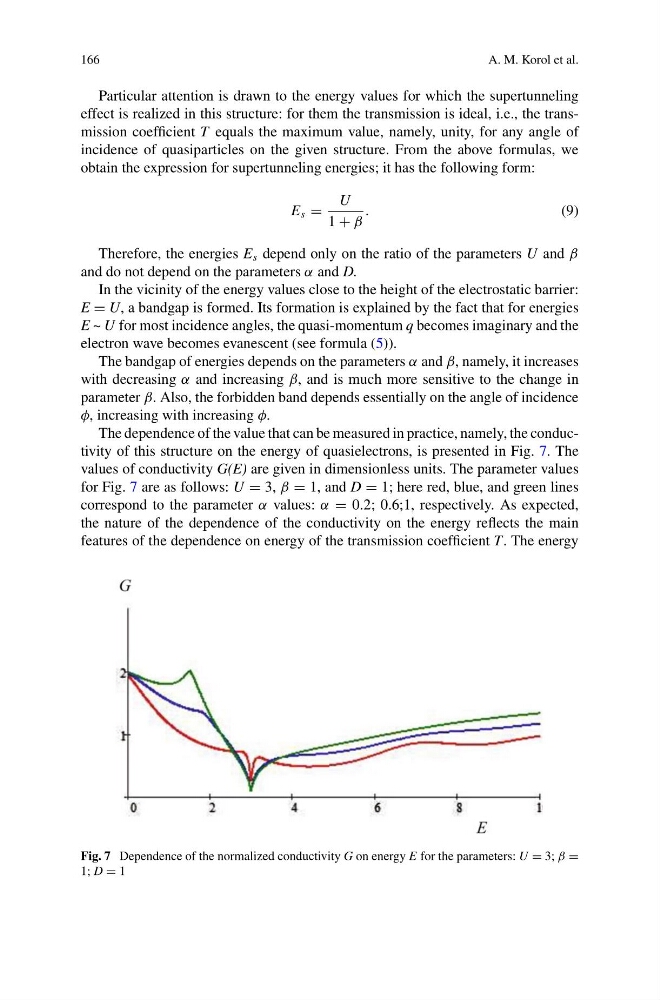
The dependence of the value that can be measured in practice, namely, the conductivity of this structure on the energy of quasielectrons, is presented in Fig. 7. The
values of conductivity G(E) are given in dimensionless units. The parameter values
for Fig. 7 are as follows: U = 3, β = 1, and D = 1; here red, blue, and green lines
correspond to the parameter α values: α = 0.2; 0.6;1, respectively. As expected,
the nature of the dependence of the conductivity on the energy reflects the main
features of the dependence on energy of the transmission coefficient T. The energy
Fig. 7 Dependence of the normalized conductivity G on energy E for the parameters: U = 3; β =
1; D = 1
A. M. Korol et al.
Particular attention is drawn to the energy values for which the supertunneling
effect is realized in this structure: for them the transmission is ideal, i.e., the transmission coefficient T equals the maximum value, namely, unity, for any angle of
incidence of quasiparticles on the given structure. From the above formulas, we
obtain the expression for supertunneling energies; it has the following form:
E s =
U
1 + β
.
(9)
Therefore, the energies E s depend only on the ratio of the parameters U and β
and do not depend on the parameters α and D.
In the vicinity of the energy values close to the height of the electrostatic barrier:
E = U, a bandgap is formed. Its formation is explained by the fact that for energies
E ~ U for most incidence angles, the quasi-momentum q becomes imaginary and the
electron wave becomes evanescent (see formula (5)).
The bandgap of energies depends on the parameters α and β, namely, it increases
with decreasing α and increasing β, and is much more sensitive to the change in
parameter β. Also, the forbidden band depends essentially on the angle of incidence
φ, increasing with increasing φ.
The dependence of the value that can be measured in practice, namely, the conductivity of this structure on the energy of quasielectrons, is presented in Fig. 7. The
values of conductivity G(E) are given in dimensionless units. The parameter values
for Fig. 7 are as follows: U = 3, β = 1, and D = 1; here red, blue, and green lines
correspond to the parameter α values: α = 0.2; 0.6;1, respectively. As expected,
the nature of the dependence of the conductivity on the energy reflects the main
features of the dependence on energy of the transmission coefficient T. The energy
Fig. 7 Dependence of the normalized conductivity G on energy E for the parameters: U = 3; β =
1; D = 1