

Ising-Like Model of Nanosize Spin-Crossover Molecular Crystals
147
J
b
J
s
J
bs
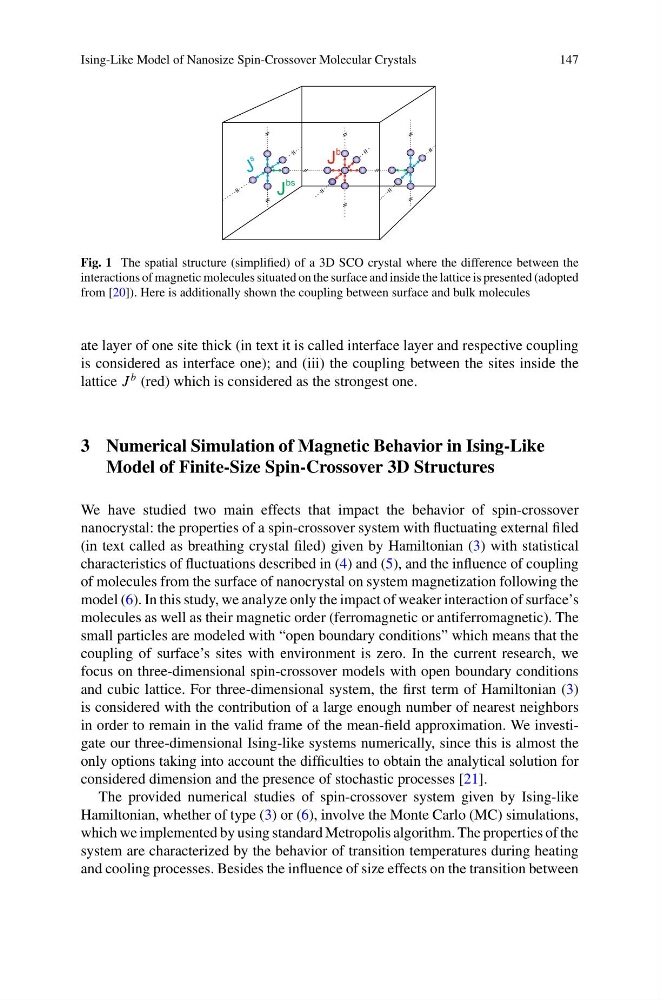
Fig. 1 The spatial structure (simplified) of a 3D SCO crystal where the difference between the
interactions of magnetic molecules situated on the surface and inside the lattice is presented (adopted
from [20]). Here is additionally shown the coupling between surface and bulk molecules
ate layer of one site thick (in text it is called interface layer and respective coupling
is considered as interface one); and (iii) the coupling between the sites inside the
lattice J
b (red) which is considered as the strongest one.
3 Numerical Simulation of Magnetic Behavior in Ising-Like
Model of Finite-Size Spin-Crossover 3D Structures
We have studied two main effects that impact the behavior of spin-crossover
nanocrystal: the properties of a spin-crossover system with fluctuating external filed
(in text called as breathing crystal filed) given by Hamiltonian (3) with statistical
characteristics of fluctuations described in (4) and (5), and the influence of coupling
of molecules from the surface of nanocrystal on system magnetization following the
model (6). In this study, we analyze only the impact of weaker interaction of surface’s
molecules as well as their magnetic order (ferromagnetic or antiferromagnetic). The
small particles are modeled with “open boundary conditions” which means that the
coupling of surface’s sites with environment is zero. In the current research, we
focus on three-dimensional spin-crossover models with open boundary conditions
and cubic lattice. For three-dimensional system, the first term of Hamiltonian (3)
is considered with the contribution of a large enough number of nearest neighbors
in order to remain in the valid frame of the mean-field approximation. We investigate our three-dimensional Ising-like systems numerically, since this is almost the
only options taking into account the difficulties to obtain the analytical solution for
considered dimension and the presence of stochastic processes [21].
The provided numerical studies of spin-crossover system given by Ising-like
Hamiltonian, whether of type (3) or (6), involve the Monte Carlo (MC) simulations,
which we implemented by using standard Metropolis algorithm. The properties of the
system are characterized by the behavior of transition temperatures during heating
and cooling processes. Besides the influence of size effects on the transition between
147
J
b
J
s
J
bs
Fig. 1 The spatial structure (simplified) of a 3D SCO crystal where the difference between the
interactions of magnetic molecules situated on the surface and inside the lattice is presented (adopted
from [20]). Here is additionally shown the coupling between surface and bulk molecules
ate layer of one site thick (in text it is called interface layer and respective coupling
is considered as interface one); and (iii) the coupling between the sites inside the
lattice J
b (red) which is considered as the strongest one.
3 Numerical Simulation of Magnetic Behavior in Ising-Like
Model of Finite-Size Spin-Crossover 3D Structures
We have studied two main effects that impact the behavior of spin-crossover
nanocrystal: the properties of a spin-crossover system with fluctuating external filed
(in text called as breathing crystal filed) given by Hamiltonian (3) with statistical
characteristics of fluctuations described in (4) and (5), and the influence of coupling
of molecules from the surface of nanocrystal on system magnetization following the
model (6). In this study, we analyze only the impact of weaker interaction of surface’s
molecules as well as their magnetic order (ferromagnetic or antiferromagnetic). The
small particles are modeled with “open boundary conditions” which means that the
coupling of surface’s sites with environment is zero. In the current research, we
focus on three-dimensional spin-crossover models with open boundary conditions
and cubic lattice. For three-dimensional system, the first term of Hamiltonian (3)
is considered with the contribution of a large enough number of nearest neighbors
in order to remain in the valid frame of the mean-field approximation. We investigate our three-dimensional Ising-like systems numerically, since this is almost the
only options taking into account the difficulties to obtain the analytical solution for
considered dimension and the presence of stochastic processes [21].
The provided numerical studies of spin-crossover system given by Ising-like
Hamiltonian, whether of type (3) or (6), involve the Monte Carlo (MC) simulations,
which we implemented by using standard Metropolis algorithm. The properties of the
system are characterized by the behavior of transition temperatures during heating
and cooling processes. Besides the influence of size effects on the transition between