

Modified Two-Pole Approximation for Systems with Strong Electron Correlations …
135
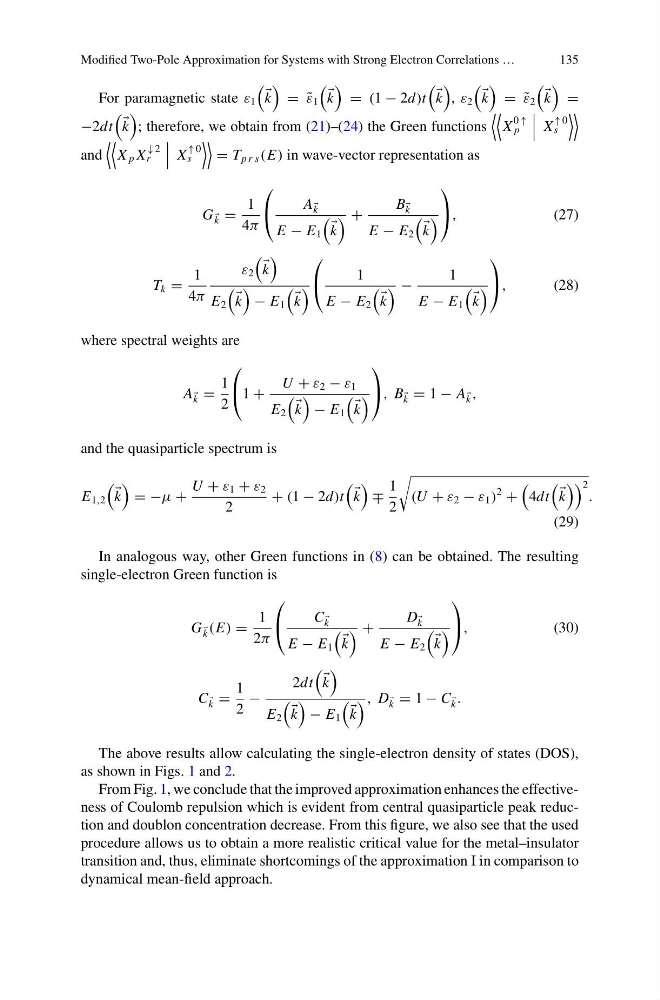
For paramagnetic state ε 1
k
= ˜
ε 1
k
= (1 − 2d)t
k
, ε 2
k
= ˜
ε 2
k
=
−2dt
k
; therefore, we obtain from (21)–(24) the Green functions
X
0 ↑
p
X
↑ 0
s
and
X p X
↓ 2
r
X
↑ 0
s
= T p r s (E) in wave-vector representation as
G
k =
1
4π
⎛
⎝
A
k
E − E 1
k
+
B
k
E − E 2
k
⎞
⎠ ,
(27)
T k =
1
4π
ε 2
k
E 2
k
− E 1
k
⎛
⎝
1
E − E 2
k
−
1
E − E 1
k
⎞
⎠ ,
(28)
where spectral weights are
A
k =
1
2
⎛
⎝ 1 +
U + ε 2 − ε 1
E 2
k
− E 1
k
⎞
⎠ , B
k = 1 − A
k ,
and the quasiparticle spectrum is
E 1,2
k
= −μ +
U + ε 1 + ε 2
2
+ (1 − 2d)t
k
∓
1
2
(U + ε 2 − ε 1 )
2
+
4dt
k
2 .
(29)
In analogous way, other Green functions in (8) can be obtained. The resulting
single-electron Green function is
G
k (E) =
1
2π
⎛
⎝
C
k
E − E 1
k
+
D
k
E − E 2
k
⎞
⎠ ,
(30)
C
k =
1
2
−
2dt
k
E 2
k
− E 1
k
, D
k = 1 − C
k .
The above results allow calculating the single-electron density of states (DOS),
as shown in Figs. 1 and 2.
From Fig. 1, we conclude that the improved approximation enhances the effectiveness of Coulomb repulsion which is evident from central quasiparticle peak reduction and doublon concentration decrease. From this figure, we also see that the used
procedure allows us to obtain a more realistic critical value for the metal–insulator
transition and, thus, eliminate shortcomings of the approximation I in comparison to
dynamical mean-field approach.
135
For paramagnetic state ε 1
k
= ˜
ε 1
k
= (1 − 2d)t
k
, ε 2
k
= ˜
ε 2
k
=
−2dt
k
; therefore, we obtain from (21)–(24) the Green functions
X
0 ↑
p
X
↑ 0
s
and
X p X
↓ 2
r
X
↑ 0
s
= T p r s (E) in wave-vector representation as
G
k =
1
4π
⎛
⎝
A
k
E − E 1
k
+
B
k
E − E 2
k
⎞
⎠ ,
(27)
T k =
1
4π
ε 2
k
E 2
k
− E 1
k
⎛
⎝
1
E − E 2
k
−
1
E − E 1
k
⎞
⎠ ,
(28)
where spectral weights are
A
k =
1
2
⎛
⎝ 1 +
U + ε 2 − ε 1
E 2
k
− E 1
k
⎞
⎠ , B
k = 1 − A
k ,
and the quasiparticle spectrum is
E 1,2
k
= −μ +
U + ε 1 + ε 2
2
+ (1 − 2d)t
k
∓
1
2
(U + ε 2 − ε 1 )
2
+
4dt
k
2 .
(29)
In analogous way, other Green functions in (8) can be obtained. The resulting
single-electron Green function is
G
k (E) =
1
2π
⎛
⎝
C
k
E − E 1
k
+
D
k
E − E 2
k
⎞
⎠ ,
(30)
C
k =
1
2
−
2dt
k
E 2
k
− E 1
k
, D
k = 1 − C
k .
The above results allow calculating the single-electron density of states (DOS),
as shown in Figs. 1 and 2.
From Fig. 1, we conclude that the improved approximation enhances the effectiveness of Coulomb repulsion which is evident from central quasiparticle peak reduction and doublon concentration decrease. From this figure, we also see that the used
procedure allows us to obtain a more realistic critical value for the metal–insulator
transition and, thus, eliminate shortcomings of the approximation I in comparison to
dynamical mean-field approach.