

3.2 Eigenvalue Problem
63
u =
-0.8507
0.5257
0.5257
0.8507
d =
1.3820
0
0
3.6180
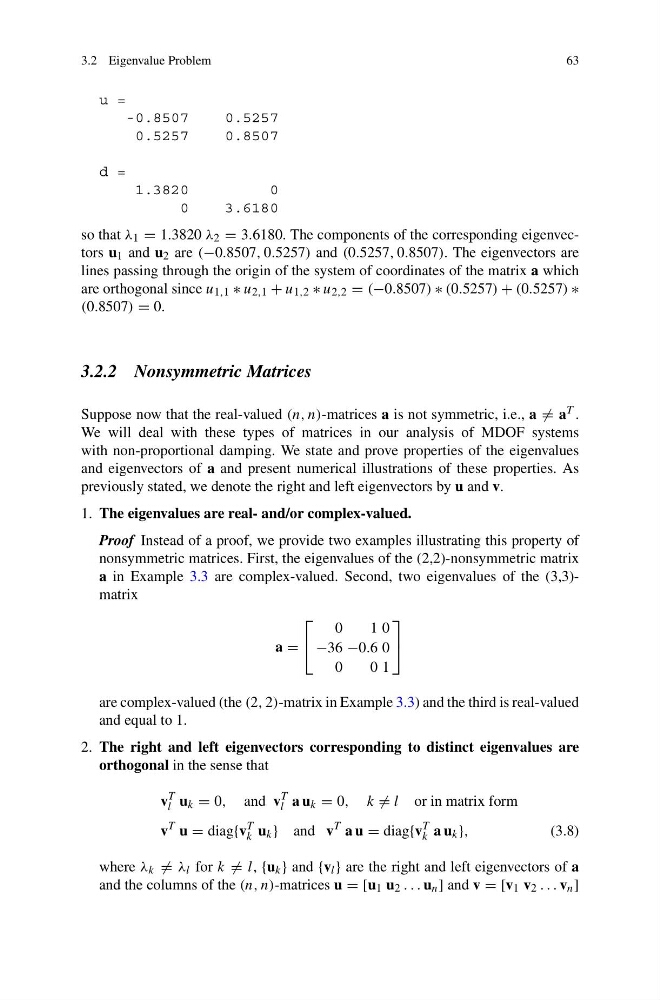
so that λ 1 = 1.3820 λ 2 = 3.6180. The components of the corresponding eigenvectors u 1 and u 2 are (−0.8507, 0.5257) and (0.5257, 0.8507). The eigenvectors are
lines passing through the origin of the system of coordinates of the matrix a which
are orthogonal since u 1,1 ∗ u 2,1 + u 1,2 ∗ u 2,2 = (−0.8507) ∗ (0.5257) + (0.5257) ∗
(0.8507) = 0.
3.2.2 Nonsymmetric Matrices
Suppose now that the real-valued (n, n)-matrices a is not symmetric, i.e., a = a T .
We will deal with these types of matrices in our analysis of MDOF systems
with non-proportional damping. We state and prove properties of the eigenvalues
and eigenvectors of a and present numerical illustrations of these properties. As
previously stated, we denote the right and left eigenvectors by u and v.
1. The eigenvalues are real- and/or complex-valued.
Proof Instead of a proof, we provide two examples illustrating this property of
nonsymmetric matrices. First, the eigenvalues of the (2,2)-nonsymmetric matrix
a in Example 3.3 are complex-valued. Second, two eigenvalues of the (3,3)matrix
a =
⎡
⎣
0
1 0
−36 −0.6 0
0
0 1
⎤
⎦
are complex-valued (the (2, 2)-matrix in Example 3.3) and the third is real-valued
and equal to 1.
2. The right and left eigenvectors corresponding to distinct eigenvalues are
orthogonal in the sense that
v
T
l u k = 0, and v
T
l a u k = 0, k = l or in matrix form
v
T u = diag{v
T
k u k } and v
T a u = diag{v
T
k a u k },
(3.8)
where λ k = λ l for k = l, {u k } and {v l } are the right and left eigenvectors of a
and the columns of the (n, n)-matrices u = [u 1 u 2 . . . u n ] and v = [v 1 v 2 . . . v n ]
63
u =
-0.8507
0.5257
0.5257
0.8507
d =
1.3820
0
0
3.6180
so that λ 1 = 1.3820 λ 2 = 3.6180. The components of the corresponding eigenvectors u 1 and u 2 are (−0.8507, 0.5257) and (0.5257, 0.8507). The eigenvectors are
lines passing through the origin of the system of coordinates of the matrix a which
are orthogonal since u 1,1 ∗ u 2,1 + u 1,2 ∗ u 2,2 = (−0.8507) ∗ (0.5257) + (0.5257) ∗
(0.8507) = 0.
3.2.2 Nonsymmetric Matrices
Suppose now that the real-valued (n, n)-matrices a is not symmetric, i.e., a = a T .
We will deal with these types of matrices in our analysis of MDOF systems
with non-proportional damping. We state and prove properties of the eigenvalues
and eigenvectors of a and present numerical illustrations of these properties. As
previously stated, we denote the right and left eigenvectors by u and v.
1. The eigenvalues are real- and/or complex-valued.
Proof Instead of a proof, we provide two examples illustrating this property of
nonsymmetric matrices. First, the eigenvalues of the (2,2)-nonsymmetric matrix
a in Example 3.3 are complex-valued. Second, two eigenvalues of the (3,3)matrix
a =
⎡
⎣
0
1 0
−36 −0.6 0
0
0 1
⎤
⎦
are complex-valued (the (2, 2)-matrix in Example 3.3) and the third is real-valued
and equal to 1.
2. The right and left eigenvectors corresponding to distinct eigenvalues are
orthogonal in the sense that
v
T
l u k = 0, and v
T
l a u k = 0, k = l or in matrix form
v
T u = diag{v
T
k u k } and v
T a u = diag{v
T
k a u k },
(3.8)
where λ k = λ l for k = l, {u k } and {v l } are the right and left eigenvectors of a
and the columns of the (n, n)-matrices u = [u 1 u 2 . . . u n ] and v = [v 1 v 2 . . . v n ]