

30
2 Single Degree of Freedom (SDOF) Systems
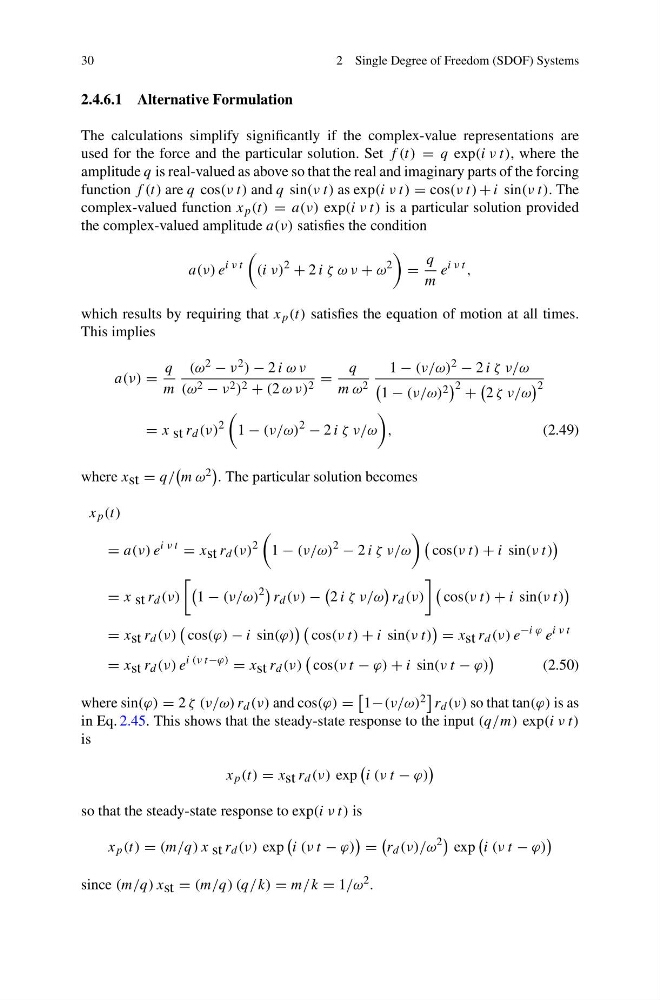
2.4.6.1 Alternative Formulation
The calculations simplify significantly if the complex-value representations are
used for the force and the particular solution. Set f (t) = q exp(i ν t), where the
amplitude q is real-valued as above so that the real and imaginary parts of the forcing
function f (t) are q cos(ν t) and q sin(ν t) as exp(i ν t) = cos(ν t) + i sin(ν t). The
complex-valued function x p (t) = a(ν) exp(i ν t) is a particular solution provided
the complex-valued amplitude a(ν) satisfies the condition
a(ν) e
i ν t
(i ν)
2
+ 2 i ζ ω ν + ω
2
=
q
m
e
i ν t ,
which results by requiring that x p (t) satisfies the equation of motion at all times.
This implies
a(ν) =
q
m
(ω 2 − ν 2 ) − 2 i ω ν
(ω 2 − ν 2 ) 2 + (2 ω ν) 2 =
q
m ω 2
1 − (ν/ω) 2 − 2 i ζ ν/ω
1 − (ν/ω) 2
2 +
2 ζ ν/ω
2
= x st r d (ν)
2
1 − (ν/ω)
2
− 2 i ζ ν/ω
,
(2.49)
where x st = q/
m ω 2
. The particular solution becomes
x p (t)
= a(ν) e
i ν t
= x st r d (ν)
2
1 − (ν/ω)
2
− 2 i ζ ν/ω
cos(ν t) + i sin(ν t)
= x st r d (ν)
1 − (ν/ω)
2
r d (ν) −
2 i ζ ν/ω
r d (ν)
cos(ν t) + i sin(ν t)
= x st r d (ν)
cos(ϕ) − i sin(ϕ)
cos(ν t) + i sin(ν t)
= x st r d (ν) e
−i ϕ e
i ν t
= x st r d (ν) e
i (ν t−ϕ)
= x st r d (ν)
cos(ν t − ϕ) + i sin(ν t − ϕ)
(2.50)
where sin(ϕ) = 2 ζ (ν/ω) r d (ν) and cos(ϕ) =
1−(ν/ω) 2
r d (ν) so that tan(ϕ) is as
in Eq. 2.45. This shows that the steady-state response to the input (q/m) exp(i ν t)
is
x p (t) = x st r d (ν) exp
i (ν t − ϕ)
so that the steady-state response to exp(i ν t) is
x p (t) = (m/q) x st r d (ν) exp
i (ν t − ϕ)
=
r d (ν)/ω
2
exp
i (ν t − ϕ)
since (m/q) x st = (m/q) (q/k) = m/k = 1/ω 2 .
2 Single Degree of Freedom (SDOF) Systems
2.4.6.1 Alternative Formulation
The calculations simplify significantly if the complex-value representations are
used for the force and the particular solution. Set f (t) = q exp(i ν t), where the
amplitude q is real-valued as above so that the real and imaginary parts of the forcing
function f (t) are q cos(ν t) and q sin(ν t) as exp(i ν t) = cos(ν t) + i sin(ν t). The
complex-valued function x p (t) = a(ν) exp(i ν t) is a particular solution provided
the complex-valued amplitude a(ν) satisfies the condition
a(ν) e
i ν t
(i ν)
2
+ 2 i ζ ω ν + ω
2
=
q
m
e
i ν t ,
which results by requiring that x p (t) satisfies the equation of motion at all times.
This implies
a(ν) =
q
m
(ω 2 − ν 2 ) − 2 i ω ν
(ω 2 − ν 2 ) 2 + (2 ω ν) 2 =
q
m ω 2
1 − (ν/ω) 2 − 2 i ζ ν/ω
1 − (ν/ω) 2
2 +
2 ζ ν/ω
2
= x st r d (ν)
2
1 − (ν/ω)
2
− 2 i ζ ν/ω
,
(2.49)
where x st = q/
m ω 2
. The particular solution becomes
x p (t)
= a(ν) e
i ν t
= x st r d (ν)
2
1 − (ν/ω)
2
− 2 i ζ ν/ω
cos(ν t) + i sin(ν t)
= x st r d (ν)
1 − (ν/ω)
2
r d (ν) −
2 i ζ ν/ω
r d (ν)
cos(ν t) + i sin(ν t)
= x st r d (ν)
cos(ϕ) − i sin(ϕ)
cos(ν t) + i sin(ν t)
= x st r d (ν) e
−i ϕ e
i ν t
= x st r d (ν) e
i (ν t−ϕ)
= x st r d (ν)
cos(ν t − ϕ) + i sin(ν t − ϕ)
(2.50)
where sin(ϕ) = 2 ζ (ν/ω) r d (ν) and cos(ϕ) =
1−(ν/ω) 2
r d (ν) so that tan(ϕ) is as
in Eq. 2.45. This shows that the steady-state response to the input (q/m) exp(i ν t)
is
x p (t) = x st r d (ν) exp
i (ν t − ϕ)
so that the steady-state response to exp(i ν t) is
x p (t) = (m/q) x st r d (ν) exp
i (ν t − ϕ)
=
r d (ν)/ω
2
exp
i (ν t − ϕ)
since (m/q) x st = (m/q) (q/k) = m/k = 1/ω 2 .