

148
D Generalized Eigenvectors
a − λ 1 I
(j ) x j =
a − λ 1 I
(j )
a − λ 1 I
(k−j) x k =
a − λ 1 I
(k) x k = 0
and
a − λ 1 I
(j −1) x j =
a − λ 1 I
(j −1)
a − λ 1 I
(k−j) x k =
a − λ 1 I
(k−1) x k = 0
since x k is a generalized vector of rank k.
Property D.2 The eigenvectors x j , j = 1, . . . , k, are linearly independent.
Proof We need to show that α 1 x 1 + · · · + α j x j = 0 implies α 1 = · · · = α j = 0.
Since
a − λ 1 i
(j −1)
α 1 x 1 + · · · + α j x j
= α 1
a − λ 1 i
(j −2)
a − λ 1 I
x 1
+ α 2
a − λ 1 i
(j −3)
a − λ 1 i
(2) x 2 · · · + α j
a − λ 1 I
(j −1) x j = 0,
a − λ 1 I
x 1 = 0,
a − λ 1 I
(2) x 2 = 0, and so on, while
a − λ 1 i
(j −1) x j = 0,
we have α j = 0. Similar arguments hold for all other values of j = 1, . . . , k − 1.
These properties show that we can construct a set of k generalized eigenvectors
for each eigenvalue of multiplicity k and that these vectors span a k-dimensional
subset of R k . They also show that the displacement vectors for MDOF systems
can be represented by projections on the generalized eigenvectors, rather than
eigenvectors, for systems with multiple eigenvalues.
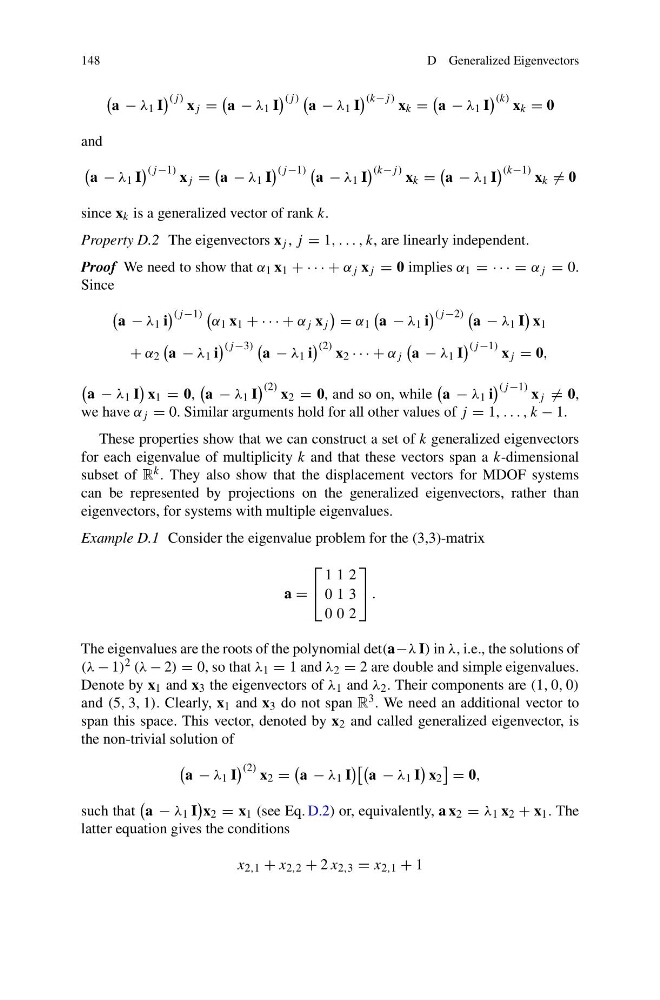
Example D.1 Consider the eigenvalue problem for the (3,3)-matrix
a =
⎡
⎣
1 1 2
0 1 3
0 0 2
⎤
⎦ .
The eigenvalues are the roots of the polynomial det(a−λ I) in λ, i.e., the solutions of
(λ − 1) 2 (λ − 2) = 0, so that λ 1 = 1 and λ 2 = 2 are double and simple eigenvalues.
Denote by x 1 and x 3 the eigenvectors of λ 1 and λ 2 . Their components are (1, 0, 0)
and (5, 3, 1). Clearly, x 1 and x 3 do not span R 3 . We need an additional vector to
span this space. This vector, denoted by x 2 and called generalized eigenvector, is
the non-trivial solution of
a − λ 1 I
(2) x 2 =
a − λ 1 I
a − λ 1 I
x 2
= 0,
such that
a − λ 1 I
x 2 = x 1 (see Eq. D.2) or, equivalently, a x 2 = λ 1 x 2 + x 1 . The
latter equation gives the conditions
x 2,1 + x 2,2 + 2 x 2,3 = x 2,1 + 1
D Generalized Eigenvectors
a − λ 1 I
(j ) x j =
a − λ 1 I
(j )
a − λ 1 I
(k−j) x k =
a − λ 1 I
(k) x k = 0
and
a − λ 1 I
(j −1) x j =
a − λ 1 I
(j −1)
a − λ 1 I
(k−j) x k =
a − λ 1 I
(k−1) x k = 0
since x k is a generalized vector of rank k.
Property D.2 The eigenvectors x j , j = 1, . . . , k, are linearly independent.
Proof We need to show that α 1 x 1 + · · · + α j x j = 0 implies α 1 = · · · = α j = 0.
Since
a − λ 1 i
(j −1)
α 1 x 1 + · · · + α j x j
= α 1
a − λ 1 i
(j −2)
a − λ 1 I
x 1
+ α 2
a − λ 1 i
(j −3)
a − λ 1 i
(2) x 2 · · · + α j
a − λ 1 I
(j −1) x j = 0,
a − λ 1 I
x 1 = 0,
a − λ 1 I
(2) x 2 = 0, and so on, while
a − λ 1 i
(j −1) x j = 0,
we have α j = 0. Similar arguments hold for all other values of j = 1, . . . , k − 1.
These properties show that we can construct a set of k generalized eigenvectors
for each eigenvalue of multiplicity k and that these vectors span a k-dimensional
subset of R k . They also show that the displacement vectors for MDOF systems
can be represented by projections on the generalized eigenvectors, rather than
eigenvectors, for systems with multiple eigenvalues.
Example D.1 Consider the eigenvalue problem for the (3,3)-matrix
a =
⎡
⎣
1 1 2
0 1 3
0 0 2
⎤
⎦ .
The eigenvalues are the roots of the polynomial det(a−λ I) in λ, i.e., the solutions of
(λ − 1) 2 (λ − 2) = 0, so that λ 1 = 1 and λ 2 = 2 are double and simple eigenvalues.
Denote by x 1 and x 3 the eigenvectors of λ 1 and λ 2 . Their components are (1, 0, 0)
and (5, 3, 1). Clearly, x 1 and x 3 do not span R 3 . We need an additional vector to
span this space. This vector, denoted by x 2 and called generalized eigenvector, is
the non-trivial solution of
a − λ 1 I
(2) x 2 =
a − λ 1 I
a − λ 1 I
x 2
= 0,
such that
a − λ 1 I
x 2 = x 1 (see Eq. D.2) or, equivalently, a x 2 = λ 1 x 2 + x 1 . The
latter equation gives the conditions
x 2,1 + x 2,2 + 2 x 2,3 = x 2,1 + 1