

C Linear or Vector Spaces
145
independent since
n
k=1 α k u k = 0 implies α k = 0, k = 1, . . . , n, by the
orthogonality property. Multiply left the above expression by v T
l , l = 1, . . . , n,
to obtain
n
k=1 α k v T
l u k = α l = 0, l = 1, . . . , n. Similar arguments hold for the
set of left eigenvectors.
The sets of either left or right eigenvectors augmented with an arbitrary vector
x are linearly dependent so that the relationships
n
k=1 α k u k + α n+1 x = 0 and
n
k=1 β k v k + β n+1 x = 0 hold with non-zero scalars. Accordingly, x can be
represented by linear forms of the right or left eigenvectors whose components can
be obtained uniquely by projection on the right or left eigenvectors.
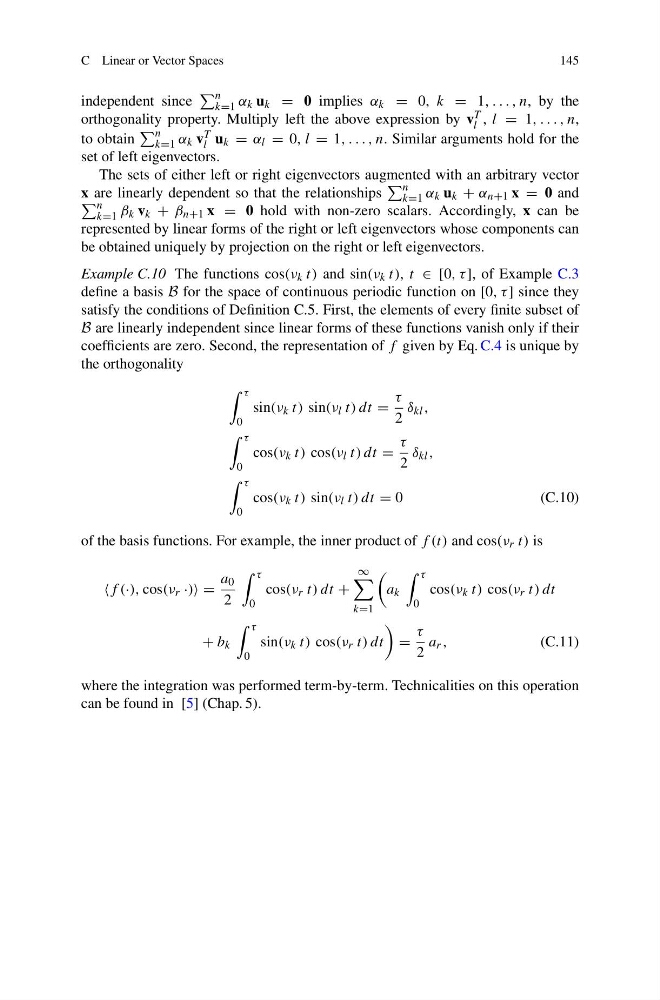
Example C.10 The functions cos(ν k t) and sin(ν k t), t ∈ [0, τ ], of Example C.3
define a basis B for the space of continuous periodic function on [0, τ ] since they
satisfy the conditions of Definition C.5. First, the elements of every finite subset of
B are linearly independent since linear forms of these functions vanish only if their
coefficients are zero. Second, the representation of f given by Eq. C.4 is unique by
the orthogonality
τ
0
sin(ν k t) sin(ν l t) dt =
τ
2
δ kl ,
τ
0
cos(ν k t) cos(ν l t) dt =
τ
2
δ kl ,
τ
0
cos(ν k t) sin(ν l t) dt = 0
(C.10)
of the basis functions. For example, the inner product of f (t) and cos(ν r t) is
f (·), cos(ν r ·) =
a 0
2
τ
0
cos(ν r t) dt +
∞
k=1
a k
τ
0
cos(ν k t) cos(ν r t) dt
+ b k
τ
0
sin(ν k t) cos(ν r t) dt
=
τ
2
a r ,
(C.11)
where the integration was performed term-by-term. Technicalities on this operation
can be found in [5] (Chap. 5).
145
independent since
n
k=1 α k u k = 0 implies α k = 0, k = 1, . . . , n, by the
orthogonality property. Multiply left the above expression by v T
l , l = 1, . . . , n,
to obtain
n
k=1 α k v T
l u k = α l = 0, l = 1, . . . , n. Similar arguments hold for the
set of left eigenvectors.
The sets of either left or right eigenvectors augmented with an arbitrary vector
x are linearly dependent so that the relationships
n
k=1 α k u k + α n+1 x = 0 and
n
k=1 β k v k + β n+1 x = 0 hold with non-zero scalars. Accordingly, x can be
represented by linear forms of the right or left eigenvectors whose components can
be obtained uniquely by projection on the right or left eigenvectors.
Example C.10 The functions cos(ν k t) and sin(ν k t), t ∈ [0, τ ], of Example C.3
define a basis B for the space of continuous periodic function on [0, τ ] since they
satisfy the conditions of Definition C.5. First, the elements of every finite subset of
B are linearly independent since linear forms of these functions vanish only if their
coefficients are zero. Second, the representation of f given by Eq. C.4 is unique by
the orthogonality
τ
0
sin(ν k t) sin(ν l t) dt =
τ
2
δ kl ,
τ
0
cos(ν k t) cos(ν l t) dt =
τ
2
δ kl ,
τ
0
cos(ν k t) sin(ν l t) dt = 0
(C.10)
of the basis functions. For example, the inner product of f (t) and cos(ν r t) is
f (·), cos(ν r ·) =
a 0
2
τ
0
cos(ν r t) dt +
∞
k=1
a k
τ
0
cos(ν k t) cos(ν r t) dt
+ b k
τ
0
sin(ν k t) cos(ν r t) dt
=
τ
2
a r ,
(C.11)
where the integration was performed term-by-term. Technicalities on this operation
can be found in [5] (Chap. 5).