

6
2 Single Degree of Freedom (SDOF) Systems
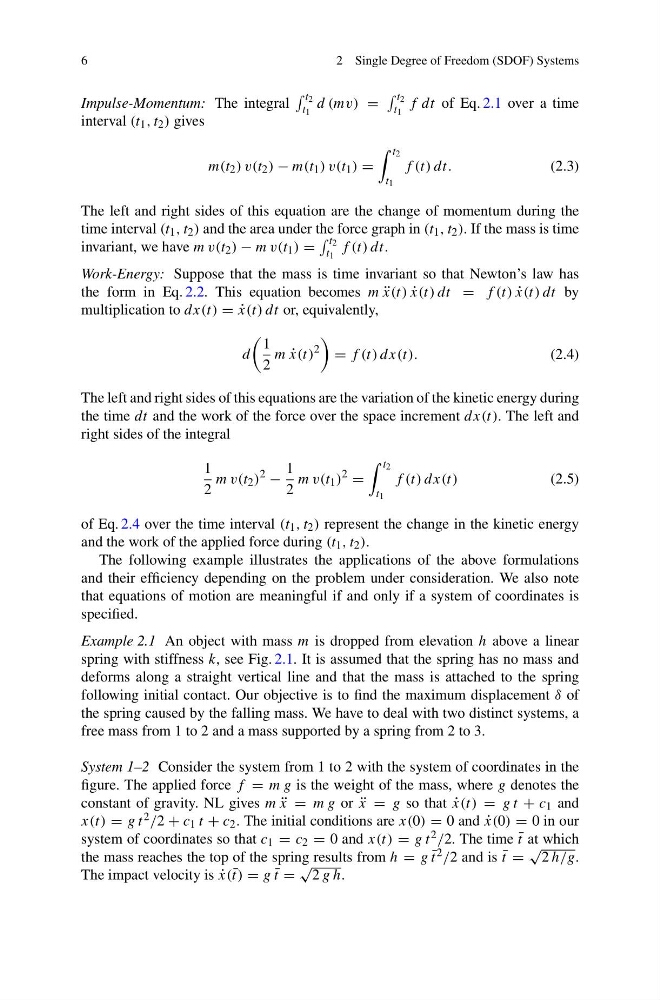
Impulse-Momentum: The integral
t 2
t 1
d (mv) =
t 2
t 1
f dt of Eq. 2.1 over a time
interval (t 1 , t 2 ) gives
m(t 2 ) v(t 2 ) − m(t 1 ) v(t 1 ) =
t 2
t 1
f (t) dt.
(2.3)
The left and right sides of this equation are the change of momentum during the
time interval (t 1 , t 2 ) and the area under the force graph in (t 1 , t 2 ). If the mass is time
invariant, we have m v(t 2 ) − m v(t 1 ) =
t 2
t 1
f (t) dt.
Work-Energy: Suppose that the mass is time invariant so that Newton’s law has
the form in Eq. 2.2. This equation becomes m ¨
x(t) ˙
x(t) dt = f (t) ˙
x(t) dt by
multiplication to dx(t) = ˙
x(t) dt or, equivalently,
d
1
2
m ˙
x(t)
2
= f (t) dx(t).
(2.4)
The left and right sides of this equations are the variation of the kinetic energy during
the time dt and the work of the force over the space increment dx(t). The left and
right sides of the integral
1
2
m v(t 2 )
2
−
1
2
m v(t 1 )
2
=
t 2
t 1
f (t) dx(t)
(2.5)
of Eq. 2.4 over the time interval (t 1 , t 2 ) represent the change in the kinetic energy
and the work of the applied force during (t 1 , t 2 ).
The following example illustrates the applications of the above formulations
and their efficiency depending on the problem under consideration. We also note
that equations of motion are meaningful if and only if a system of coordinates is
specified.
Example 2.1 An object with mass m is dropped from elevation h above a linear
spring with stiffness k, see Fig. 2.1. It is assumed that the spring has no mass and
deforms along a straight vertical line and that the mass is attached to the spring
following initial contact. Our objective is to find the maximum displacement δ of
the spring caused by the falling mass. We have to deal with two distinct systems, a
free mass from 1 to 2 and a mass supported by a spring from 2 to 3.
System 1–2 Consider the system from 1 to 2 with the system of coordinates in the
figure. The applied force f = m g is the weight of the mass, where g denotes the
constant of gravity. NL gives m ¨
x = m g or ¨
x = g so that ˙
x(t) = g t + c 1 and
x(t) = g t 2 /2 + c 1 t + c 2 . The initial conditions are x(0) = 0 and ˙
x(0) = 0 in our
system of coordinates so that c 1 = c 2 = 0 and x(t) = g t 2 /2. The time ¯
t at which
the mass reaches the top of the spring results from h = g ¯
t 2 /2 and is ¯
t =
√
2 h/g.
The impact velocity is ˙
x(¯ t) = g ¯
t =
√
2 g h.
2 Single Degree of Freedom (SDOF) Systems
Impulse-Momentum: The integral
t 2
t 1
d (mv) =
t 2
t 1
f dt of Eq. 2.1 over a time
interval (t 1 , t 2 ) gives
m(t 2 ) v(t 2 ) − m(t 1 ) v(t 1 ) =
t 2
t 1
f (t) dt.
(2.3)
The left and right sides of this equation are the change of momentum during the
time interval (t 1 , t 2 ) and the area under the force graph in (t 1 , t 2 ). If the mass is time
invariant, we have m v(t 2 ) − m v(t 1 ) =
t 2
t 1
f (t) dt.
Work-Energy: Suppose that the mass is time invariant so that Newton’s law has
the form in Eq. 2.2. This equation becomes m ¨
x(t) ˙
x(t) dt = f (t) ˙
x(t) dt by
multiplication to dx(t) = ˙
x(t) dt or, equivalently,
d
1
2
m ˙
x(t)
2
= f (t) dx(t).
(2.4)
The left and right sides of this equations are the variation of the kinetic energy during
the time dt and the work of the force over the space increment dx(t). The left and
right sides of the integral
1
2
m v(t 2 )
2
−
1
2
m v(t 1 )
2
=
t 2
t 1
f (t) dx(t)
(2.5)
of Eq. 2.4 over the time interval (t 1 , t 2 ) represent the change in the kinetic energy
and the work of the applied force during (t 1 , t 2 ).
The following example illustrates the applications of the above formulations
and their efficiency depending on the problem under consideration. We also note
that equations of motion are meaningful if and only if a system of coordinates is
specified.
Example 2.1 An object with mass m is dropped from elevation h above a linear
spring with stiffness k, see Fig. 2.1. It is assumed that the spring has no mass and
deforms along a straight vertical line and that the mass is attached to the spring
following initial contact. Our objective is to find the maximum displacement δ of
the spring caused by the falling mass. We have to deal with two distinct systems, a
free mass from 1 to 2 and a mass supported by a spring from 2 to 3.
System 1–2 Consider the system from 1 to 2 with the system of coordinates in the
figure. The applied force f = m g is the weight of the mass, where g denotes the
constant of gravity. NL gives m ¨
x = m g or ¨
x = g so that ˙
x(t) = g t + c 1 and
x(t) = g t 2 /2 + c 1 t + c 2 . The initial conditions are x(0) = 0 and ˙
x(0) = 0 in our
system of coordinates so that c 1 = c 2 = 0 and x(t) = g t 2 /2. The time ¯
t at which
the mass reaches the top of the spring results from h = g ¯
t 2 /2 and is ¯
t =
√
2 h/g.
The impact velocity is ˙
x(¯ t) = g ¯
t =
√
2 g h.