

4.7 Problems
113
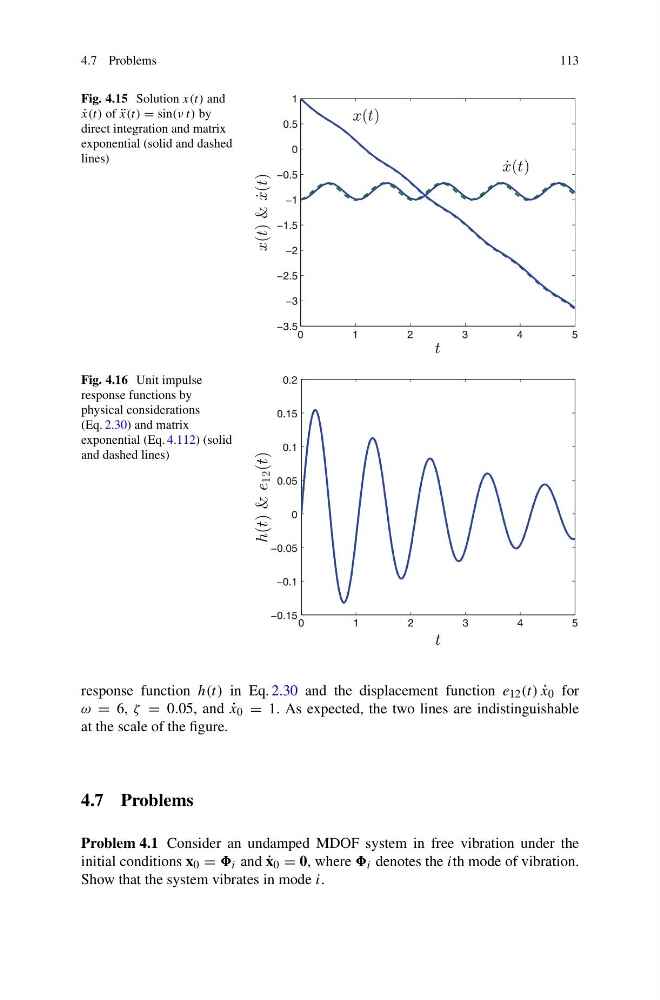
Fig. 4.15 Solution x(t) and
˙
x(t) of ¨
x(t) = sin(ν t) by
direct integration and matrix
exponential (solid and dashed
lines)
0
1
2
3
4
5
−3.5
−3
−2.5
−2
−1.5
−1
−0.5
0
0.5
1
t
x(t) & ˙
x(t)
x(t)
˙
x(t)
Fig. 4.16 Unit impulse
response functions by
physical considerations
(Eq. 2.30) and matrix
exponential (Eq. 4.112) (solid
and dashed lines)
0
1
2
3
4
5
−0.15
−0.1
−0.05
0
0.05
0.1
0.15
0.2
t
h(t) & e
12 (t)
response function h(t) in Eq. 2.30 and the displacement function e 12 (t) ˙
x 0 for
ω = 6, ζ = 0.05, and ˙
x 0 = 1. As expected, the two lines are indistinguishable
at the scale of the figure.
4.7 Problems
Problem 4.1 Consider an undamped MDOF system in free vibration under the
initial conditions x 0 = i and ˙
x 0 = 0, where i denotes the ith mode of vibration.
Show that the system vibrates in mode i.
113
Fig. 4.15 Solution x(t) and
˙
x(t) of ¨
x(t) = sin(ν t) by
direct integration and matrix
exponential (solid and dashed
lines)
0
1
2
3
4
5
−3.5
−3
−2.5
−2
−1.5
−1
−0.5
0
0.5
1
t
x(t) & ˙
x(t)
x(t)
˙
x(t)
Fig. 4.16 Unit impulse
response functions by
physical considerations
(Eq. 2.30) and matrix
exponential (Eq. 4.112) (solid
and dashed lines)
0
1
2
3
4
5
−0.15
−0.1
−0.05
0
0.05
0.1
0.15
0.2
t
h(t) & e
12 (t)
response function h(t) in Eq. 2.30 and the displacement function e 12 (t) ˙
x 0 for
ω = 6, ζ = 0.05, and ˙
x 0 = 1. As expected, the two lines are indistinguishable
at the scale of the figure.
4.7 Problems
Problem 4.1 Consider an undamped MDOF system in free vibration under the
initial conditions x 0 = i and ˙
x 0 = 0, where i denotes the ith mode of vibration.
Show that the system vibrates in mode i.