

51
Nowadays, we do not have many functioning
organisations and groups that can be used as the
basis for dialogue and actions at community and
national levels. People are self-centred and selfish
regarding how they respond to the issues. There is
no sense of community responding collectively to
address a development issue that may confront
them.
Youth presented a different view on the dynamism and capacity within the communities.
Notwithstanding the devastating impact of climate change in communities, a young woman
from FGD X7 stated that the disaster contributed
to bringing friendship and harmony among people in her community:
The storm assisted in improving the friendship and
partnership among people at the community level.
People helped out their neighbours who were
affected by tending to the sick and disabled within
the community (De starm mek ahwe feh improve
frenship and partnaship an feh we wok as wan.
Ahwe help ahwe naeba. Ahwe help dem who wos
sic an dem who ah disablo).
Over 90% of youth stated that communities
across St. Vincent and the Grenadines were able
to rapidly organise themselves in response to natural climatic disasters and calamities such as
storms and volcanic eruptions. They claimed that
over the years, people have developed a level of
competency, knowledge and skills on how to
respond to climate change impacts. Therefore,
despite their differences, as soon as there is a climatic disaster or calamity, people come together
to work in harmony to rebuild their communities.
Both policymakers and youth highlighted the
non-functioning of youth and community-based
organisations (CBOs) in most communities.
Youth surmised that there is a need to create more
community groups in communities across SVG
to educate youth and the wider community on the
impact of climate change and the need to develop
effective strategies to respond to these occurrences. They agreed to move towards setting up
community and youth groups to implement education programmes to explore issues of climate
rights and justice further.
Between 1978 and 2000, the Government of
SVG implemented a vibrant community development policy which invested and supported the
development of youth and community organisations, cooperatives and other civil society organisation/institutions. The present ULP government
has withdrawn financial support to these programmes when it came into office in 2001.
Presently, most active groups are organised along
political lines, thus resulting in tension and
antagonism among each other. Although there are
efforts on the part of JEMS and other NGOs to
enhance the capacity of community groups to
implement CCA programme, these organisations
are starved of funding and additional support
from the government and cannot sustain their
capacity development programmes (Table 3.1).
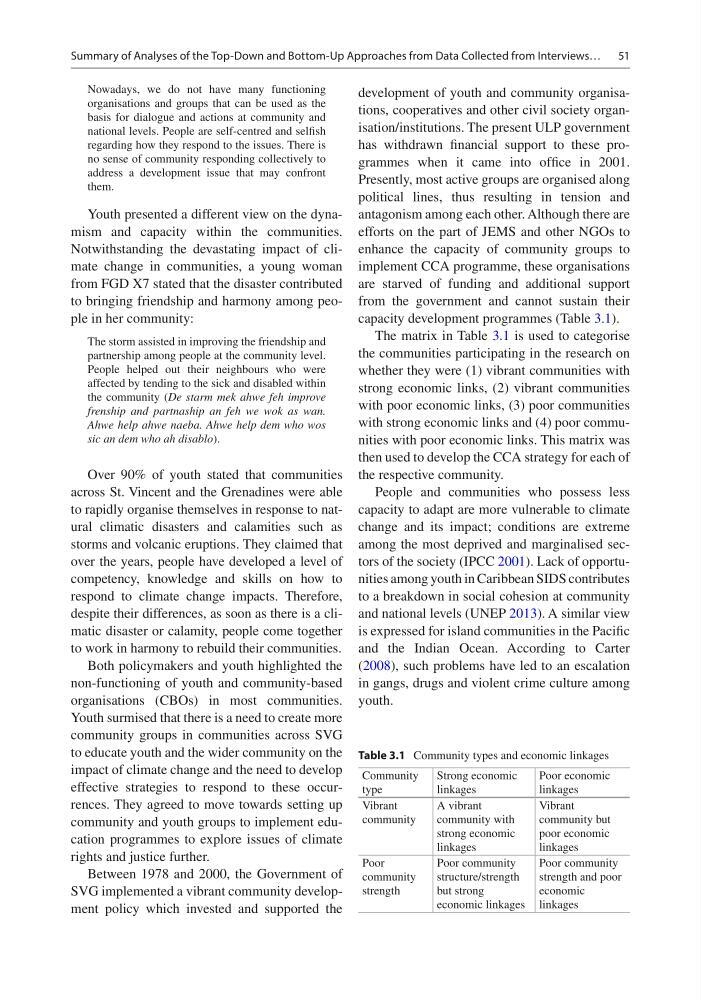
The matrix in Table 3.1 is used to categorise
the communities participating in the research on
whether they were (1) vibrant communities with
strong economic links, (2) vibrant communities
with poor economic links, (3) poor communities
with strong economic links and (4) poor communities with poor economic links. This matrix was
then used to develop the CCA strategy for each of
the respective community.
People and communities who possess less
capacity to adapt are more vulnerable to climate
change and its impact; conditions are extreme
among the most deprived and marginalised sectors of the society (IPCC 2001). Lack of opportunities among youth in Caribbean SIDS contributes
to a breakdown in social cohesion at community
and national levels (UNEP 2013). A similar view
is expressed for island communities in the Pacific
and the Indian Ocean. According to Carter
(2008), such problems have led to an escalation
in gangs, drugs and violent crime culture among
youth.
Table 3.1 Community types and economic linkages
Community
type
Strong economic
linkages
Poor economic
linkages
Vibrant
community
A vibrant
community with
strong economic
linkages
Vibrant
community but
poor economic
linkages
Poor
community
strength
Poor community
structure/strength
but strong
economic linkages
Poor community
strength and poor
economic
linkages
Summary of Analyses of the Top- Down and Bottom-Up Approaches from Data Collected from Interviews…
Nowadays, we do not have many functioning
organisations and groups that can be used as the
basis for dialogue and actions at community and
national levels. People are self-centred and selfish
regarding how they respond to the issues. There is
no sense of community responding collectively to
address a development issue that may confront
them.
Youth presented a different view on the dynamism and capacity within the communities.
Notwithstanding the devastating impact of climate change in communities, a young woman
from FGD X7 stated that the disaster contributed
to bringing friendship and harmony among people in her community:
The storm assisted in improving the friendship and
partnership among people at the community level.
People helped out their neighbours who were
affected by tending to the sick and disabled within
the community (De starm mek ahwe feh improve
frenship and partnaship an feh we wok as wan.
Ahwe help ahwe naeba. Ahwe help dem who wos
sic an dem who ah disablo).
Over 90% of youth stated that communities
across St. Vincent and the Grenadines were able
to rapidly organise themselves in response to natural climatic disasters and calamities such as
storms and volcanic eruptions. They claimed that
over the years, people have developed a level of
competency, knowledge and skills on how to
respond to climate change impacts. Therefore,
despite their differences, as soon as there is a climatic disaster or calamity, people come together
to work in harmony to rebuild their communities.
Both policymakers and youth highlighted the
non-functioning of youth and community-based
organisations (CBOs) in most communities.
Youth surmised that there is a need to create more
community groups in communities across SVG
to educate youth and the wider community on the
impact of climate change and the need to develop
effective strategies to respond to these occurrences. They agreed to move towards setting up
community and youth groups to implement education programmes to explore issues of climate
rights and justice further.
Between 1978 and 2000, the Government of
SVG implemented a vibrant community development policy which invested and supported the
development of youth and community organisations, cooperatives and other civil society organisation/institutions. The present ULP government
has withdrawn financial support to these programmes when it came into office in 2001.
Presently, most active groups are organised along
political lines, thus resulting in tension and
antagonism among each other. Although there are
efforts on the part of JEMS and other NGOs to
enhance the capacity of community groups to
implement CCA programme, these organisations
are starved of funding and additional support
from the government and cannot sustain their
capacity development programmes (Table 3.1).
The matrix in Table 3.1 is used to categorise
the communities participating in the research on
whether they were (1) vibrant communities with
strong economic links, (2) vibrant communities
with poor economic links, (3) poor communities
with strong economic links and (4) poor communities with poor economic links. This matrix was
then used to develop the CCA strategy for each of
the respective community.
People and communities who possess less
capacity to adapt are more vulnerable to climate
change and its impact; conditions are extreme
among the most deprived and marginalised sectors of the society (IPCC 2001). Lack of opportunities among youth in Caribbean SIDS contributes
to a breakdown in social cohesion at community
and national levels (UNEP 2013). A similar view
is expressed for island communities in the Pacific
and the Indian Ocean. According to Carter
(2008), such problems have led to an escalation
in gangs, drugs and violent crime culture among
youth.
Table 3.1 Community types and economic linkages
Community
type
Strong economic
linkages
Poor economic
linkages
Vibrant
community
A vibrant
community with
strong economic
linkages
Vibrant
community but
poor economic
linkages
Poor
community
strength
Poor community
structure/strength
but strong
economic linkages
Poor community
strength and poor
economic
linkages
Summary of Analyses of the Top- Down and Bottom-Up Approaches from Data Collected from Interviews…