

46
the people in SIDS, including SVG. Youth who
participated in FGDs felt that climate change and
other calamities are negatively impacting their
lives. They strongly agreed that climate change
stressors were wreaking havoc on small island
communities.
Policymaker V2 complained that:
It (Climate Change) is one of the most severe
issues that is facing the world. It [Climate change]
is making people more vulnerable to stronger
storms, droughts and diseases.
A similar view was echoed by a young woman
from X4 participating in the focus group
discussion:
Climate change is a severe problem impacting dangerously on our small islands. We have some lowlying islands which can be entirely covered by the
sea (dis climate change is ah seras ting. E rale sick
(dangerous) affectin bad pon ahwe smarl islan.
Ahwe ha alat af smarl islan dat de sea can cover
dem an all ahwe up).
All policymakers and senior officials emphasised the fear they have regarding the impact of
climate change and other calamities on their
small island communities. The youth showed a
similar level of concern regarding the effects of
climate change. They claimed that it is affecting
them in different ways such the slow creeping
impact of SLR eating away the land around their
coastal communities and beaches and the violent
instant effects of storms and hurricanes, which
blew down everything in their path. These fears
are supported in the literature which states that
increased frequency of storms and cyclones,
SLR, temperature rise, invasive species and diseases are already threatening the health system,
local economies and livelihoods of SIDS (Gomez
2013; Hernandez-Delgado 2015). These islands
are facing risks both from climate hazards that
have occurred over centuries and from new
threats from climate change. Therefore, people
living in SIDS are particularly vulnerable to the
impact of climate change (Gomez 2013; Nurse
et al. 2014; Economist 2017; Fieser 2017). Here
is an analysis of the perspective of the policymakers and senior officials on the climate change
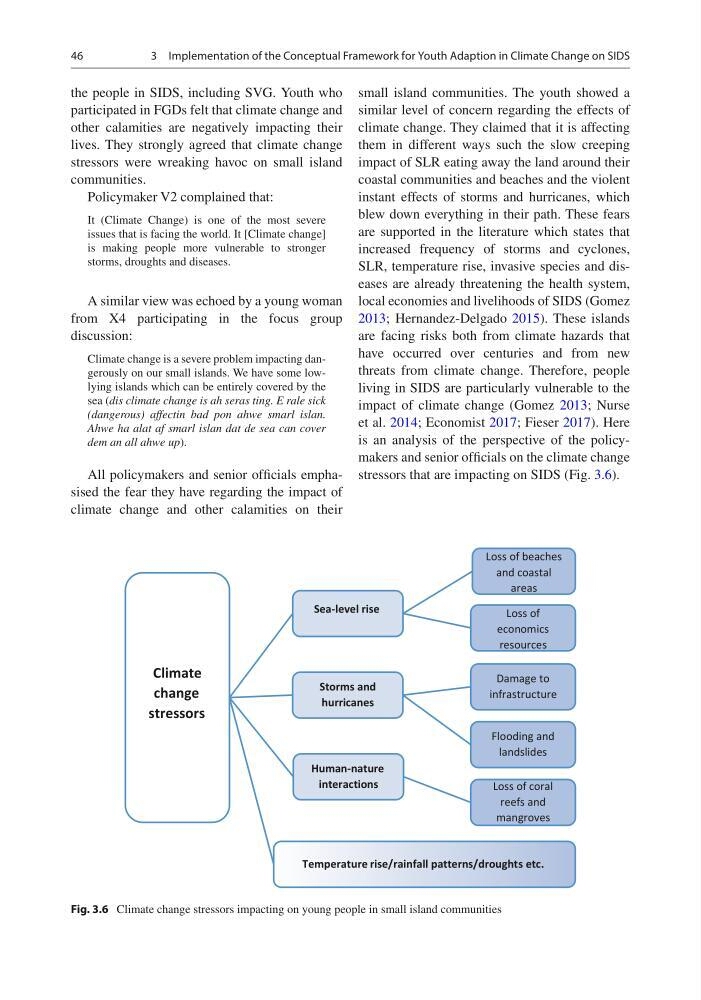
stressors that are impacting on SIDS (Fig. 3.6).
Climate
change
stressors
Sea-level rise
Storms and
hurricanes
Human-nature
interactions
Temperature rise/rainfall patterns/droughts etc.
Loss of beaches
and coastal
areas
Loss of
economics
resources
Damage to
infrastructure
Flooding and
landslides
Loss of coral
reefs and
mangroves
Fig. 3.6 Climate change stressors impacting on young people in small island communities
3 Implementation of the Conceptual Framework for Youth Adaption in Climate Change on SIDS
the people in SIDS, including SVG. Youth who
participated in FGDs felt that climate change and
other calamities are negatively impacting their
lives. They strongly agreed that climate change
stressors were wreaking havoc on small island
communities.
Policymaker V2 complained that:
It (Climate Change) is one of the most severe
issues that is facing the world. It [Climate change]
is making people more vulnerable to stronger
storms, droughts and diseases.
A similar view was echoed by a young woman
from X4 participating in the focus group
discussion:
Climate change is a severe problem impacting dangerously on our small islands. We have some lowlying islands which can be entirely covered by the
sea (dis climate change is ah seras ting. E rale sick
(dangerous) affectin bad pon ahwe smarl islan.
Ahwe ha alat af smarl islan dat de sea can cover
dem an all ahwe up).
All policymakers and senior officials emphasised the fear they have regarding the impact of
climate change and other calamities on their
small island communities. The youth showed a
similar level of concern regarding the effects of
climate change. They claimed that it is affecting
them in different ways such the slow creeping
impact of SLR eating away the land around their
coastal communities and beaches and the violent
instant effects of storms and hurricanes, which
blew down everything in their path. These fears
are supported in the literature which states that
increased frequency of storms and cyclones,
SLR, temperature rise, invasive species and diseases are already threatening the health system,
local economies and livelihoods of SIDS (Gomez
2013; Hernandez-Delgado 2015). These islands
are facing risks both from climate hazards that
have occurred over centuries and from new
threats from climate change. Therefore, people
living in SIDS are particularly vulnerable to the
impact of climate change (Gomez 2013; Nurse
et al. 2014; Economist 2017; Fieser 2017). Here
is an analysis of the perspective of the policymakers and senior officials on the climate change
stressors that are impacting on SIDS (Fig. 3.6).
Climate
change
stressors
Sea-level rise
Storms and
hurricanes
Human-nature
interactions
Temperature rise/rainfall patterns/droughts etc.
Loss of beaches
and coastal
areas
Loss of
economics
resources
Damage to
infrastructure
Flooding and
landslides
Loss of coral
reefs and
mangroves
Fig. 3.6 Climate change stressors impacting on young people in small island communities
3 Implementation of the Conceptual Framework for Youth Adaption in Climate Change on SIDS