

4 Contact Hamiltonian Systems for Probability Distribution Functions …
67
l[ g, ˙
γ ]
∞
t :=
∞
t
g( ˙
γ ( t ), ˙
γ (t ) ) dt
.
Then one has the statement below.
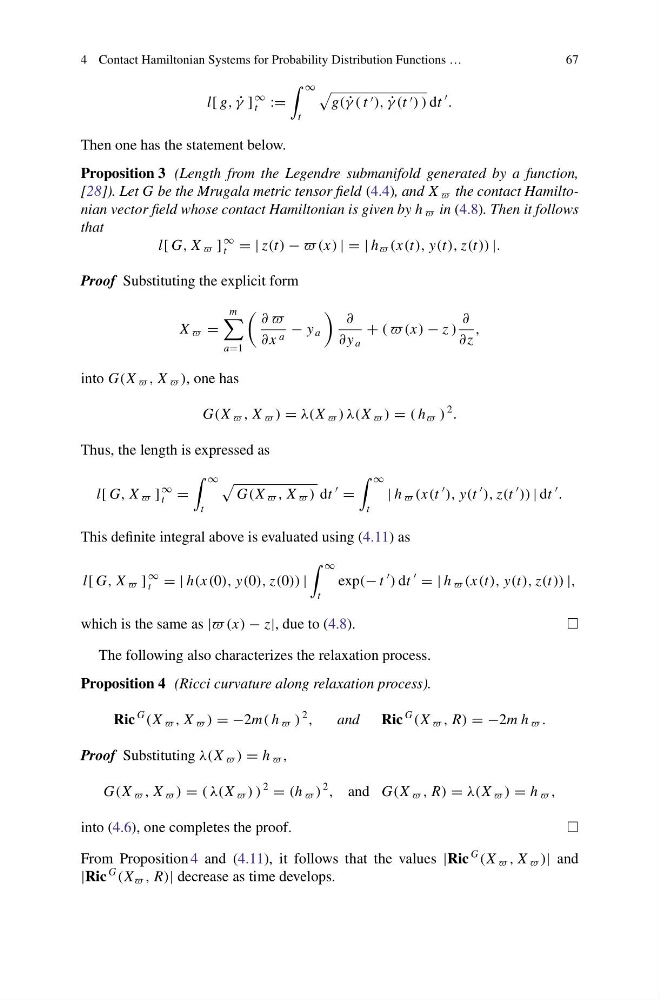
Proposition 3 (Length from the Legendre submanifold generated by a function,
[28]). Let G be the Mrugala metric tensor field (4.4), and X the contact Hamiltonian vector field whose contact Hamiltonian is given by h in (4.8). Then it follows
that
l[ G, X ]
∞
t = | z(t) − (x) | = | h (x(t), y(t), z(t)) |.
Proof Substituting the explicit form
X =
m
a=1
∂ ∂
∂ x a − y a
∂
∂ y a
+ ( ( (x) − z )
∂
∂z
,
into G(X , X ), one has
G(X , X ) = λ(X ) λ(X ) = ( h )
2
.
Thus, the length is expressed as
l[ G, X ]
∞
t =
∞
t
G(X , X ) dt
=
∞
t
| h (x(t
), y(t
), z(t
)) | dt
.
This definite integral above is evaluated using (4.11) as
l[ G, X ]
∞
t = | h(x(0), y(0), z(0)) |
∞
t
exp(− t
) dt
= | h (x(t), y(t), z(t)) |,
which is the same as | (x) − z|, due to (4.8).
The following also characterizes the relaxation process.
Proposition 4 (Ricci curvature along relaxation process).
Ric
G
(X , X ) = −2m( h )
2
,
and Ric
G
(X , R) = −2m h .
Proof Substituting λ(X ) = h ,
G(X , X ) = ( λ(X ) )
2
= (h )
2
, and G(X , R) = λ(X ) = h ,
into (4.6), one completes the proof.
From Proposition 4 and (4.11), it follows that the values |Ric
G
(X , X )| and
|Ric
G
(X , R)| decrease as time develops.
67
l[ g, ˙
γ ]
∞
t :=
∞
t
g( ˙
γ ( t ), ˙
γ (t ) ) dt
.
Then one has the statement below.
Proposition 3 (Length from the Legendre submanifold generated by a function,
[28]). Let G be the Mrugala metric tensor field (4.4), and X the contact Hamiltonian vector field whose contact Hamiltonian is given by h in (4.8). Then it follows
that
l[ G, X ]
∞
t = | z(t) − (x) | = | h (x(t), y(t), z(t)) |.
Proof Substituting the explicit form
X =
m
a=1
∂ ∂
∂ x a − y a
∂
∂ y a
+ ( ( (x) − z )
∂
∂z
,
into G(X , X ), one has
G(X , X ) = λ(X ) λ(X ) = ( h )
2
.
Thus, the length is expressed as
l[ G, X ]
∞
t =
∞
t
G(X , X ) dt
=
∞
t
| h (x(t
), y(t
), z(t
)) | dt
.
This definite integral above is evaluated using (4.11) as
l[ G, X ]
∞
t = | h(x(0), y(0), z(0)) |
∞
t
exp(− t
) dt
= | h (x(t), y(t), z(t)) |,
which is the same as | (x) − z|, due to (4.8).
The following also characterizes the relaxation process.
Proposition 4 (Ricci curvature along relaxation process).
Ric
G
(X , X ) = −2m( h )
2
,
and Ric
G
(X , R) = −2m h .
Proof Substituting λ(X ) = h ,
G(X , X ) = ( λ(X ) )
2
= (h )
2
, and G(X , R) = λ(X ) = h ,
into (4.6), one completes the proof.
From Proposition 4 and (4.11), it follows that the values |Ric
G
(X , X )| and
|Ric
G
(X , R)| decrease as time develops.