

54
J. Zhang and G. Khan
We call the above Eq. (3.18) “Condition H”. It is the (1, 1)-part of the
(para)complexified torsion-coupling condition, which is a slight relaxation to the
standard torsion-coupling condition. If the lefthand side (and the righthand side)
equals 0, that is the standard torsion-coupling condition Eq. (3.13).
Proposition 6 Condition H or Eq. (3.18), which expresses the (1,1)-part of torsioncoupling, is satisfied if and only if ∇ is (para-)holomorphic.
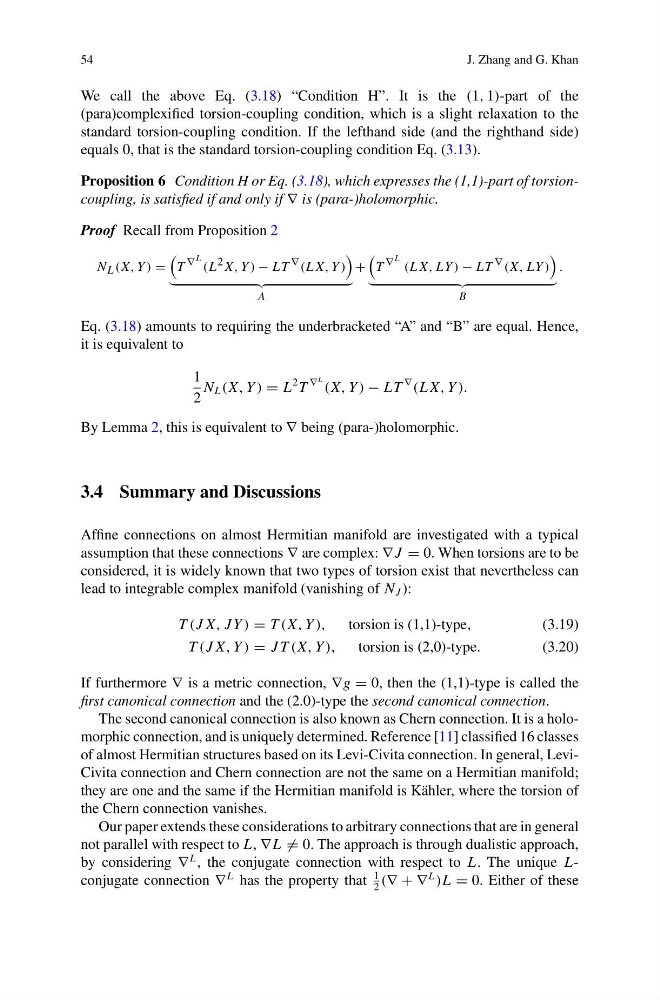
Proof Recall from Proposition 2
N L (X, Y ) =
T ∇ L (L 2 X, Y ) − LT ∇ (L X, Y )
A
+
T ∇ L (L X, LY ) − LT ∇ (X, LY )
B
.
Eq. (3.18) amounts to requiring the underbracketed “A” and “B” are equal. Hence,
it is equivalent to
1
2
N L (X, Y ) = L
2 T
∇
L (X, Y ) − LT
∇
(L X, Y ).
By Lemma 2, this is equivalent to ∇ being (para-)holomorphic.
3.4 Summary and Discussions
Affine connections on almost Hermitian manifold are investigated with a typical
assumption that these connections ∇ are complex: ∇ J = 0. When torsions are to be
considered, it is widely known that two types of torsion exist that nevertheless can
lead to integrable complex manifold (vanishing of N J ):
T (J X, J Y ) = T (X, Y ),
torsion is (1,1)-type,
(3.19)
T (J X, Y ) = J T (X, Y ),
torsion is (2,0)-type.
(3.20)
If furthermore ∇ is a metric connection, ∇g = 0, then the (1,1)-type is called the
first canonical connection and the (2.0)-type the second canonical connection.
The second canonical connection is also known as Chern connection. It is a holomorphic connection, and is uniquely determined. Reference [11] classified 16 classes
of almost Hermitian structures based on its Levi-Civita connection. In general, LeviCivita connection and Chern connection are not the same on a Hermitian manifold;
they are one and the same if the Hermitian manifold is Kähler, where the torsion of
the Chern connection vanishes.
Our paper extends these considerations to arbitrary connections that are in general
not parallel with respect to L, ∇ L = 0. The approach is through dualistic approach,
by considering ∇
L , the conjugate connection with respect to L. The unique Lconjugate connection ∇
L has the property that
1
2
(∇ + ∇
L
)L = 0. Either of these
J. Zhang and G. Khan
We call the above Eq. (3.18) “Condition H”. It is the (1, 1)-part of the
(para)complexified torsion-coupling condition, which is a slight relaxation to the
standard torsion-coupling condition. If the lefthand side (and the righthand side)
equals 0, that is the standard torsion-coupling condition Eq. (3.13).
Proposition 6 Condition H or Eq. (3.18), which expresses the (1,1)-part of torsioncoupling, is satisfied if and only if ∇ is (para-)holomorphic.
Proof Recall from Proposition 2
N L (X, Y ) =
T ∇ L (L 2 X, Y ) − LT ∇ (L X, Y )
A
+
T ∇ L (L X, LY ) − LT ∇ (X, LY )
B
.
Eq. (3.18) amounts to requiring the underbracketed “A” and “B” are equal. Hence,
it is equivalent to
1
2
N L (X, Y ) = L
2 T
∇
L (X, Y ) − LT
∇
(L X, Y ).
By Lemma 2, this is equivalent to ∇ being (para-)holomorphic.
3.4 Summary and Discussions
Affine connections on almost Hermitian manifold are investigated with a typical
assumption that these connections ∇ are complex: ∇ J = 0. When torsions are to be
considered, it is widely known that two types of torsion exist that nevertheless can
lead to integrable complex manifold (vanishing of N J ):
T (J X, J Y ) = T (X, Y ),
torsion is (1,1)-type,
(3.19)
T (J X, Y ) = J T (X, Y ),
torsion is (2,0)-type.
(3.20)
If furthermore ∇ is a metric connection, ∇g = 0, then the (1,1)-type is called the
first canonical connection and the (2.0)-type the second canonical connection.
The second canonical connection is also known as Chern connection. It is a holomorphic connection, and is uniquely determined. Reference [11] classified 16 classes
of almost Hermitian structures based on its Levi-Civita connection. In general, LeviCivita connection and Chern connection are not the same on a Hermitian manifold;
they are one and the same if the Hermitian manifold is Kähler, where the torsion of
the Chern connection vanishes.
Our paper extends these considerations to arbitrary connections that are in general
not parallel with respect to L, ∇ L = 0. The approach is through dualistic approach,
by considering ∇
L , the conjugate connection with respect to L. The unique Lconjugate connection ∇
L has the property that
1
2
(∇ + ∇
L
)L = 0. Either of these