

52
J. Zhang and G. Khan
Substituting X → L X in the first equation leads to the second equation. So (para)complexifying Codazzi coupling leads to a relaxation of the relation T
∇
(X, Y ) =
T
∇
L (X, Y ).
Codazzi coupling, along with MC1 applied to either ∇ or ∇
L , will lead to MC1
satisfied for both ∇ and ∇
L and hence, the integrability of L.
3.3.5 Torsion-Coupling (MC2)
In contrast to MC1, the situation is different when (para-)complexifying torsioncoupling (MC2)—after complexifying, the (2,0)- and (1,1)-part reveal independent
information, as we will show now.
3.3.5.1 (2,0)-Part of Torsion-Coupling: Integrability
From Sect. 3.3.3.1, we see that the only non-vanishing part of the (para-)complexfied
N L is N
(2,0) (and N
(0,2) ). In this subsection, we relate N
(0,2) to MC2 or torsioncoupling.
Proposition 5 The (2,0)-part N
(2,0) of N L vanishes if and only if the (2,0)-part of
torsion-coupling is enforced. That is,
N
(2,0)
:= N L (X
+
, Y
+
) = 0
if and only if
LT
∇
L (X
+
, Y
+
) = T
∇
(L X
+
, Y
+
).
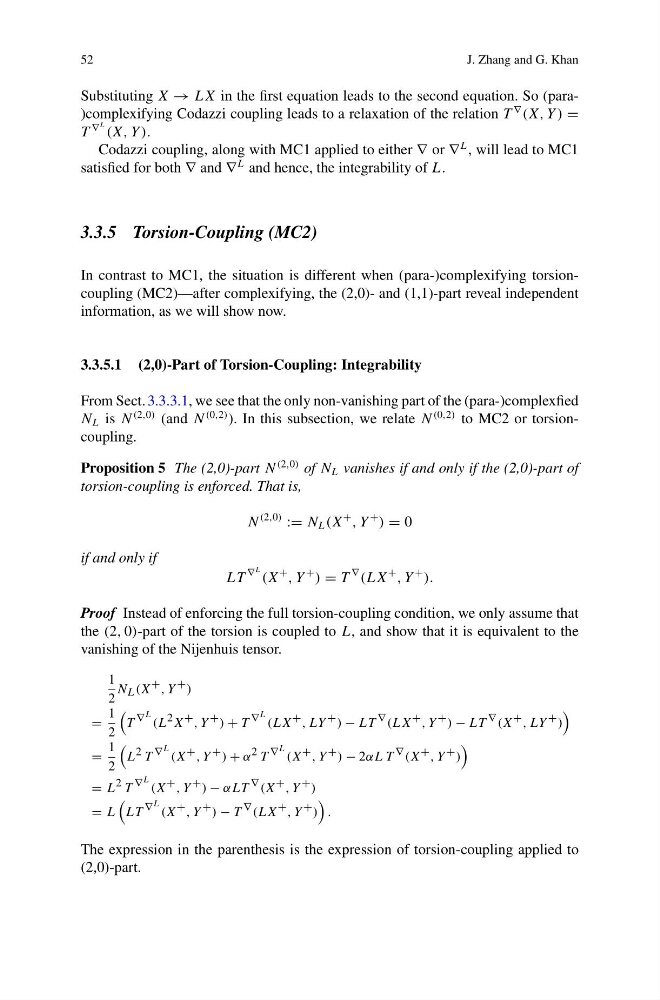
Proof Instead of enforcing the full torsion-coupling condition, we only assume that
the (2, 0)-part of the torsion is coupled to L, and show that it is equivalent to the
vanishing of the Nijenhuis tensor.
1
2
N L (X + , Y + )
=
1
2
T ∇ L (L 2 X + , Y + ) + T ∇ L (L X + , LY + ) − LT ∇ (L X + , Y + ) − LT ∇ (X + , LY + )
=
1
2
L 2 T ∇ L (X + , Y + ) + α 2 T ∇ L (X + , Y + ) − 2αL T ∇ (X + , Y + )
= L 2 T ∇ L (X + , Y + ) − αLT ∇ (X + , Y + )
= L
LT ∇ L (X + , Y + ) − T ∇ (L X + , Y + )
.
The expression in the parenthesis is the expression of torsion-coupling applied to
(2,0)-part.
J. Zhang and G. Khan
Substituting X → L X in the first equation leads to the second equation. So (para)complexifying Codazzi coupling leads to a relaxation of the relation T
∇
(X, Y ) =
T
∇
L (X, Y ).
Codazzi coupling, along with MC1 applied to either ∇ or ∇
L , will lead to MC1
satisfied for both ∇ and ∇
L and hence, the integrability of L.
3.3.5 Torsion-Coupling (MC2)
In contrast to MC1, the situation is different when (para-)complexifying torsioncoupling (MC2)—after complexifying, the (2,0)- and (1,1)-part reveal independent
information, as we will show now.
3.3.5.1 (2,0)-Part of Torsion-Coupling: Integrability
From Sect. 3.3.3.1, we see that the only non-vanishing part of the (para-)complexfied
N L is N
(2,0) (and N
(0,2) ). In this subsection, we relate N
(0,2) to MC2 or torsioncoupling.
Proposition 5 The (2,0)-part N
(2,0) of N L vanishes if and only if the (2,0)-part of
torsion-coupling is enforced. That is,
N
(2,0)
:= N L (X
+
, Y
+
) = 0
if and only if
LT
∇
L (X
+
, Y
+
) = T
∇
(L X
+
, Y
+
).
Proof Instead of enforcing the full torsion-coupling condition, we only assume that
the (2, 0)-part of the torsion is coupled to L, and show that it is equivalent to the
vanishing of the Nijenhuis tensor.
1
2
N L (X + , Y + )
=
1
2
T ∇ L (L 2 X + , Y + ) + T ∇ L (L X + , LY + ) − LT ∇ (L X + , Y + ) − LT ∇ (X + , LY + )
=
1
2
L 2 T ∇ L (X + , Y + ) + α 2 T ∇ L (X + , Y + ) − 2αL T ∇ (X + , Y + )
= L 2 T ∇ L (X + , Y + ) − αLT ∇ (X + , Y + )
= L
LT ∇ L (X + , Y + ) − T ∇ (L X + , Y + )
.
The expression in the parenthesis is the expression of torsion-coupling applied to
(2,0)-part.