

3 Affine Connections with Torsion in (Para-)complexified Structures
49
tensor is (apart from a multiplicative constant) the (0, 1)-part of the Lie bracket of
two (1, 0)-vector fields N (Z 1 , Z 2 ) = π
−
[π
+ Z 1 , π
+ Z 2 ]. Therefore, we do not expect
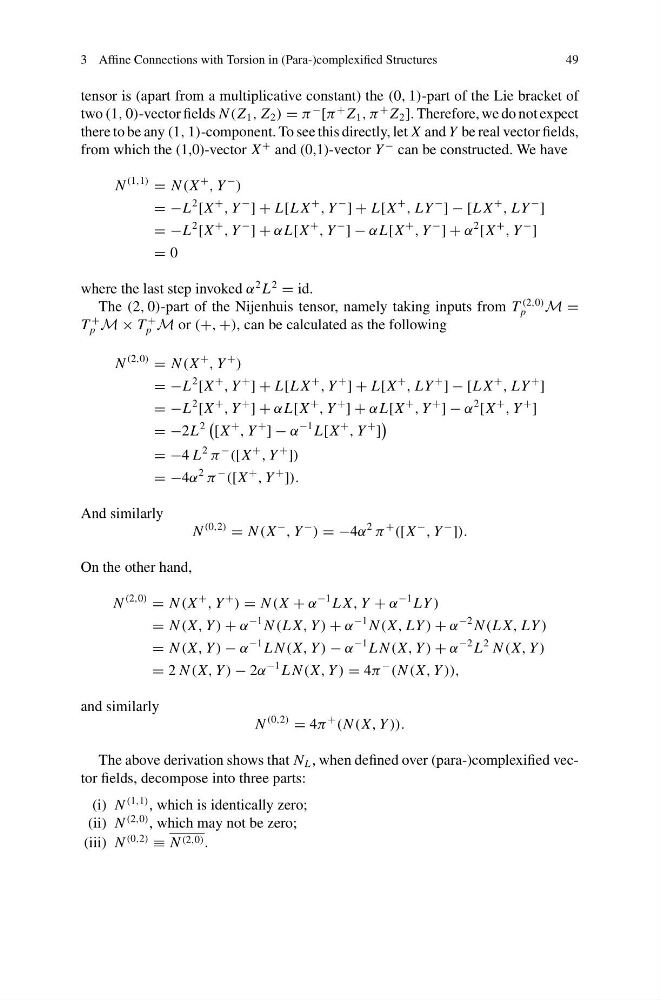
there to be any (1, 1)-component. To see this directly, let X and Y be real vector fields,
from which the (1,0)-vector X
+ and (0,1)-vector Y
− can be constructed. We have
N
(1,1)
= N (X
+
, Y
−
)
= −L
2
[X
+
, Y
−
] + L[L X
+
, Y
−
] + L[X
+
, LY
−
] − [L X
+
, LY
−
]
= −L
2
[X
+
, Y
−
] + αL[X
+
, Y
−
] − αL[X
+
, Y
−
] + α
2
[X
+
, Y
−
]
= 0
where the last step invoked α
2 L
2
= id.
The (2, 0)-part of the Nijenhuis tensor, namely taking inputs from T
(2,0)
p
M =
T
+
p M × T
+
p M or (+, +), can be calculated as the following
N
(2,0)
= N (X
+
, Y
+
)
= −L
2
[X
+
, Y
+
] + L[L X
+
, Y
+
] + L[X
+
, LY
+
] − [L X
+
, LY
+
]
= −L
2
[X
+
, Y
+
] + αL[X
+
, Y
+
] + αL[X
+
, Y
+
] − α
2
[X
+
, Y
+
]
= −2L
2
[X
+
, Y
+
] − α
−1 L[X
+
, Y
+
]
= −4 L
2
π
−
([X
+
, Y
+
])
= −4α
2
π
−
([X
+
, Y
+
]).
And similarly
N
(0,2)
= N (X
−
, Y
−
) = −4α
2
π
+
([X
−
, Y
−
]).
On the other hand,
N
(2,0)
= N (X
+
, Y
+
) = N (X + α
−1 L X, Y + α
−1 LY )
= N (X, Y ) + α
−1 N (L X, Y ) + α
−1 N (X, LY ) + α
−2 N (L X, LY )
= N (X, Y ) − α
−1 L N (X, Y ) − α
−1 L N (X, Y ) + α
−2 L
2 N (X, Y )
= 2 N (X, Y ) − 2α
−1 L N (X, Y ) = 4π
−
(N (X, Y )),
and similarly
N
(0,2)
= 4π
+
(N (X, Y )).
The above derivation shows that N L , when defined over (para-)complexified vector fields, decompose into three parts:
(i) N
(1,1) , which is identically zero;
(ii) N
(2,0) , which may not be zero;
(iii) N
(0,2)
≡ N (2,0) .
49
tensor is (apart from a multiplicative constant) the (0, 1)-part of the Lie bracket of
two (1, 0)-vector fields N (Z 1 , Z 2 ) = π
−
[π
+ Z 1 , π
+ Z 2 ]. Therefore, we do not expect
there to be any (1, 1)-component. To see this directly, let X and Y be real vector fields,
from which the (1,0)-vector X
+ and (0,1)-vector Y
− can be constructed. We have
N
(1,1)
= N (X
+
, Y
−
)
= −L
2
[X
+
, Y
−
] + L[L X
+
, Y
−
] + L[X
+
, LY
−
] − [L X
+
, LY
−
]
= −L
2
[X
+
, Y
−
] + αL[X
+
, Y
−
] − αL[X
+
, Y
−
] + α
2
[X
+
, Y
−
]
= 0
where the last step invoked α
2 L
2
= id.
The (2, 0)-part of the Nijenhuis tensor, namely taking inputs from T
(2,0)
p
M =
T
+
p M × T
+
p M or (+, +), can be calculated as the following
N
(2,0)
= N (X
+
, Y
+
)
= −L
2
[X
+
, Y
+
] + L[L X
+
, Y
+
] + L[X
+
, LY
+
] − [L X
+
, LY
+
]
= −L
2
[X
+
, Y
+
] + αL[X
+
, Y
+
] + αL[X
+
, Y
+
] − α
2
[X
+
, Y
+
]
= −2L
2
[X
+
, Y
+
] − α
−1 L[X
+
, Y
+
]
= −4 L
2
π
−
([X
+
, Y
+
])
= −4α
2
π
−
([X
+
, Y
+
]).
And similarly
N
(0,2)
= N (X
−
, Y
−
) = −4α
2
π
+
([X
−
, Y
−
]).
On the other hand,
N
(2,0)
= N (X
+
, Y
+
) = N (X + α
−1 L X, Y + α
−1 LY )
= N (X, Y ) + α
−1 N (L X, Y ) + α
−1 N (X, LY ) + α
−2 N (L X, LY )
= N (X, Y ) − α
−1 L N (X, Y ) − α
−1 L N (X, Y ) + α
−2 L
2 N (X, Y )
= 2 N (X, Y ) − 2α
−1 L N (X, Y ) = 4π
−
(N (X, Y )),
and similarly
N
(0,2)
= 4π
+
(N (X, Y )).
The above derivation shows that N L , when defined over (para-)complexified vector fields, decompose into three parts:
(i) N
(1,1) , which is identically zero;
(ii) N
(2,0) , which may not be zero;
(iii) N
(0,2)
≡ N (2,0) .