

3 Affine Connections with Torsion in (Para-)complexified Structures
47
¯
∂ X Y =
1
2
[X, Y ] − L
−1 [L X, Y ] +
1
2
L
2 N L (X, Y )
.
(3.15)
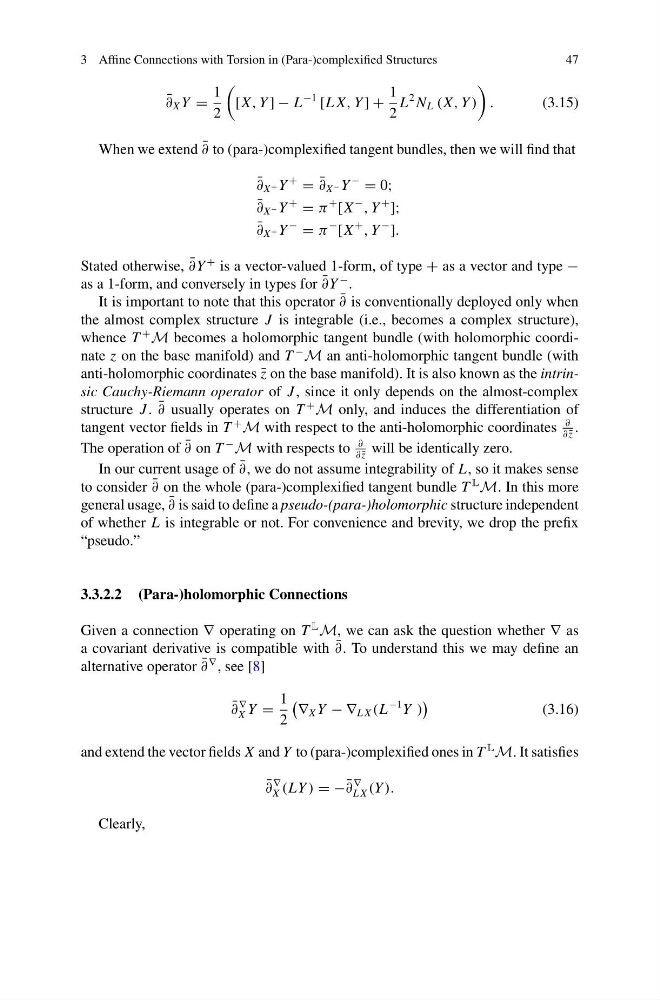
When we extend ¯
∂ to (para-)complexified tangent bundles, then we will find that
¯
∂ X + Y
+
= ¯
∂ X − Y
−
= 0;
¯
∂ X − Y
+
= π
+
[X
−
, Y
+
];
¯
∂ X + Y
−
= π
−
[X
+
, Y
−
].
Stated otherwise, ¯
∂Y
+ is a vector-valued 1-form, of type + as a vector and type −
as a 1-form, and conversely in types for ¯
∂Y
− .
It is important to note that this operator ¯
∂ is conventionally deployed only when
the almost complex structure J is integrable (i.e., becomes a complex structure),
whence T
+
M becomes a holomorphic tangent bundle (with holomorphic coordinate z on the base manifold) and T
−
M an anti-holomorphic tangent bundle (with
anti-holomorphic coordinates ¯
z on the base manifold). It is also known as the intrinsic Cauchy-Riemann operator of J , since it only depends on the almost-complex
structure J . ¯
∂ usually operates on T
+
M only, and induces the differentiation of
tangent vector fields in T
+
M with respect to the anti-holomorphic coordinates
∂
∂ ¯
z
.
The operation of ¯
∂ on T
−
M with respects to
∂
∂ ¯
z
will be identically zero.
In our current usage of ¯
∂, we do not assume integrability of L, so it makes sense
to consider ¯
∂ on the whole (para-)complexified tangent bundle T
L
M. In this more
general usage, ¯
∂ is said to define a pseudo-(para-)holomorphic structure independent
of whether L is integrable or not. For convenience and brevity, we drop the prefix
“pseudo.”
3.3.2.2 (Para-)holomorphic Connections
Given a connection ∇ operating on T
L
M, we can ask the question whether ∇ as
a covariant derivative is compatible with ¯
∂. To understand this we may define an
alternative operator ¯
∂
∇ , see [8]
¯
∂
∇
X Y =
1
2
∇ X Y − ∇ L X (L
−1 Y )
(3.16)
and extend the vector fields X and Y to (para-)complexified ones in T
L
M. It satisfies
¯
∂
∇
X (LY ) = − ¯
∂
∇
L X (Y ).
Clearly,
47
¯
∂ X Y =
1
2
[X, Y ] − L
−1 [L X, Y ] +
1
2
L
2 N L (X, Y )
.
(3.15)
When we extend ¯
∂ to (para-)complexified tangent bundles, then we will find that
¯
∂ X + Y
+
= ¯
∂ X − Y
−
= 0;
¯
∂ X − Y
+
= π
+
[X
−
, Y
+
];
¯
∂ X + Y
−
= π
−
[X
+
, Y
−
].
Stated otherwise, ¯
∂Y
+ is a vector-valued 1-form, of type + as a vector and type −
as a 1-form, and conversely in types for ¯
∂Y
− .
It is important to note that this operator ¯
∂ is conventionally deployed only when
the almost complex structure J is integrable (i.e., becomes a complex structure),
whence T
+
M becomes a holomorphic tangent bundle (with holomorphic coordinate z on the base manifold) and T
−
M an anti-holomorphic tangent bundle (with
anti-holomorphic coordinates ¯
z on the base manifold). It is also known as the intrinsic Cauchy-Riemann operator of J , since it only depends on the almost-complex
structure J . ¯
∂ usually operates on T
+
M only, and induces the differentiation of
tangent vector fields in T
+
M with respect to the anti-holomorphic coordinates
∂
∂ ¯
z
.
The operation of ¯
∂ on T
−
M with respects to
∂
∂ ¯
z
will be identically zero.
In our current usage of ¯
∂, we do not assume integrability of L, so it makes sense
to consider ¯
∂ on the whole (para-)complexified tangent bundle T
L
M. In this more
general usage, ¯
∂ is said to define a pseudo-(para-)holomorphic structure independent
of whether L is integrable or not. For convenience and brevity, we drop the prefix
“pseudo.”
3.3.2.2 (Para-)holomorphic Connections
Given a connection ∇ operating on T
L
M, we can ask the question whether ∇ as
a covariant derivative is compatible with ¯
∂. To understand this we may define an
alternative operator ¯
∂
∇ , see [8]
¯
∂
∇
X Y =
1
2
∇ X Y − ∇ L X (L
−1 Y )
(3.16)
and extend the vector fields X and Y to (para-)complexified ones in T
L
M. It satisfies
¯
∂
∇
X (LY ) = − ¯
∂
∇
L X (Y ).
Clearly,