

6 Gauge Freedom of Entropies on q-Gaussian Measures
145
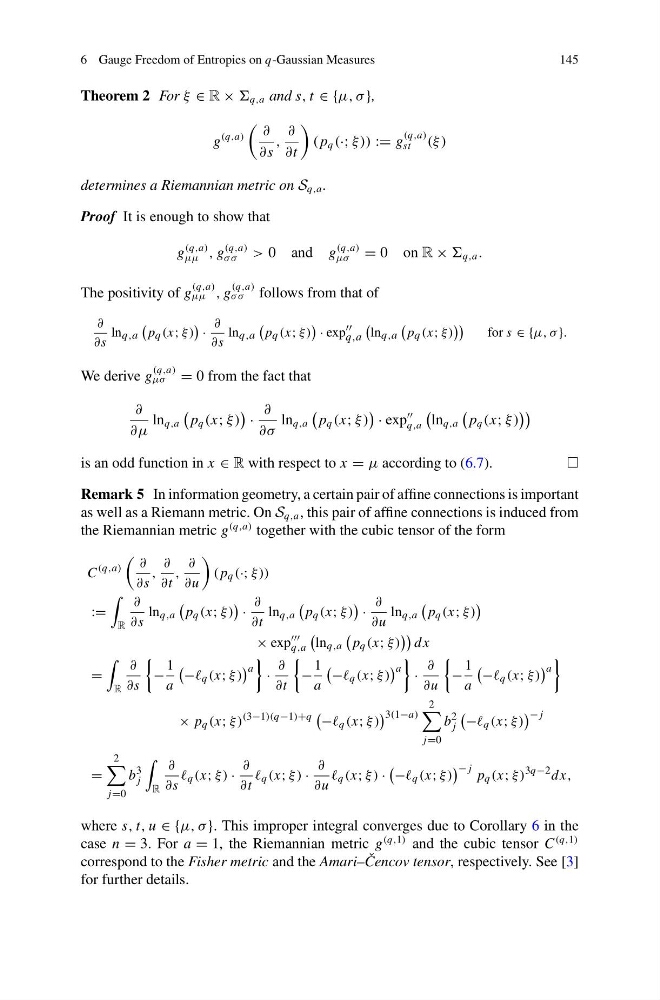
Theorem 2 For ξ ∈ R × q,a and s, t ∈ {μ, σ },
g
(q,a)
∂
∂s
,
∂
∂t
( p q (·; ξ)) := g
(q,a)
st
(ξ )
determines a Riemannian metric on S q,a .
Proof It is enough to show that
g
(q,a)
μμ , g
(q,a)
σ σ
> 0 and g
(q,a)
μσ = 0 on R × q,a .
The positivity of g
(q,a)
μμ , g
(q,a)
σ σ follows from that of
∂
∂s
ln q,a
p q (x; ξ)
·
∂
∂s
ln q,a
p q (x; ξ)
· exp
q,a
ln q,a
p q (x; ξ)
for s ∈ {μ, σ }.
We derive g
(q,a)
μσ = 0 from the fact that
∂
∂μ
ln q,a
p q (x; ξ)
·
∂
∂σ
ln q,a
p q (x; ξ)
· exp
q,a
ln q,a
p q (x; ξ)
is an odd function in x ∈ R with respect to x = μ according to (6.7).
Remark 5 In information geometry, a certain pair of affine connections is important
as well as a Riemann metric. On S q,a , this pair of affine connections is induced from
the Riemannian metric g
(q,a) together with the cubic tensor of the form
C
(q,a)
∂
∂s
,
∂
∂t
,
∂
∂u
( p q (·; ξ))
:=
R
∂
∂s
ln q,a
p q (x; ξ)
·
∂
∂t
ln q,a
p q (x; ξ)
·
∂
∂u
ln q,a
p q (x; ξ)
× exp
q,a
ln q,a
p q (x; ξ)
dx
=
R
∂
∂s
−
1
a
− q (x; ξ)
a
·
∂
∂t
−
1
a
− q (x; ξ)
a
·
∂
∂u
−
1
a
− q (x; ξ)
a
× p q (x; ξ)
(3−1)(q−1)+q
− q (x; ξ)
3(1−a)
2
j=0
b
2
j
− q (x; ξ)
− j
=
2
j=0
b
3
j
R
∂
∂s
q (x; ξ) ·
∂
∂t
q (x; ξ) ·
∂
∂u
q (x; ξ) ·
− q (x; ξ)
− j p q (x; ξ)
3q−2 dx,
where s, t, u ∈ {μ, σ }. This improper integral converges due to Corollary 6 in the
case n = 3. For a = 1, the Riemannian metric g
(q,1) and the cubic tensor C
(q,1)
correspond to the Fisher metric and the Amari– ˇ
Cencov tensor, respectively. See [3]
for further details.
145
Theorem 2 For ξ ∈ R × q,a and s, t ∈ {μ, σ },
g
(q,a)
∂
∂s
,
∂
∂t
( p q (·; ξ)) := g
(q,a)
st
(ξ )
determines a Riemannian metric on S q,a .
Proof It is enough to show that
g
(q,a)
μμ , g
(q,a)
σ σ
> 0 and g
(q,a)
μσ = 0 on R × q,a .
The positivity of g
(q,a)
μμ , g
(q,a)
σ σ follows from that of
∂
∂s
ln q,a
p q (x; ξ)
·
∂
∂s
ln q,a
p q (x; ξ)
· exp
q,a
ln q,a
p q (x; ξ)
for s ∈ {μ, σ }.
We derive g
(q,a)
μσ = 0 from the fact that
∂
∂μ
ln q,a
p q (x; ξ)
·
∂
∂σ
ln q,a
p q (x; ξ)
· exp
q,a
ln q,a
p q (x; ξ)
is an odd function in x ∈ R with respect to x = μ according to (6.7).
Remark 5 In information geometry, a certain pair of affine connections is important
as well as a Riemann metric. On S q,a , this pair of affine connections is induced from
the Riemannian metric g
(q,a) together with the cubic tensor of the form
C
(q,a)
∂
∂s
,
∂
∂t
,
∂
∂u
( p q (·; ξ))
:=
R
∂
∂s
ln q,a
p q (x; ξ)
·
∂
∂t
ln q,a
p q (x; ξ)
·
∂
∂u
ln q,a
p q (x; ξ)
× exp
q,a
ln q,a
p q (x; ξ)
dx
=
R
∂
∂s
−
1
a
− q (x; ξ)
a
·
∂
∂t
−
1
a
− q (x; ξ)
a
·
∂
∂u
−
1
a
− q (x; ξ)
a
× p q (x; ξ)
(3−1)(q−1)+q
− q (x; ξ)
3(1−a)
2
j=0
b
2
j
− q (x; ξ)
− j
=
2
j=0
b
3
j
R
∂
∂s
q (x; ξ) ·
∂
∂t
q (x; ξ) ·
∂
∂u
q (x; ξ) ·
− q (x; ξ)
− j p q (x; ξ)
3q−2 dx,
where s, t, u ∈ {μ, σ }. This improper integral converges due to Corollary 6 in the
case n = 3. For a = 1, the Riemannian metric g
(q,1) and the cubic tensor C
(q,1)
correspond to the Fisher metric and the Amari– ˇ
Cencov tensor, respectively. See [3]
for further details.