

6 Gauge Freedom of Entropies on q-Gaussian Measures
143
The function x → ρ
(q,a)
(x; ξ 1 , ξ 2 ) is the integrand of D
(q,a)
( p q (·; ξ 1 ), p q (·; ξ 2 )) for
(ξ 1 , ξ 2 ) ∈ (R × q,a )
2 .
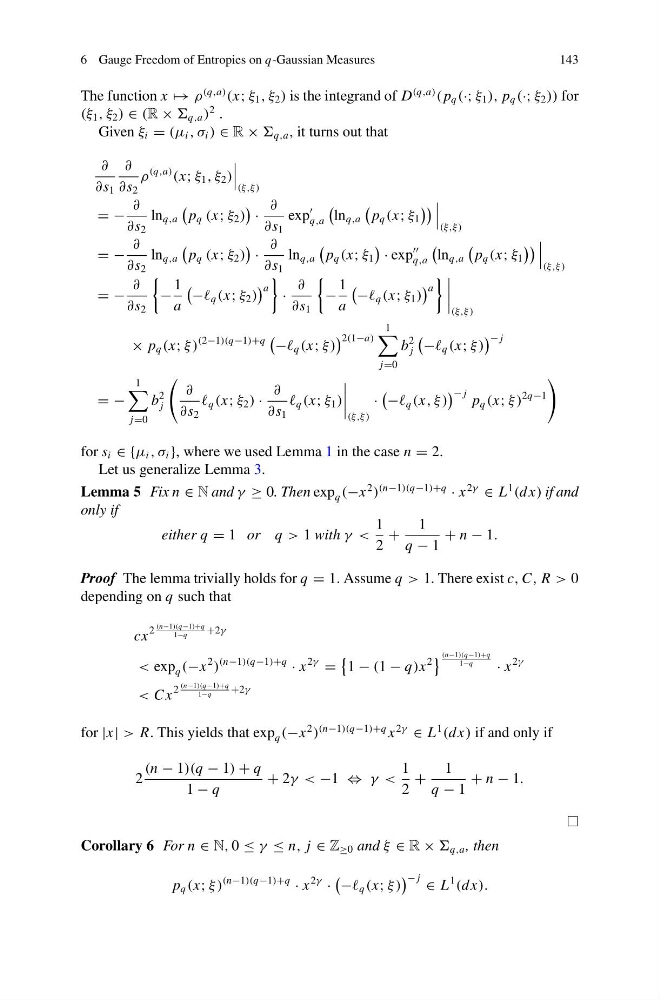
Given ξ i = (μ i , σ i ) ∈ R × q,a , it turns out that
∂
∂s 1
∂
∂s 2
ρ
(q,a)
(x; ξ 1 , ξ 2 )
(ξ,ξ )
= −
∂
∂s 2
ln q,a
p q (x; ξ 2 )
·
∂
∂s 1
exp
q,a
ln q,a
p q (x; ξ 1
(ξ,ξ )
= −
∂
∂s 2
ln q,a
p q (x; ξ 2 )
·
∂
∂s 1
ln q,a
p q (x; ξ 1
· exp
q,a
ln q,a
p q (x; ξ 1
(ξ,ξ )
= −
∂
∂s 2
−
1
a
− q (x; ξ 2 )
a
·
∂
∂s 1
−
1
a
− q (x; ξ 1 )
a
(ξ,ξ )
× p q (x; ξ)
(2−1)(q−1)+q
− q (x; ξ)
2(1−a)
1
j=0
b
2
j
− q (x; ξ)
− j
= −
1
j=0
b
2
j
∂
∂s 2
q (x; ξ 2 ) ·
∂
∂s 1
q (x; ξ 1 )
(ξ,ξ )
·
− q (x, ξ)
− j p q (x; ξ)
2q−1
for s i ∈ {μ i , σ i }, where we used Lemma 1 in the case n = 2.
Let us generalize Lemma 3.
Lemma 5 Fix n ∈ N and γ ≥ 0. Then exp q (−x
2
)
(n−1)(q−1)+q
· x
2γ
∈ L
1
(dx) if and
only if
either q = 1 or q > 1 with γ <
1
2
+
1
q − 1
+ n − 1.
Proof The lemma trivially holds for q = 1. Assume q > 1. There exist c, C, R > 0
depending on q such that
cx
2
(n−1)(q−1)+q
1−q
+2γ
< exp q (−x
2
)
(n−1)(q−1)+q
· x
2γ
=
1 − (1 − q)x
2
(n−1)(q−1)+q
1−q
· x
2γ
< C x
2
(n−1)(q−1)+q
1−q
+2γ
for |x| > R. This yields that exp q (−x
2
)
(n−1)(q−1)+q x
2γ
∈ L
1
(dx) if and only if
2
(n − 1)(q − 1) + q
1 − q
+ 2γ < −1 ⇔ γ <
1
2
+
1
q − 1
+ n − 1.
Corollary 6 For n ∈ N, 0 ≤ γ ≤ n, j ∈ Z ≥0 and ξ ∈ R × q,a , then
p q (x; ξ)
(n−1)(q−1)+q
· x
2γ
·
− q (x; ξ)
− j ∈ L
1
(dx).
143
The function x → ρ
(q,a)
(x; ξ 1 , ξ 2 ) is the integrand of D
(q,a)
( p q (·; ξ 1 ), p q (·; ξ 2 )) for
(ξ 1 , ξ 2 ) ∈ (R × q,a )
2 .
Given ξ i = (μ i , σ i ) ∈ R × q,a , it turns out that
∂
∂s 1
∂
∂s 2
ρ
(q,a)
(x; ξ 1 , ξ 2 )
(ξ,ξ )
= −
∂
∂s 2
ln q,a
p q (x; ξ 2 )
·
∂
∂s 1
exp
q,a
ln q,a
p q (x; ξ 1
(ξ,ξ )
= −
∂
∂s 2
ln q,a
p q (x; ξ 2 )
·
∂
∂s 1
ln q,a
p q (x; ξ 1
· exp
q,a
ln q,a
p q (x; ξ 1
(ξ,ξ )
= −
∂
∂s 2
−
1
a
− q (x; ξ 2 )
a
·
∂
∂s 1
−
1
a
− q (x; ξ 1 )
a
(ξ,ξ )
× p q (x; ξ)
(2−1)(q−1)+q
− q (x; ξ)
2(1−a)
1
j=0
b
2
j
− q (x; ξ)
− j
= −
1
j=0
b
2
j
∂
∂s 2
q (x; ξ 2 ) ·
∂
∂s 1
q (x; ξ 1 )
(ξ,ξ )
·
− q (x, ξ)
− j p q (x; ξ)
2q−1
for s i ∈ {μ i , σ i }, where we used Lemma 1 in the case n = 2.
Let us generalize Lemma 3.
Lemma 5 Fix n ∈ N and γ ≥ 0. Then exp q (−x
2
)
(n−1)(q−1)+q
· x
2γ
∈ L
1
(dx) if and
only if
either q = 1 or q > 1 with γ <
1
2
+
1
q − 1
+ n − 1.
Proof The lemma trivially holds for q = 1. Assume q > 1. There exist c, C, R > 0
depending on q such that
cx
2
(n−1)(q−1)+q
1−q
+2γ
< exp q (−x
2
)
(n−1)(q−1)+q
· x
2γ
=
1 − (1 − q)x
2
(n−1)(q−1)+q
1−q
· x
2γ
< C x
2
(n−1)(q−1)+q
1−q
+2γ
for |x| > R. This yields that exp q (−x
2
)
(n−1)(q−1)+q x
2γ
∈ L
1
(dx) if and only if
2
(n − 1)(q − 1) + q
1 − q
+ 2γ < −1 ⇔ γ <
1
2
+
1
q − 1
+ n − 1.
Corollary 6 For n ∈ N, 0 ≤ γ ≤ n, j ∈ Z ≥0 and ξ ∈ R × q,a , then
p q (x; ξ)
(n−1)(q−1)+q
· x
2γ
·
− q (x; ξ)
− j ∈ L
1
(dx).