

116
F. Barbaresco
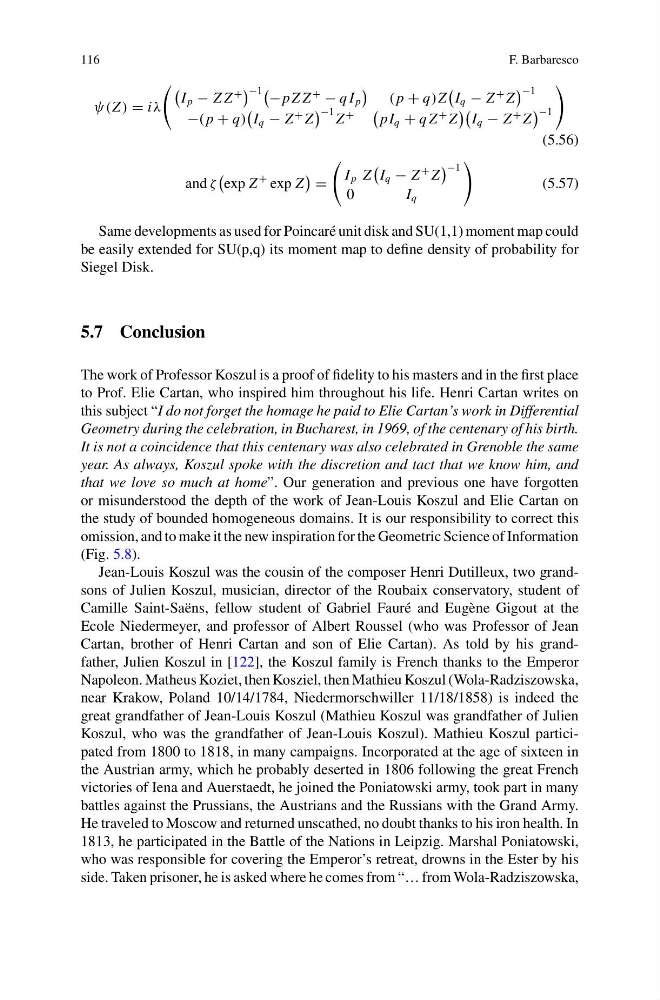
ψ(Z ) = iλ
I p − Z Z
+
−1
− pZ Z
+
− q I p
( p + q)Z
I q − Z
+ Z
−1
−( p + q)
I q − Z
+ Z
−1 Z
+
pI q + q Z
+ Z
I q − Z
+ Z
−1
(5.56)
and ζ
exp Z
+ exp Z
=
I p Z
I q − Z
+ Z
−1
0
I q
(5.57)
Same developments as used for Poincaré unit disk and SU(1,1) moment map could
be easily extended for SU(p,q) its moment map to define density of probability for
Siegel Disk.
5.7 Conclusion
The work of Professor Koszul is a proof of fidelity to his masters and in the first place
to Prof. Elie Cartan, who inspired him throughout his life. Henri Cartan writes on
this subject “I do not forget the homage he paid to Elie Cartan’s work in Differential
Geometry during the celebration, in Bucharest, in 1969, of the centenary of his birth.
It is not a coincidence that this centenary was also celebrated in Grenoble the same
year. As always, Koszul spoke with the discretion and tact that we know him, and
that we love so much at home”. Our generation and previous one have forgotten
or misunderstood the depth of the work of Jean-Louis Koszul and Elie Cartan on
the study of bounded homogeneous domains. It is our responsibility to correct this
omission, and to make it the new inspiration for the Geometric Science of Information
(Fig. 5.8).
Jean-Louis Koszul was the cousin of the composer Henri Dutilleux, two grandsons of Julien Koszul, musician, director of the Roubaix conservatory, student of
Camille Saint-Saëns, fellow student of Gabriel Fauré and Eugène Gigout at the
Ecole Niedermeyer, and professor of Albert Roussel (who was Professor of Jean
Cartan, brother of Henri Cartan and son of Elie Cartan). As told by his grandfather, Julien Koszul in [122], the Koszul family is French thanks to the Emperor
Napoleon. Matheus Koziet, then Kosziel, then Mathieu Koszul (Wola-Radziszowska,
near Krakow, Poland 10/14/1784, Niedermorschwiller 11/18/1858) is indeed the
great grandfather of Jean-Louis Koszul (Mathieu Koszul was grandfather of Julien
Koszul, who was the grandfather of Jean-Louis Koszul). Mathieu Koszul participated from 1800 to 1818, in many campaigns. Incorporated at the age of sixteen in
the Austrian army, which he probably deserted in 1806 following the great French
victories of Iena and Auerstaedt, he joined the Poniatowski army, took part in many
battles against the Prussians, the Austrians and the Russians with the Grand Army.
He traveled to Moscow and returned unscathed, no doubt thanks to his iron health. In
1813, he participated in the Battle of the Nations in Leipzig. Marshal Poniatowski,
who was responsible for covering the Emperor’s retreat, drowns in the Ester by his
side. Taken prisoner, he is asked where he comes from “… from Wola-Radziszowska,
F. Barbaresco
ψ(Z ) = iλ
I p − Z Z
+
−1
− pZ Z
+
− q I p
( p + q)Z
I q − Z
+ Z
−1
−( p + q)
I q − Z
+ Z
−1 Z
+
pI q + q Z
+ Z
I q − Z
+ Z
−1
(5.56)
and ζ
exp Z
+ exp Z
=
I p Z
I q − Z
+ Z
−1
0
I q
(5.57)
Same developments as used for Poincaré unit disk and SU(1,1) moment map could
be easily extended for SU(p,q) its moment map to define density of probability for
Siegel Disk.
5.7 Conclusion
The work of Professor Koszul is a proof of fidelity to his masters and in the first place
to Prof. Elie Cartan, who inspired him throughout his life. Henri Cartan writes on
this subject “I do not forget the homage he paid to Elie Cartan’s work in Differential
Geometry during the celebration, in Bucharest, in 1969, of the centenary of his birth.
It is not a coincidence that this centenary was also celebrated in Grenoble the same
year. As always, Koszul spoke with the discretion and tact that we know him, and
that we love so much at home”. Our generation and previous one have forgotten
or misunderstood the depth of the work of Jean-Louis Koszul and Elie Cartan on
the study of bounded homogeneous domains. It is our responsibility to correct this
omission, and to make it the new inspiration for the Geometric Science of Information
(Fig. 5.8).
Jean-Louis Koszul was the cousin of the composer Henri Dutilleux, two grandsons of Julien Koszul, musician, director of the Roubaix conservatory, student of
Camille Saint-Saëns, fellow student of Gabriel Fauré and Eugène Gigout at the
Ecole Niedermeyer, and professor of Albert Roussel (who was Professor of Jean
Cartan, brother of Henri Cartan and son of Elie Cartan). As told by his grandfather, Julien Koszul in [122], the Koszul family is French thanks to the Emperor
Napoleon. Matheus Koziet, then Kosziel, then Mathieu Koszul (Wola-Radziszowska,
near Krakow, Poland 10/14/1784, Niedermorschwiller 11/18/1858) is indeed the
great grandfather of Jean-Louis Koszul (Mathieu Koszul was grandfather of Julien
Koszul, who was the grandfather of Jean-Louis Koszul). Mathieu Koszul participated from 1800 to 1818, in many campaigns. Incorporated at the age of sixteen in
the Austrian army, which he probably deserted in 1806 following the great French
victories of Iena and Auerstaedt, he joined the Poniatowski army, took part in many
battles against the Prussians, the Austrians and the Russians with the Grand Army.
He traveled to Moscow and returned unscathed, no doubt thanks to his iron health. In
1813, he participated in the Battle of the Nations in Leipzig. Marshal Poniatowski,
who was responsible for covering the Emperor’s retreat, drowns in the Ester by his
side. Taken prisoner, he is asked where he comes from “… from Wola-Radziszowska,