

104
F. Barbaresco
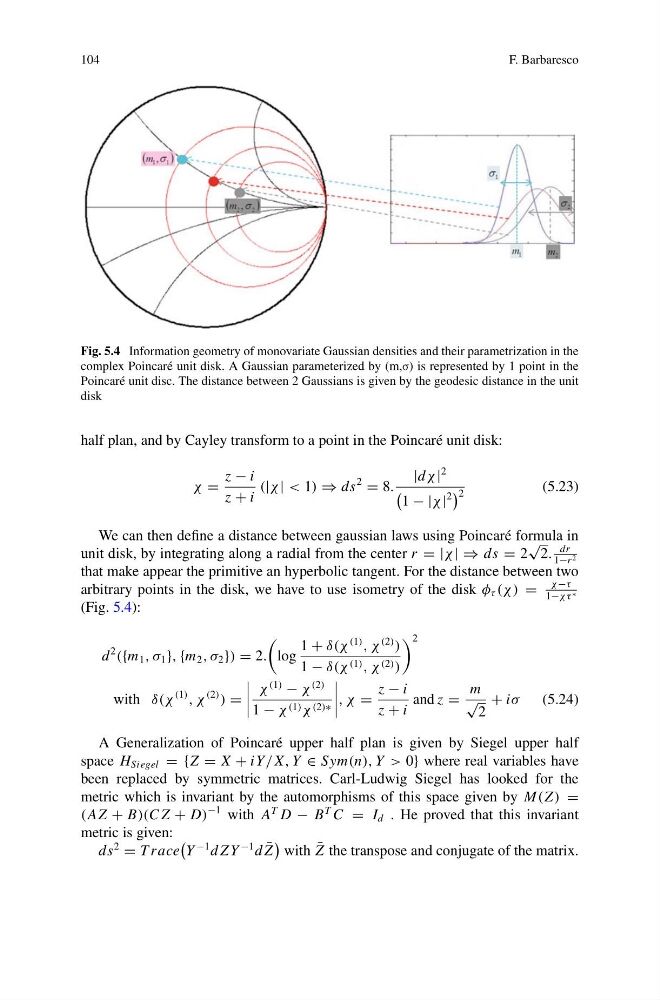
Fig. 5.4 Information geometry of monovariate Gaussian densities and their parametrization in the
complex Poincaré unit disk. A Gaussian parameterized by (m,σ) is represented by 1 point in the
Poincaré unit disc. The distance between 2 Gaussians is given by the geodesic distance in the unit
disk
half plan, and by Cayley transform to a point in the Poincaré unit disk:
χ =
z − i
z + i
(|χ | < 1) ⇒ ds
2
= 8.
|dχ |
2
1 − |χ |
2
2
(5.23)
We can then define a distance between gaussian laws using Poincaré formula in
unit disk, by integrating along a radial from the center r = |χ | ⇒ ds = 2
√
2.
dr
1−r 2
that make appear the primitive an hyperbolic tangent. For the distance between two
arbitrary points in the disk, we have to use isometry of the disk φ τ (χ ) =
χ−τ
1−χτ ∗
(Fig. 5.4):
d
2
({m 1 , σ 1 }, {m 2 , σ 2 }) = 2.
log
1 + δ(χ
(1)
, χ
(2)
)
1 − δ(χ (1) , χ (2) )
2
with δ(χ
(1)
, χ
(2)
) =
χ
(1)
− χ
(2)
1 − χ (1) χ (2)∗
, χ =
z − i
z + i
and z =
m
√
2
+ iσ
(5.24)
A Generalization of Poincaré upper half plan is given by Siegel upper half
space H Siegel = {Z = X + iY/ X, Y ∈ Sym(n), Y > 0} where real variables have
been replaced by symmetric matrices. Carl-Ludwig Siegel has looked for the
metric which is invariant by the automorphisms of this space given by M(Z ) =
(AZ + B)(C Z + D)
−1 with A
T D − B
T C = I d . He proved that this invariant
metric is given:
ds
2
= T race
Y
−1 d ZY
−1 d ¯
Z
with ¯
Z the transpose and conjugate of the matrix.
F. Barbaresco
Fig. 5.4 Information geometry of monovariate Gaussian densities and their parametrization in the
complex Poincaré unit disk. A Gaussian parameterized by (m,σ) is represented by 1 point in the
Poincaré unit disc. The distance between 2 Gaussians is given by the geodesic distance in the unit
disk
half plan, and by Cayley transform to a point in the Poincaré unit disk:
χ =
z − i
z + i
(|χ | < 1) ⇒ ds
2
= 8.
|dχ |
2
1 − |χ |
2
2
(5.23)
We can then define a distance between gaussian laws using Poincaré formula in
unit disk, by integrating along a radial from the center r = |χ | ⇒ ds = 2
√
2.
dr
1−r 2
that make appear the primitive an hyperbolic tangent. For the distance between two
arbitrary points in the disk, we have to use isometry of the disk φ τ (χ ) =
χ−τ
1−χτ ∗
(Fig. 5.4):
d
2
({m 1 , σ 1 }, {m 2 , σ 2 }) = 2.
log
1 + δ(χ
(1)
, χ
(2)
)
1 − δ(χ (1) , χ (2) )
2
with δ(χ
(1)
, χ
(2)
) =
χ
(1)
− χ
(2)
1 − χ (1) χ (2)∗
, χ =
z − i
z + i
and z =
m
√
2
+ iσ
(5.24)
A Generalization of Poincaré upper half plan is given by Siegel upper half
space H Siegel = {Z = X + iY/ X, Y ∈ Sym(n), Y > 0} where real variables have
been replaced by symmetric matrices. Carl-Ludwig Siegel has looked for the
metric which is invariant by the automorphisms of this space given by M(Z ) =
(AZ + B)(C Z + D)
−1 with A
T D − B
T C = I d . He proved that this invariant
metric is given:
ds
2
= T race
Y
−1 d ZY
−1 d ¯
Z
with ¯
Z the transpose and conjugate of the matrix.