

98
F. Barbaresco
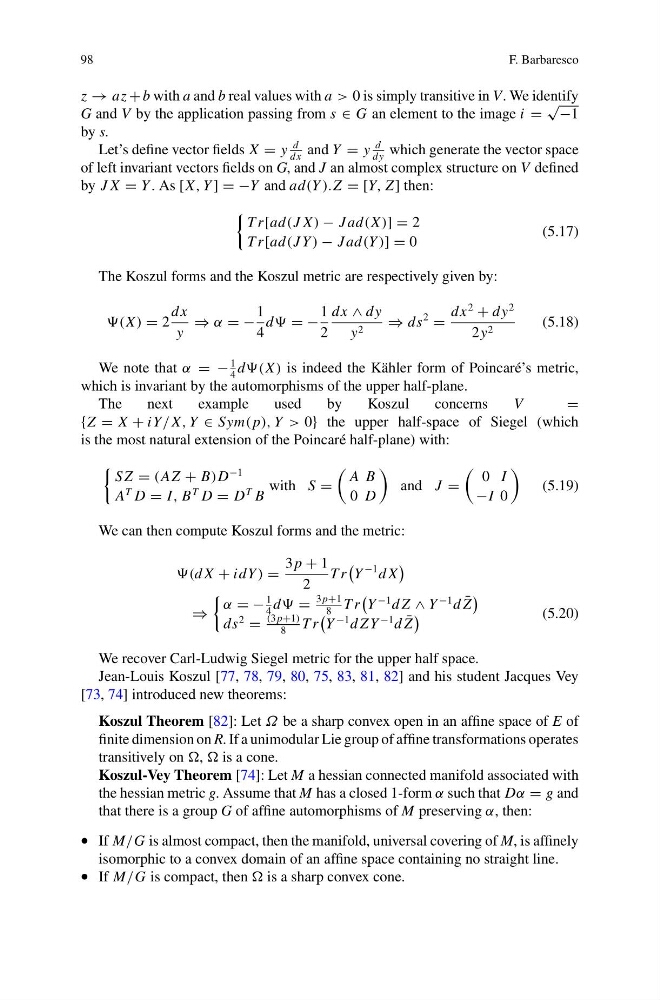
z → az + b with a and b real values with a > 0 is simply transitive in V. We identify
G and V by the application passing from s ∈ G an element to the image i =
√
−1
by s.
Let’s define vector fields X = y
d
dx
and Y = y
d
dy
which generate the vector space
of left invariant vectors fields on G, and J an almost complex structure on V defined
by J X = Y . As [X, Y ] = −Y and ad(Y ).Z = [Y, Z ] then:
T r[ad(J X) − J ad(X )] = 2
T r[ad(J Y ) − J ad(Y )] = 0
(5.17)
The Koszul forms and the Koszul metric are respectively given by:
(X ) = 2
dx
y
⇒ α = −
1
4
d = −
1
2
dx ∧ dy
y 2
⇒ ds
2
=
dx
2
+ dy
2
2y 2
(5.18)
We note that α = −
1
4
d(X ) is indeed the Kähler form of Poincaré’s metric,
which is invariant by the automorphisms of the upper half-plane.
The
next
example
used
by
Koszul
concerns
V
=
{Z = X + iY/ X, Y ∈ Sym( p), Y > 0} the upper half-space of Siegel (which
is the most natural extension of the Poincaré half-plane) with:
S Z = (AZ + B)D
−1
A
T D = I, B
T D = D
T B
with S =
A B
0 D
and J =
0 I
−I 0
(5.19)
We can then compute Koszul forms and the metric:
(d X + idY ) =
3 p + 1
2
T r
Y
−1 d X
⇒
α = −
1
4
d =
3 p+1
8
T r
Y
−1 d Z ∧ Y
−1 d ¯
Z
ds
2
=
(3 p+1)
8
T r
Y
−1 d ZY
−1 d ¯
Z
(5.20)
We recover Carl-Ludwig Siegel metric for the upper half space.
Jean-Louis Koszul [77, 78, 79, 80, 75, 83, 81, 82] and his student Jacques Vey
[73, 74] introduced new theorems:
Koszul Theorem [82]: Let Ω be a sharp convex open in an affine space of E of
finite dimension on R. If a unimodular Lie group of affine transformations operates
transitively on , is a cone.
Koszul-Vey Theorem [74]: Let M a hessian connected manifold associated with
the hessian metric g. Assume that M has a closed 1-form α such that Dα = g and
that there is a group G of affine automorphisms of M preserving α, then:
• If M/G is almost compact, then the manifold, universal covering of M, is affinely
isomorphic to a convex domain of an affine space containing no straight line.
• If M/G is compact, then is a sharp convex cone.
F. Barbaresco
z → az + b with a and b real values with a > 0 is simply transitive in V. We identify
G and V by the application passing from s ∈ G an element to the image i =
√
−1
by s.
Let’s define vector fields X = y
d
dx
and Y = y
d
dy
which generate the vector space
of left invariant vectors fields on G, and J an almost complex structure on V defined
by J X = Y . As [X, Y ] = −Y and ad(Y ).Z = [Y, Z ] then:
T r[ad(J X) − J ad(X )] = 2
T r[ad(J Y ) − J ad(Y )] = 0
(5.17)
The Koszul forms and the Koszul metric are respectively given by:
(X ) = 2
dx
y
⇒ α = −
1
4
d = −
1
2
dx ∧ dy
y 2
⇒ ds
2
=
dx
2
+ dy
2
2y 2
(5.18)
We note that α = −
1
4
d(X ) is indeed the Kähler form of Poincaré’s metric,
which is invariant by the automorphisms of the upper half-plane.
The
next
example
used
by
Koszul
concerns
V
=
{Z = X + iY/ X, Y ∈ Sym( p), Y > 0} the upper half-space of Siegel (which
is the most natural extension of the Poincaré half-plane) with:
S Z = (AZ + B)D
−1
A
T D = I, B
T D = D
T B
with S =
A B
0 D
and J =
0 I
−I 0
(5.19)
We can then compute Koszul forms and the metric:
(d X + idY ) =
3 p + 1
2
T r
Y
−1 d X
⇒
α = −
1
4
d =
3 p+1
8
T r
Y
−1 d Z ∧ Y
−1 d ¯
Z
ds
2
=
(3 p+1)
8
T r
Y
−1 d ZY
−1 d ¯
Z
(5.20)
We recover Carl-Ludwig Siegel metric for the upper half space.
Jean-Louis Koszul [77, 78, 79, 80, 75, 83, 81, 82] and his student Jacques Vey
[73, 74] introduced new theorems:
Koszul Theorem [82]: Let Ω be a sharp convex open in an affine space of E of
finite dimension on R. If a unimodular Lie group of affine transformations operates
transitively on , is a cone.
Koszul-Vey Theorem [74]: Let M a hessian connected manifold associated with
the hessian metric g. Assume that M has a closed 1-form α such that Dα = g and
that there is a group G of affine automorphisms of M preserving α, then:
• If M/G is almost compact, then the manifold, universal covering of M, is affinely
isomorphic to a convex domain of an affine space containing no straight line.
• If M/G is compact, then is a sharp convex cone.