

5 Peculiarities of the Crystal-Chemical Structure of Spinel Ferrites. . .
83
Table 5.4 Distribution of cations in ferrite determined by the Poix method
Distribution of cations in ferrite
Ø
ω
a, ÐÏ
d Td , ÐÏ
d Oh , ÐÏ
Fe
3+
0,919
Co
2+
0,25 Fe
3+
1,581 0,25
O 4
0.25
0.675
0.833735
0.170704
0.214244
Fe
3+
0.84
Co
2+
0.5 Fe
3+
1.49 0.16
O 4
0.5
0.68
0.83154
0.156183
0.222508
Fe
3+
0.869
Co
2+
0.75 Fe
3+
1.297 0.083
O 4
0.75
0.826
0.833831
0.161553
0.21996
Fe
3+
0.855
Co
2+ Fe
3+
1.145
O 4
1.0
0.855
0.83401
0.158339
0.222078
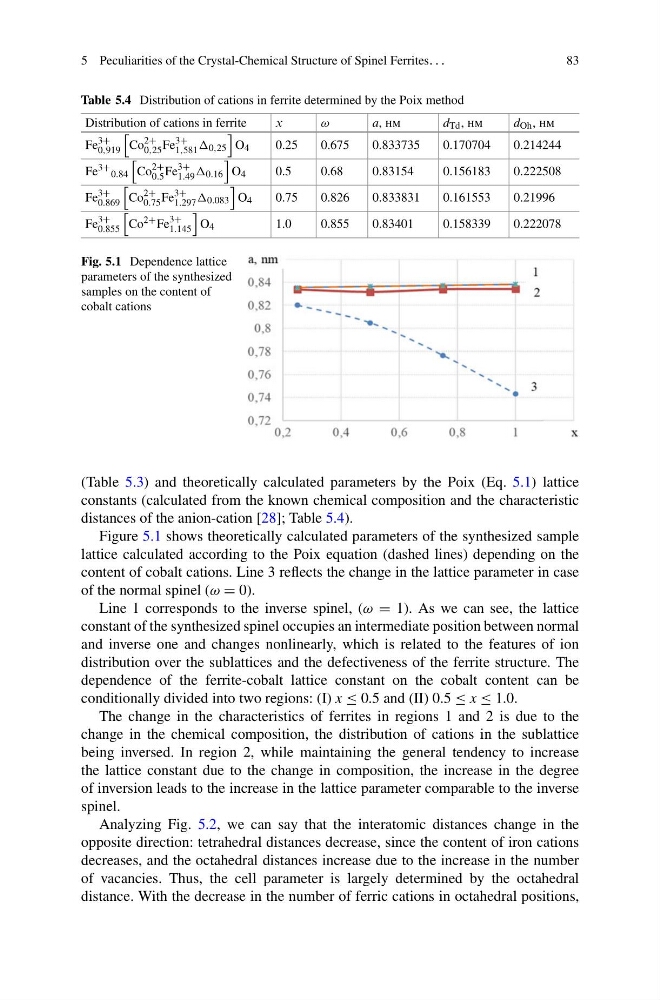
Fig. 5.1 Dependence lattice
parameters of the synthesized
samples on the content of
cobalt cations
(Table 5.3) and theoretically calculated parameters by the Poix (Eq. 5.1) lattice
constants (calculated from the known chemical composition and the characteristic
distances of the anion-cation [28]; Table 5.4).
Figure 5.1 shows theoretically calculated parameters of the synthesized sample
lattice calculated according to the Poix equation (dashed lines) depending on the
content of cobalt cations. Line 3 reflects the change in the lattice parameter in case
of the normal spinel (ω = 0).
Line 1 corresponds to the inverse spinel, (ω = 1). As we can see, the lattice
constant of the synthesized spinel occupies an intermediate position between normal
and inverse one and changes nonlinearly, which is related to the features of ion
distribution over the sublattices and the defectiveness of the ferrite structure. The
dependence of the ferrite-cobalt lattice constant on the cobalt content can be
conditionally divided into two regions: (I) x ≤ 0.5 and (II) 0.5 ≤ x ≤ 1.0.
The change in the characteristics of ferrites in regions 1 and 2 is due to the
change in the chemical composition, the distribution of cations in the sublattice
being inversed. In region 2, while maintaining the general tendency to increase
the lattice constant due to the change in composition, the increase in the degree
of inversion leads to the increase in the lattice parameter comparable to the inverse
spinel.
Analyzing Fig. 5.2, we can say that the interatomic distances change in the
opposite direction: tetrahedral distances decrease, since the content of iron cations
decreases, and the octahedral distances increase due to the increase in the number
of vacancies. Thus, the cell parameter is largely determined by the octahedral
distance. With the decrease in the number of ferric cations in octahedral positions,
83
Table 5.4 Distribution of cations in ferrite determined by the Poix method
Distribution of cations in ferrite
Ø
ω
a, ÐÏ
d Td , ÐÏ
d Oh , ÐÏ
Fe
3+
0,919
Co
2+
0,25 Fe
3+
1,581 0,25
O 4
0.25
0.675
0.833735
0.170704
0.214244
Fe
3+
0.84
Co
2+
0.5 Fe
3+
1.49 0.16
O 4
0.5
0.68
0.83154
0.156183
0.222508
Fe
3+
0.869
Co
2+
0.75 Fe
3+
1.297 0.083
O 4
0.75
0.826
0.833831
0.161553
0.21996
Fe
3+
0.855
Co
2+ Fe
3+
1.145
O 4
1.0
0.855
0.83401
0.158339
0.222078
Fig. 5.1 Dependence lattice
parameters of the synthesized
samples on the content of
cobalt cations
(Table 5.3) and theoretically calculated parameters by the Poix (Eq. 5.1) lattice
constants (calculated from the known chemical composition and the characteristic
distances of the anion-cation [28]; Table 5.4).
Figure 5.1 shows theoretically calculated parameters of the synthesized sample
lattice calculated according to the Poix equation (dashed lines) depending on the
content of cobalt cations. Line 3 reflects the change in the lattice parameter in case
of the normal spinel (ω = 0).
Line 1 corresponds to the inverse spinel, (ω = 1). As we can see, the lattice
constant of the synthesized spinel occupies an intermediate position between normal
and inverse one and changes nonlinearly, which is related to the features of ion
distribution over the sublattices and the defectiveness of the ferrite structure. The
dependence of the ferrite-cobalt lattice constant on the cobalt content can be
conditionally divided into two regions: (I) x ≤ 0.5 and (II) 0.5 ≤ x ≤ 1.0.
The change in the characteristics of ferrites in regions 1 and 2 is due to the
change in the chemical composition, the distribution of cations in the sublattice
being inversed. In region 2, while maintaining the general tendency to increase
the lattice constant due to the change in composition, the increase in the degree
of inversion leads to the increase in the lattice parameter comparable to the inverse
spinel.
Analyzing Fig. 5.2, we can say that the interatomic distances change in the
opposite direction: tetrahedral distances decrease, since the content of iron cations
decreases, and the octahedral distances increase due to the increase in the number
of vacancies. Thus, the cell parameter is largely determined by the octahedral
distance. With the decrease in the number of ferric cations in octahedral positions,