

5 Peculiarities of the Crystal-Chemical Structure of Spinel Ferrites. . .
81
5.2 Methodology of the Experiment
Aqueous solutions of cobalt sulfate hexahydrate and ferrous sulfate hexahydrate
have been used as starting precursors. The preparation of nanosized cobalt ferrite has
been carried out on a laboratory plasma chemical plant, which consists of a singlestage plasma reactor of a discrete type, a step-up transformer, a transformer-igniter,
and a vacuum pump. The pH of the solution was monitored at regular intervals,
and the product obtained was washed and dried for further investigation. Infrared
(IR) reflection spectra of cobalt ferrites Co x Fe 3-x O 4 (x = 0.25, 0.5, 0.75, 1.0) were
measured within a 400–4000 cm −1 range by employing a Fourier-transform infrared
(FTIR) spectrometer Nicolet iS10. The phase composition and structure of ferrite
samples were studied using X-ray diffractometer DRON-2 with Cu-K α radiation.
The magnetic properties of the final powder have been studied using a vibrating
sample magnetometer.
5.3 Results and Discussion
It was established [27] that the formation of cobalt ferrites from coprecipitated
hydroxides occurs during CNP treatment for 40 min. According to X-ray phase
analysis, a spinel phase is formed at this time. It should be noted that a single-phase
spinel of a similar composition is formed at 1200–1400 ◦ C in standard ceramic
technology using oxides.
Cationic distributions in cobalt ferrites obtained with the help of different
technologies were considered in [8, 9, 15]. Cobalt (II) ions are known [28] to tend
to tetrahedral positions, which are related to the structure of their electron shell.
With an increase in cobalt content in spinel, cobalt (II) cations are partially oxidized
to trivalent cations. Co 3 + cations replace Fe 3 + cations in octahedral positions, and
Co 2+ cations migrate from tetrahedral to octahedral positions. For 1< x <2 and
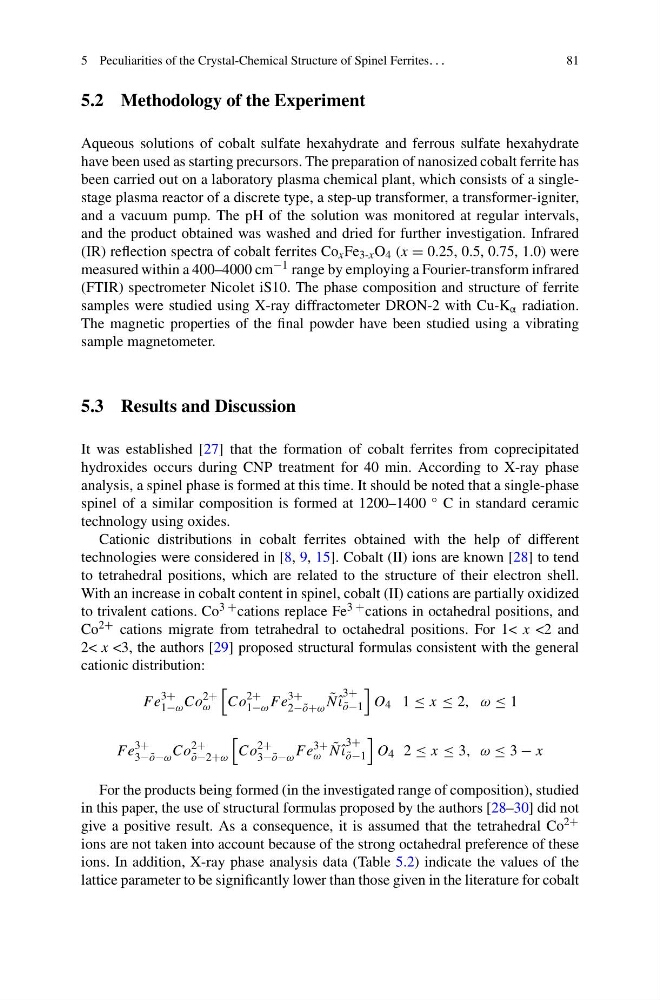
2< x <3, the authors [29] proposed structural formulas consistent with the general
cationic distribution:
F e
3+
1−ω Co
2+
ω
Co
2+
1−ω F e
3+
2− ˜
o+ω
˜
N ˆ
ι
3+
˜
o−1
O 4 1 ≤ x ≤ 2, ω ≤ 1
F e
3+
3− ˜
o−ω Co
2+
˜
o−2+ω
Co
2+
3− ˜
o−ω F e
3+
ω
˜
N ˆ
ι
3+
˜
o−1
O 4 2 ≤ x ≤ 3, ω ≤ 3 − x
For the products being formed (in the investigated range of composition), studied
in this paper, the use of structural formulas proposed by the authors [28–30] did not
give a positive result. As a consequence, it is assumed that the tetrahedral Co 2+
ions are not taken into account because of the strong octahedral preference of these
ions. In addition, X-ray phase analysis data (Table 5.2) indicate the values of the
lattice parameter to be significantly lower than those given in the literature for cobalt
81
5.2 Methodology of the Experiment
Aqueous solutions of cobalt sulfate hexahydrate and ferrous sulfate hexahydrate
have been used as starting precursors. The preparation of nanosized cobalt ferrite has
been carried out on a laboratory plasma chemical plant, which consists of a singlestage plasma reactor of a discrete type, a step-up transformer, a transformer-igniter,
and a vacuum pump. The pH of the solution was monitored at regular intervals,
and the product obtained was washed and dried for further investigation. Infrared
(IR) reflection spectra of cobalt ferrites Co x Fe 3-x O 4 (x = 0.25, 0.5, 0.75, 1.0) were
measured within a 400–4000 cm −1 range by employing a Fourier-transform infrared
(FTIR) spectrometer Nicolet iS10. The phase composition and structure of ferrite
samples were studied using X-ray diffractometer DRON-2 with Cu-K α radiation.
The magnetic properties of the final powder have been studied using a vibrating
sample magnetometer.
5.3 Results and Discussion
It was established [27] that the formation of cobalt ferrites from coprecipitated
hydroxides occurs during CNP treatment for 40 min. According to X-ray phase
analysis, a spinel phase is formed at this time. It should be noted that a single-phase
spinel of a similar composition is formed at 1200–1400 ◦ C in standard ceramic
technology using oxides.
Cationic distributions in cobalt ferrites obtained with the help of different
technologies were considered in [8, 9, 15]. Cobalt (II) ions are known [28] to tend
to tetrahedral positions, which are related to the structure of their electron shell.
With an increase in cobalt content in spinel, cobalt (II) cations are partially oxidized
to trivalent cations. Co 3 + cations replace Fe 3 + cations in octahedral positions, and
Co 2+ cations migrate from tetrahedral to octahedral positions. For 1< x <2 and
2< x <3, the authors [29] proposed structural formulas consistent with the general
cationic distribution:
F e
3+
1−ω Co
2+
ω
Co
2+
1−ω F e
3+
2− ˜
o+ω
˜
N ˆ
ι
3+
˜
o−1
O 4 1 ≤ x ≤ 2, ω ≤ 1
F e
3+
3− ˜
o−ω Co
2+
˜
o−2+ω
Co
2+
3− ˜
o−ω F e
3+
ω
˜
N ˆ
ι
3+
˜
o−1
O 4 2 ≤ x ≤ 3, ω ≤ 3 − x
For the products being formed (in the investigated range of composition), studied
in this paper, the use of structural formulas proposed by the authors [28–30] did not
give a positive result. As a consequence, it is assumed that the tetrahedral Co 2+
ions are not taken into account because of the strong octahedral preference of these
ions. In addition, X-ray phase analysis data (Table 5.2) indicate the values of the
lattice parameter to be significantly lower than those given in the literature for cobalt