

50
V. Demchenko et al.
Developing of such materials is not possible without fundamental researches and
studying their structure and physicochemical and mechanical properties.
The current review of scientific sources revealed that data concerning investigations of structural organization and physical, mechanical, and antimicrobial
properties of Ag-containing nanocomposites obtained by chemical or thermal reduction of Ag + ions in the interpolyelectrolyte–metal complexes are not published yet.
So, the aim of this work is to study the structural organization and thermomechanical and antimicrobial properties of nanocomposites prepared involving natural
and synthetic polymers – pectin, polyethyleneimine, poly(4-vinylpyridine), and Ag
nanoparticles – obtained by the chemical and thermal reduction of silver ions in the
interpolyelectrolyte–metal complexes.
3.2 Structural Formation and Thermomechanical Properties
of Polymer Nanocomposites Based
on Pectin–Poly(4-Vinylpyridine) Interpolyelectrolyte
Complexes and Ag Nanoparticles
To obtain the interpolyelectrolyte complexes (IPEC), pectin–poly(4-vinylpyridine)
(P4VP); the interpolyelectrolyte–metal complexes (IMC), pectin–Ag + –P4VP; and
nanocomposites of IPEC–Ag, the following reagents were used: pectin sodium salt
(Na-pectin), obtained by mixing citrus pectin production (“Cargill Deutschland
GmbH” (Germany)), ¯ = 3·10 4 , with NaOH; hydrochloride poly(4-vinylpyridine)
(P4VP-Cl), obtained by protonation of pyridine ring poly(4-vinylpyridine)
(Aldrich), ¯ w = 6·10 4 , with HCl; silver (I) nitrate (AgNO 3 ) (Aldrich) with
¯ = 169.9; and sodium borohydride (NaBH 4 ) (Aldrich) with ¯ = 37.83.
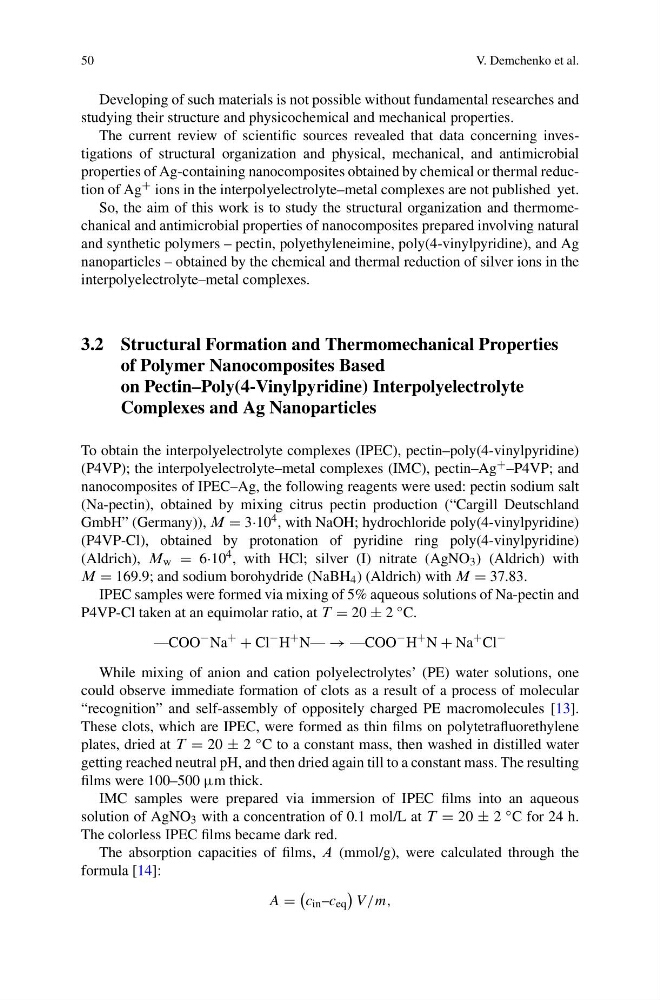
IPEC samples were formed via mixing of 5% aqueous solutions of Na-pectin and
P4VP-Cl taken at an equimolar ratio, at µ = 20 ± 2 ◦ C.
—COO
− Na
+
+ Cl
− H
+ N— → —COO
− H
+ N + Na
+ Cl
−
While mixing of anion and cation polyelectrolytes’ (PE) water solutions, one
could observe immediate formation of clots as a result of a process of molecular
“recognition” and self-assembly of oppositely charged PE macromolecules [13].
These clots, which are IPEC, were formed as thin films on polytetrafluorethylene
plates, dried at µ = 20 ± 2 ◦ C to a constant mass, then washed in distilled water
getting reached neutral pH, and then dried again till to a constant mass. The resulting
films were 100–500 μm thick.
IMC samples were prepared via immersion of IPEC films into an aqueous
solution of AgNO 3 with a concentration of 0.1 mol/L at µ = 20 ± 2 ◦ C for 24 h.
The colorless IPEC films became dark red.
The absorption capacities of films, £ (mmol/g), were calculated through the
formula [14]:
A =
c in –c eq
V /m,
V. Demchenko et al.
Developing of such materials is not possible without fundamental researches and
studying their structure and physicochemical and mechanical properties.
The current review of scientific sources revealed that data concerning investigations of structural organization and physical, mechanical, and antimicrobial
properties of Ag-containing nanocomposites obtained by chemical or thermal reduction of Ag + ions in the interpolyelectrolyte–metal complexes are not published yet.
So, the aim of this work is to study the structural organization and thermomechanical and antimicrobial properties of nanocomposites prepared involving natural
and synthetic polymers – pectin, polyethyleneimine, poly(4-vinylpyridine), and Ag
nanoparticles – obtained by the chemical and thermal reduction of silver ions in the
interpolyelectrolyte–metal complexes.
3.2 Structural Formation and Thermomechanical Properties
of Polymer Nanocomposites Based
on Pectin–Poly(4-Vinylpyridine) Interpolyelectrolyte
Complexes and Ag Nanoparticles
To obtain the interpolyelectrolyte complexes (IPEC), pectin–poly(4-vinylpyridine)
(P4VP); the interpolyelectrolyte–metal complexes (IMC), pectin–Ag + –P4VP; and
nanocomposites of IPEC–Ag, the following reagents were used: pectin sodium salt
(Na-pectin), obtained by mixing citrus pectin production (“Cargill Deutschland
GmbH” (Germany)), ¯ = 3·10 4 , with NaOH; hydrochloride poly(4-vinylpyridine)
(P4VP-Cl), obtained by protonation of pyridine ring poly(4-vinylpyridine)
(Aldrich), ¯ w = 6·10 4 , with HCl; silver (I) nitrate (AgNO 3 ) (Aldrich) with
¯ = 169.9; and sodium borohydride (NaBH 4 ) (Aldrich) with ¯ = 37.83.
IPEC samples were formed via mixing of 5% aqueous solutions of Na-pectin and
P4VP-Cl taken at an equimolar ratio, at µ = 20 ± 2 ◦ C.
—COO
− Na
+
+ Cl
− H
+ N— → —COO
− H
+ N + Na
+ Cl
−
While mixing of anion and cation polyelectrolytes’ (PE) water solutions, one
could observe immediate formation of clots as a result of a process of molecular
“recognition” and self-assembly of oppositely charged PE macromolecules [13].
These clots, which are IPEC, were formed as thin films on polytetrafluorethylene
plates, dried at µ = 20 ± 2 ◦ C to a constant mass, then washed in distilled water
getting reached neutral pH, and then dried again till to a constant mass. The resulting
films were 100–500 μm thick.
IMC samples were prepared via immersion of IPEC films into an aqueous
solution of AgNO 3 with a concentration of 0.1 mol/L at µ = 20 ± 2 ◦ C for 24 h.
The colorless IPEC films became dark red.
The absorption capacities of films, £ (mmol/g), were calculated through the
formula [14]:
A =
c in –c eq
V /m,