

32 Grain Porous Structure and Exploitation Properties of Humidity-Sensitive. . .
501
analyses were performed using X-ray reflections approximation method by pseudoVoigt function. The lattice parameters and crystal structures of phases were refined
using the Rietveld method [23] and WinPLOTR software [24, 25].
The grain porous structure of ceramics was studied using scanning electron
microscopy (SEM) with LEO 982 field emission microscope [14, 16, 17]. The pore
size distribution of MgAl 2 O 4 ceramics in the region from 2 to 1000 nm was studied
using Hg-porosimetry (Porosimetr 4000, Carlo Erba Strumentazione) [26, 27].
The PAL measurements with a full width at half maximum of 270 ps were
performed with the ORTEC spectrometer using 22 Na source placed between two
sandwiched samples as it was described in more details elsewhere [14, 16, 28–34].
In order to study the influence of the sintering temperature on the size of nanopores
in ceramic bulk, the PALS investigations were performed at 22 ◦ C and RH = 35%
after 7 days of exposure in water (vapor in desiccator at RH = 100%) and further
drying in vacuum at 120 ◦ C during 4 h. The obtained spectra were analyzed with LT
9.0 computer program [35, 36], and the best fitting results were obtained using fourcomponent fitting procedures. Each of these spectra was processed multiple times
owing to slight changes in the number of final channels, annihilation background,
and the time shift of the spectrum. Then, the variance of statistically weighted leastsquares deviations between experimental points and theoretical curve was taken into
account to compare the obtained results. Only the results having deviations close
to 1.0 (the optimal deviation typically ranges from 0.95 to ∼1.1–1.2 [37]) were
selected for further consideration. In such a manner, we obtained numerical PAL
parameters (positron lifetimes τ 1 , τ 2 , τ 3 , and τ 4 and intensities I 1 , I 2 , I 3 , and I 4 )
which correspond to annihilation of positrons in the samples of interest [14, 16, 34].
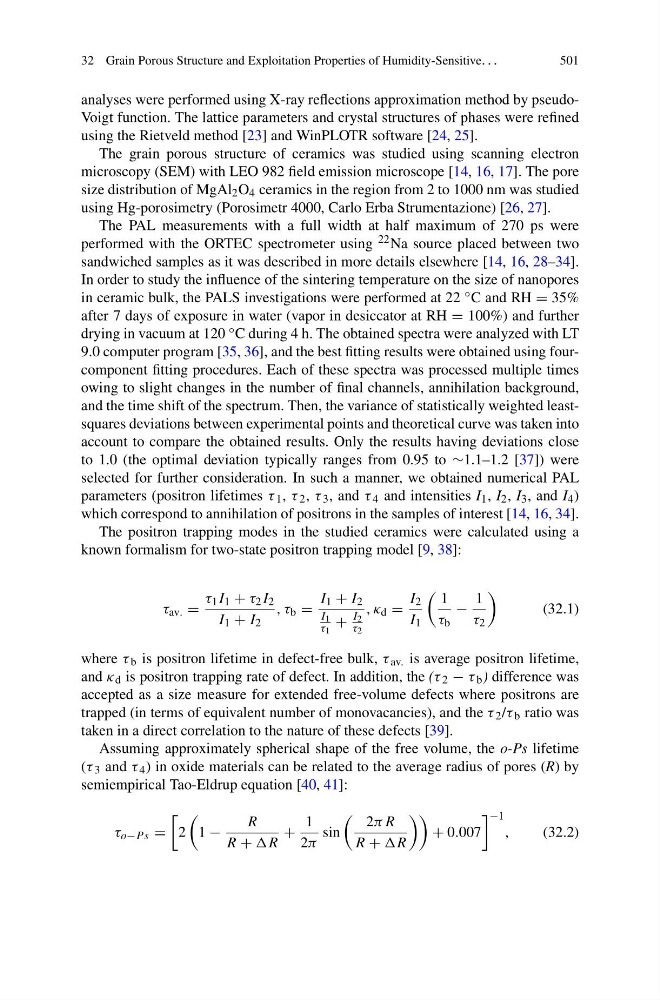
The positron trapping modes in the studied ceramics were calculated using a
known formalism for two-state positron trapping model [9, 38]:
τ av. =
τ 1 I 1 + τ 2 I 2
I 1 + I 2
, τ b =
I 1 + I 2
I 1
τ 1
+
I 2
τ 2
, κ d =
I 2
I 1
1
τ b
−
1
τ 2
(32.1)
where τ b is positron lifetime in defect-free bulk, τ av. is average positron lifetime,
and κ d is positron trapping rate of defect. In addition, the (τ 2 − τ b ) difference was
accepted as a size measure for extended free-volume defects where positrons are
trapped (in terms of equivalent number of monovacancies), and the τ 2 /τ b ratio was
taken in a direct correlation to the nature of these defects [39].
Assuming approximately spherical shape of the free volume, the o-Ps lifetime
(τ 3 and τ 4 ) in oxide materials can be related to the average radius of pores (R) by
semiempirical Tao-Eldrup equation [40, 41]:
τ o−P s =
2
1 −
R
R + R
+
1
2π
sin
2πR
R + R
+ 0.007
−1
,
(32.2)
501
analyses were performed using X-ray reflections approximation method by pseudoVoigt function. The lattice parameters and crystal structures of phases were refined
using the Rietveld method [23] and WinPLOTR software [24, 25].
The grain porous structure of ceramics was studied using scanning electron
microscopy (SEM) with LEO 982 field emission microscope [14, 16, 17]. The pore
size distribution of MgAl 2 O 4 ceramics in the region from 2 to 1000 nm was studied
using Hg-porosimetry (Porosimetr 4000, Carlo Erba Strumentazione) [26, 27].
The PAL measurements with a full width at half maximum of 270 ps were
performed with the ORTEC spectrometer using 22 Na source placed between two
sandwiched samples as it was described in more details elsewhere [14, 16, 28–34].
In order to study the influence of the sintering temperature on the size of nanopores
in ceramic bulk, the PALS investigations were performed at 22 ◦ C and RH = 35%
after 7 days of exposure in water (vapor in desiccator at RH = 100%) and further
drying in vacuum at 120 ◦ C during 4 h. The obtained spectra were analyzed with LT
9.0 computer program [35, 36], and the best fitting results were obtained using fourcomponent fitting procedures. Each of these spectra was processed multiple times
owing to slight changes in the number of final channels, annihilation background,
and the time shift of the spectrum. Then, the variance of statistically weighted leastsquares deviations between experimental points and theoretical curve was taken into
account to compare the obtained results. Only the results having deviations close
to 1.0 (the optimal deviation typically ranges from 0.95 to ∼1.1–1.2 [37]) were
selected for further consideration. In such a manner, we obtained numerical PAL
parameters (positron lifetimes τ 1 , τ 2 , τ 3 , and τ 4 and intensities I 1 , I 2 , I 3 , and I 4 )
which correspond to annihilation of positrons in the samples of interest [14, 16, 34].
The positron trapping modes in the studied ceramics were calculated using a
known formalism for two-state positron trapping model [9, 38]:
τ av. =
τ 1 I 1 + τ 2 I 2
I 1 + I 2
, τ b =
I 1 + I 2
I 1
τ 1
+
I 2
τ 2
, κ d =
I 2
I 1
1
τ b
−
1
τ 2
(32.1)
where τ b is positron lifetime in defect-free bulk, τ av. is average positron lifetime,
and κ d is positron trapping rate of defect. In addition, the (τ 2 − τ b ) difference was
accepted as a size measure for extended free-volume defects where positrons are
trapped (in terms of equivalent number of monovacancies), and the τ 2 /τ b ratio was
taken in a direct correlation to the nature of these defects [39].
Assuming approximately spherical shape of the free volume, the o-Ps lifetime
(τ 3 and τ 4 ) in oxide materials can be related to the average radius of pores (R) by
semiempirical Tao-Eldrup equation [40, 41]:
τ o−P s =
2
1 −
R
R + R
+
1
2π
sin
2πR
R + R
+ 0.007
−1
,
(32.2)