

494
Y. V. Naidich et al.
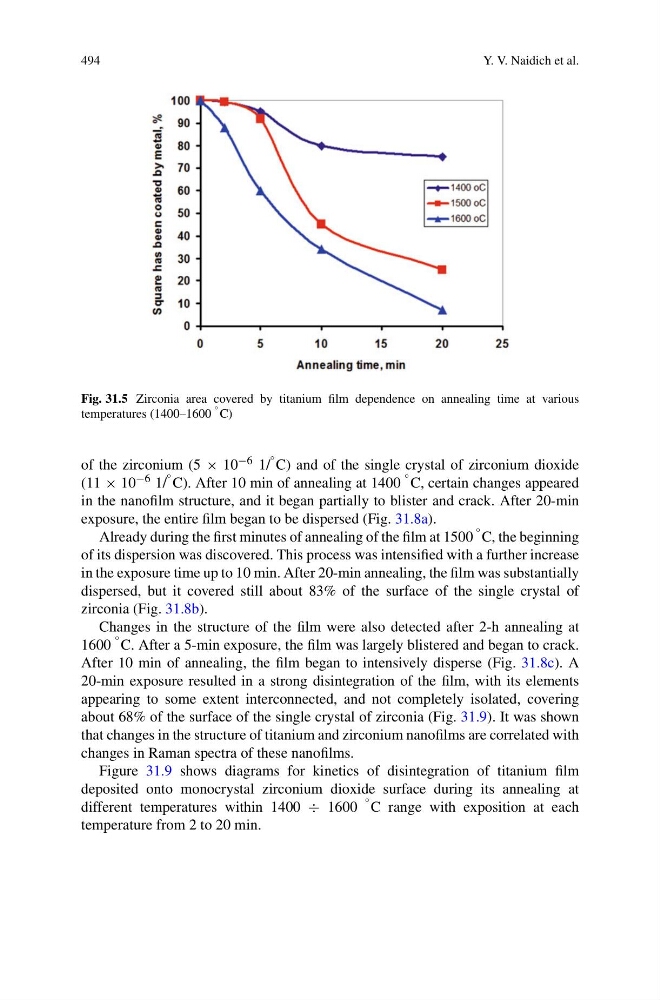
Fig. 31.5 Zirconia area covered by titanium film dependence on annealing time at various
temperatures (1400–1600
◦ C)
of the zirconium (5 × 10 −6 1/
◦ C) and of the single crystal of zirconium dioxide
(11 × 10 −6 1/
◦ C). After 10 min of annealing at 1400
◦ C, certain changes appeared
in the nanofilm structure, and it began partially to blister and crack. After 20-min
exposure, the entire film began to be dispersed (Fig. 31.8a).
Already during the first minutes of annealing of the film at 1500
◦ C, the beginning
of its dispersion was discovered. This process was intensified with a further increase
in the exposure time up to 10 min. After 20-min annealing, the film was substantially
dispersed, but it covered still about 83% of the surface of the single crystal of
zirconia (Fig. 31.8b).
Changes in the structure of the film were also detected after 2-h annealing at
1600
◦ C. After a 5-min exposure, the film was largely blistered and began to crack.
After 10 min of annealing, the film began to intensively disperse (Fig. 31.8c). A
20-min exposure resulted in a strong disintegration of the film, with its elements
appearing to some extent interconnected, and not completely isolated, covering
about 68% of the surface of the single crystal of zirconia (Fig. 31.9). It was shown
that changes in the structure of titanium and zirconium nanofilms are correlated with
changes in Raman spectra of these nanofilms.
Figure 31.9 shows diagrams for kinetics of disintegration of titanium film
deposited onto monocrystal zirconium dioxide surface during its annealing at
different temperatures within 1400 ÷ 1600
◦ C range with exposition at each
temperature from 2 to 20 min.
Y. V. Naidich et al.
Fig. 31.5 Zirconia area covered by titanium film dependence on annealing time at various
temperatures (1400–1600
◦ C)
of the zirconium (5 × 10 −6 1/
◦ C) and of the single crystal of zirconium dioxide
(11 × 10 −6 1/
◦ C). After 10 min of annealing at 1400
◦ C, certain changes appeared
in the nanofilm structure, and it began partially to blister and crack. After 20-min
exposure, the entire film began to be dispersed (Fig. 31.8a).
Already during the first minutes of annealing of the film at 1500
◦ C, the beginning
of its dispersion was discovered. This process was intensified with a further increase
in the exposure time up to 10 min. After 20-min annealing, the film was substantially
dispersed, but it covered still about 83% of the surface of the single crystal of
zirconia (Fig. 31.8b).
Changes in the structure of the film were also detected after 2-h annealing at
1600
◦ C. After a 5-min exposure, the film was largely blistered and began to crack.
After 10 min of annealing, the film began to intensively disperse (Fig. 31.8c). A
20-min exposure resulted in a strong disintegration of the film, with its elements
appearing to some extent interconnected, and not completely isolated, covering
about 68% of the surface of the single crystal of zirconia (Fig. 31.9). It was shown
that changes in the structure of titanium and zirconium nanofilms are correlated with
changes in Raman spectra of these nanofilms.
Figure 31.9 shows diagrams for kinetics of disintegration of titanium film
deposited onto monocrystal zirconium dioxide surface during its annealing at
different temperatures within 1400 ÷ 1600
◦ C range with exposition at each
temperature from 2 to 20 min.