

482
B. D. Vasyliv et al.
No changes in the electrical conductivity of porous Ni were found for all the
treatment modes (see Table 30.1). Even a relatively high concentration of hydrogen
sulfide (18 vol%) in a hydrogenous environment did not cause a formation of a
protective surface layer which could decrease surface conductivity of the material.
The YSZ–NiO anode ceramics, depending on a content of hydrogen in a gaseous
atmosphere, displayed quite different mechanical behavior as compared to porous
Ni (Fig. 30.5). Based on previously obtained data [5, 7], it was stated that after a
single exposure of the YSZ–NiO ceramics in Ar–5 vol% ° 2 gas mixture, only the
surface layers of the particles of nickel oxide are reduced, and after exposure in
hydrogen, the particles are reduced completely what causes the substantial growth
of electrical conductivity of the material (up to (2.1–2.7)·10 6 S/m).
As a result of complete reduction of the nickel phase in pure hydrogen followed
by a significant plasticization of reduced Ni, the relative stiffness decreased to 62%.
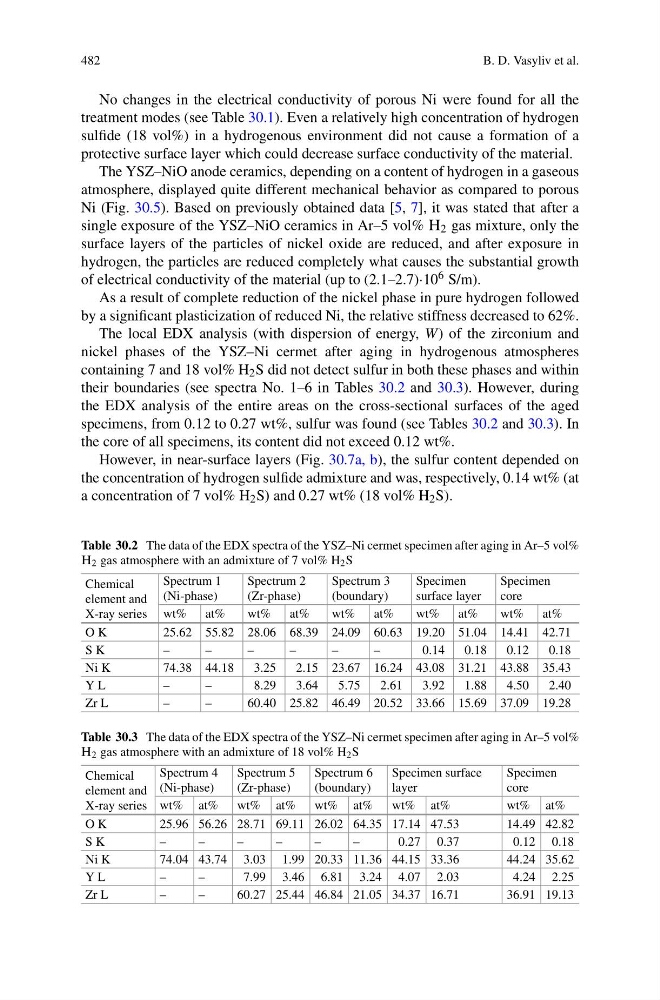
The local EDX analysis (with dispersion of energy, W) of the zirconium and
nickel phases of the YSZ–Ni cermet after aging in hydrogenous atmospheres
containing 7 and 18 vol% H 2 S did not detect sulfur in both these phases and within
their boundaries (see spectra No. 1–6 in Tables 30.2 and 30.3). However, during
the EDX analysis of the entire areas on the cross-sectional surfaces of the aged
specimens, from 0.12 to 0.27 wt%, sulfur was found (see Tables 30.2 and 30.3). In
the core of all specimens, its content did not exceed 0.12 wt%.
However, in near-surface layers (Fig. 30.7a, b), the sulfur content depended on
the concentration of hydrogen sulfide admixture and was, respectively, 0.14 wt% (at
a concentration of 7 vol% H 2 S) and 0.27 wt% (18 vol% H 2 S).
Table 30.2 The data of the EDX spectra of the YSZ–Ni cermet specimen after aging in Ar–5 vol%
° 2 gas atmosphere with an admixture of 7 vol% H 2 S
Spectrum 1
(Ni-phase)
Spectrum 2
(Zr-phase)
Spectrum 3
(boundary)
Specimen
surface layer
Specimen
core
Chemical
element and
X-ray series wt% at%
wt% at%
wt% at%
wt% at%
wt% at%
O K
25.62 55.82 28.06 68.39 24.09 60.63 19.20 51.04 14.41 42.71
S K
–
–
–
–
–
–
0.14
0.18
0.12
0.18
Ni K
74.38 44.18
3.25
2.15 23.67 16.24 43.08 31.21 43.88 35.43
Y L
–
–
8.29
3.64
5.75
2.61
3.92
1.88
4.50
2.40
Zr L
–
–
60.40 25.82 46.49 20.52 33.66 15.69 37.09 19.28
Table 30.3 The data of the EDX spectra of the YSZ–Ni cermet specimen after aging in Ar–5 vol%
° 2 gas atmosphere with an admixture of 18 vol% H 2 S
Spectrum 4
(Ni-phase)
Spectrum 5
(Zr-phase)
Spectrum 6
(boundary)
Specimen surface
layer
Specimen
core
Chemical
element and
X-ray series wt% at% wt% at% wt% at% wt% at%
wt% at%
O K
25.96 56.26 28.71 69.11 26.02 64.35 17.14 47.53
14.49 42.82
S K
–
–
–
–
–
–
0.27 0.37
0.12 0.18
Ni K
74.04 43.74 3.03 1.99 20.33 11.36 44.15 33.36
44.24 35.62
Y L
–
–
7.99 3.46 6.81 3.24 4.07 2.03
4.24 2.25
Zr L
–
–
60.27 25.44 46.84 21.05 34.37 16.71
36.91 19.13
B. D. Vasyliv et al.
No changes in the electrical conductivity of porous Ni were found for all the
treatment modes (see Table 30.1). Even a relatively high concentration of hydrogen
sulfide (18 vol%) in a hydrogenous environment did not cause a formation of a
protective surface layer which could decrease surface conductivity of the material.
The YSZ–NiO anode ceramics, depending on a content of hydrogen in a gaseous
atmosphere, displayed quite different mechanical behavior as compared to porous
Ni (Fig. 30.5). Based on previously obtained data [5, 7], it was stated that after a
single exposure of the YSZ–NiO ceramics in Ar–5 vol% ° 2 gas mixture, only the
surface layers of the particles of nickel oxide are reduced, and after exposure in
hydrogen, the particles are reduced completely what causes the substantial growth
of electrical conductivity of the material (up to (2.1–2.7)·10 6 S/m).
As a result of complete reduction of the nickel phase in pure hydrogen followed
by a significant plasticization of reduced Ni, the relative stiffness decreased to 62%.
The local EDX analysis (with dispersion of energy, W) of the zirconium and
nickel phases of the YSZ–Ni cermet after aging in hydrogenous atmospheres
containing 7 and 18 vol% H 2 S did not detect sulfur in both these phases and within
their boundaries (see spectra No. 1–6 in Tables 30.2 and 30.3). However, during
the EDX analysis of the entire areas on the cross-sectional surfaces of the aged
specimens, from 0.12 to 0.27 wt%, sulfur was found (see Tables 30.2 and 30.3). In
the core of all specimens, its content did not exceed 0.12 wt%.
However, in near-surface layers (Fig. 30.7a, b), the sulfur content depended on
the concentration of hydrogen sulfide admixture and was, respectively, 0.14 wt% (at
a concentration of 7 vol% H 2 S) and 0.27 wt% (18 vol% H 2 S).
Table 30.2 The data of the EDX spectra of the YSZ–Ni cermet specimen after aging in Ar–5 vol%
° 2 gas atmosphere with an admixture of 7 vol% H 2 S
Spectrum 1
(Ni-phase)
Spectrum 2
(Zr-phase)
Spectrum 3
(boundary)
Specimen
surface layer
Specimen
core
Chemical
element and
X-ray series wt% at%
wt% at%
wt% at%
wt% at%
wt% at%
O K
25.62 55.82 28.06 68.39 24.09 60.63 19.20 51.04 14.41 42.71
S K
–
–
–
–
–
–
0.14
0.18
0.12
0.18
Ni K
74.38 44.18
3.25
2.15 23.67 16.24 43.08 31.21 43.88 35.43
Y L
–
–
8.29
3.64
5.75
2.61
3.92
1.88
4.50
2.40
Zr L
–
–
60.40 25.82 46.49 20.52 33.66 15.69 37.09 19.28
Table 30.3 The data of the EDX spectra of the YSZ–Ni cermet specimen after aging in Ar–5 vol%
° 2 gas atmosphere with an admixture of 18 vol% H 2 S
Spectrum 4
(Ni-phase)
Spectrum 5
(Zr-phase)
Spectrum 6
(boundary)
Specimen surface
layer
Specimen
core
Chemical
element and
X-ray series wt% at% wt% at% wt% at% wt% at%
wt% at%
O K
25.96 56.26 28.71 69.11 26.02 64.35 17.14 47.53
14.49 42.82
S K
–
–
–
–
–
–
0.27 0.37
0.12 0.18
Ni K
74.04 43.74 3.03 1.99 20.33 11.36 44.15 33.36
44.24 35.62
Y L
–
–
7.99 3.46 6.81 3.24 4.07 2.03
4.24 2.25
Zr L
–
–
60.27 25.44 46.84 21.05 34.37 16.71
36.91 19.13