

446
A. Maizelis and B. Bairachniy
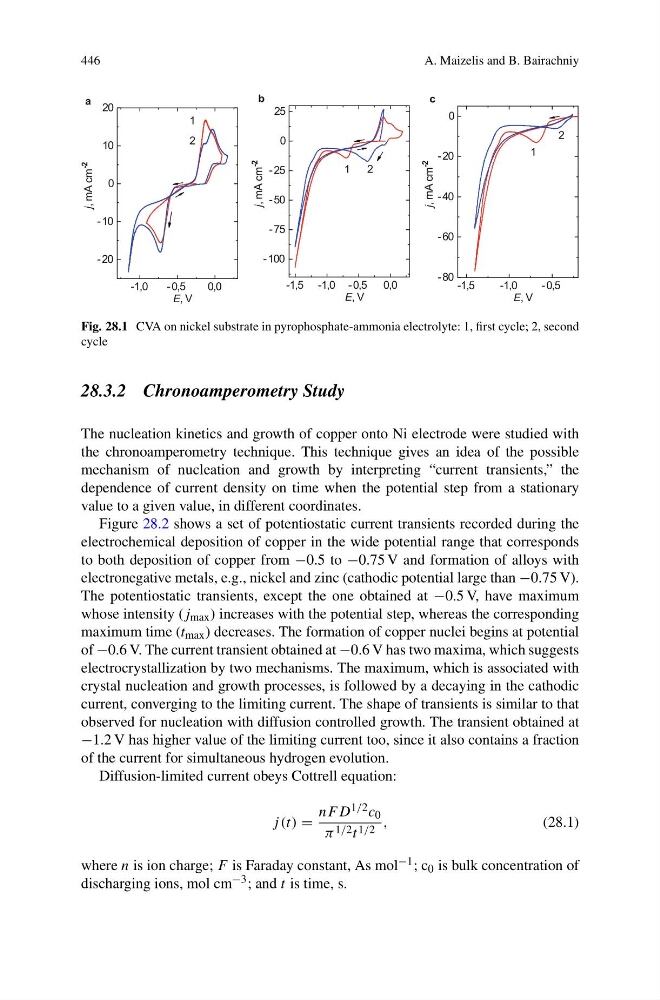
Fig. 28.1 CVA on nickel substrate in pyrophosphate-ammonia electrolyte: 1, first cycle; 2, second
cycle
28.3.2 Chronoamperometry Study
The nucleation kinetics and growth of copper onto Ni electrode were studied with
the chronoamperometry technique. This technique gives an idea of the possible
mechanism of nucleation and growth by interpreting “current transients,” the
dependence of current density on time when the potential step from a stationary
value to a given value, in different coordinates.
Figure 28.2 shows a set of potentiostatic current transients recorded during the
electrochemical deposition of copper in the wide potential range that corresponds
to both deposition of copper from −0.5 to −0.75 V and formation of alloys with
electronegative metals, e.g., nickel and zinc (cathodic potential large than −0.75 V).
The potentiostatic transients, except the one obtained at −0.5 V, have maximum
whose intensity (j max ) increases with the potential step, whereas the corresponding
maximum time (t max ) decreases. The formation of copper nuclei begins at potential
of −0.6 V. The current transient obtained at −0.6 V has two maxima, which suggests
electrocrystallization by two mechanisms. The maximum, which is associated with
crystal nucleation and growth processes, is followed by a decaying in the cathodic
current, converging to the limiting current. The shape of transients is similar to that
observed for nucleation with diffusion controlled growth. The transient obtained at
−1.2 V has higher value of the limiting current too, since it also contains a fraction
of the current for simultaneous hydrogen evolution.
Diffusion-limited current obeys Cottrell equation:
j (t) =
nF D 1/2 c 0
π 1/2 t 1/2 ,
(28.1)
where n is ion charge; F is Faraday constant, As mol −1 ; c 0 is bulk concentration of
discharging ions, mol cm −3 ; and t is time, s.
A. Maizelis and B. Bairachniy
Fig. 28.1 CVA on nickel substrate in pyrophosphate-ammonia electrolyte: 1, first cycle; 2, second
cycle
28.3.2 Chronoamperometry Study
The nucleation kinetics and growth of copper onto Ni electrode were studied with
the chronoamperometry technique. This technique gives an idea of the possible
mechanism of nucleation and growth by interpreting “current transients,” the
dependence of current density on time when the potential step from a stationary
value to a given value, in different coordinates.
Figure 28.2 shows a set of potentiostatic current transients recorded during the
electrochemical deposition of copper in the wide potential range that corresponds
to both deposition of copper from −0.5 to −0.75 V and formation of alloys with
electronegative metals, e.g., nickel and zinc (cathodic potential large than −0.75 V).
The potentiostatic transients, except the one obtained at −0.5 V, have maximum
whose intensity (j max ) increases with the potential step, whereas the corresponding
maximum time (t max ) decreases. The formation of copper nuclei begins at potential
of −0.6 V. The current transient obtained at −0.6 V has two maxima, which suggests
electrocrystallization by two mechanisms. The maximum, which is associated with
crystal nucleation and growth processes, is followed by a decaying in the cathodic
current, converging to the limiting current. The shape of transients is similar to that
observed for nucleation with diffusion controlled growth. The transient obtained at
−1.2 V has higher value of the limiting current too, since it also contains a fraction
of the current for simultaneous hydrogen evolution.
Diffusion-limited current obeys Cottrell equation:
j (t) =
nF D 1/2 c 0
π 1/2 t 1/2 ,
(28.1)
where n is ion charge; F is Faraday constant, As mol −1 ; c 0 is bulk concentration of
discharging ions, mol cm −3 ; and t is time, s.