

398
A. E. Artyukhov et al.
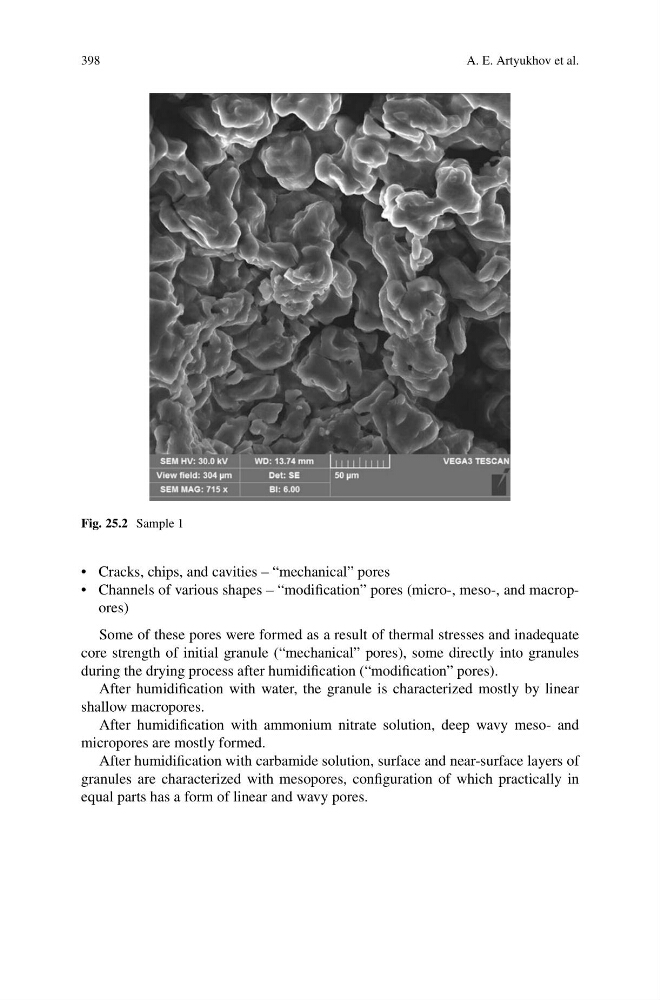
Fig. 25.2 Sample 1
• Cracks, chips, and cavities – “mechanical” pores
• Channels of various shapes – “modification” pores (micro-, meso-, and macropores)
Some of these pores were formed as a result of thermal stresses and inadequate
core strength of initial granule (“mechanical” pores), some directly into granules
during the drying process after humidification (“modification” pores).
After humidification with water, the granule is characterized mostly by linear
shallow macropores.
After humidification with ammonium nitrate solution, deep wavy meso- and
micropores are mostly formed.
After humidification with carbamide solution, surface and near-surface layers of
granules are characterized with mesopores, configuration of which practically in
equal parts has a form of linear and wavy pores.
A. E. Artyukhov et al.
Fig. 25.2 Sample 1
• Cracks, chips, and cavities – “mechanical” pores
• Channels of various shapes – “modification” pores (micro-, meso-, and macropores)
Some of these pores were formed as a result of thermal stresses and inadequate
core strength of initial granule (“mechanical” pores), some directly into granules
during the drying process after humidification (“modification” pores).
After humidification with water, the granule is characterized mostly by linear
shallow macropores.
After humidification with ammonium nitrate solution, deep wavy meso- and
micropores are mostly formed.
After humidification with carbamide solution, surface and near-surface layers of
granules are characterized with mesopores, configuration of which practically in
equal parts has a form of linear and wavy pores.