

24 Dielectric Properties and AC Conductivity of Epoxy/Hybrid Nanocarbon. . .
389
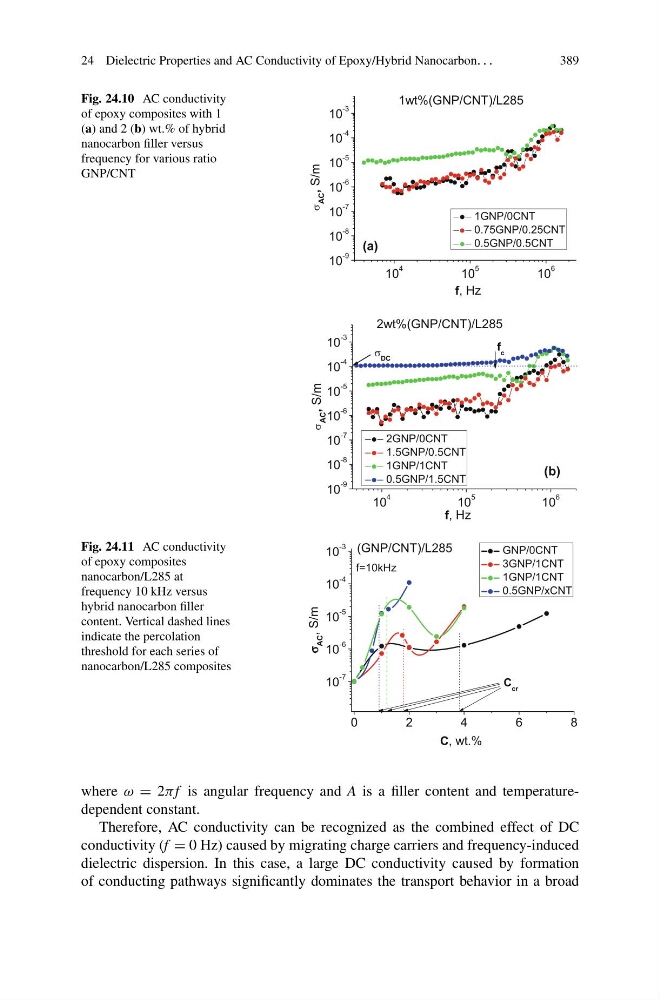
Fig. 24.10 AC conductivity
of epoxy composites with 1
(a) and 2 (b) wt.% of hybrid
nanocarbon filler versus
frequency for various ratio
GNP/CNT
10
4
10
5
10
6
10
-9
10
-8
10
-7
10
-6
10
-5
10
-4
10
-3
(a)
1wt%(GNP/CNT)/L285
s
AC
, S/m
f, Hz
1GNP/0CNT
0.75GNP/0.25CNT
0.5GNP/0.5CNT
10
4
10
5
10
6
10
-9
10
-8
10
-7
10
-6
10
-5
10
-4
10
-3
f c
s DC
(b)
f, Hz
2wt%(GNP/CNT)/L285
2GNP/0CNT
1.5GNP/0.5CNT
1GNP/1CNT
0.5GNP/1.5CNT
s
AC
, S/m
Fig. 24.11 AC conductivity
of epoxy composites
nanocarbon/L285 at
frequency 10 kHz versus
hybrid nanocarbon filler
content. Vertical dashed lines
indicate the percolation
threshold for each series of
nanocarbon/L285 composites
0
2
4
6
8
10
-7
10
-6
10
-5
10
-4
10
-3
C cr
f=10kHz
(GNP/CNT)/L285
C, wt.%
s
AC
, S/m
GNP/0CNT
3GNP/1CNT
1GNP/1CNT
0.5GNP/xCNT
where ω = 2π f is angular frequency and A is a filler content and temperaturedependent constant.
Therefore, AC conductivity can be recognized as the combined effect of DC
conductivity (f = 0 Hz) caused by migrating charge carriers and frequency-induced
dielectric dispersion. In this case, a large DC conductivity caused by formation
of conducting pathways significantly dominates the transport behavior in a broad
389
Fig. 24.10 AC conductivity
of epoxy composites with 1
(a) and 2 (b) wt.% of hybrid
nanocarbon filler versus
frequency for various ratio
GNP/CNT
10
4
10
5
10
6
10
-9
10
-8
10
-7
10
-6
10
-5
10
-4
10
-3
(a)
1wt%(GNP/CNT)/L285
s
AC
, S/m
f, Hz
1GNP/0CNT
0.75GNP/0.25CNT
0.5GNP/0.5CNT
10
4
10
5
10
6
10
-9
10
-8
10
-7
10
-6
10
-5
10
-4
10
-3
f c
s DC
(b)
f, Hz
2wt%(GNP/CNT)/L285
2GNP/0CNT
1.5GNP/0.5CNT
1GNP/1CNT
0.5GNP/1.5CNT
s
AC
, S/m
Fig. 24.11 AC conductivity
of epoxy composites
nanocarbon/L285 at
frequency 10 kHz versus
hybrid nanocarbon filler
content. Vertical dashed lines
indicate the percolation
threshold for each series of
nanocarbon/L285 composites
0
2
4
6
8
10
-7
10
-6
10
-5
10
-4
10
-3
C cr
f=10kHz
(GNP/CNT)/L285
C, wt.%
s
AC
, S/m
GNP/0CNT
3GNP/1CNT
1GNP/1CNT
0.5GNP/xCNT
where ω = 2π f is angular frequency and A is a filler content and temperaturedependent constant.
Therefore, AC conductivity can be recognized as the combined effect of DC
conductivity (f = 0 Hz) caused by migrating charge carriers and frequency-induced
dielectric dispersion. In this case, a large DC conductivity caused by formation
of conducting pathways significantly dominates the transport behavior in a broad