

386
L. L. Vovchenko et al.
polymer matrix and conductive filler) [26] and thus causes the increase in the
dielectric constant, especially in low-frequency range [26, 27].
Furthermore, a thin insulating layer of epoxy resin is combined with the GNP or
CNT particles to form a nanoscale structure in the polymer nanocomposites. This
structure can fully realize the advantages of GNPs and CNTs (i.e., large specific
surface area and high aspect ratio) and result in a huge interfacial area between
nanocarbon filler and epoxy in the nanocomposite [28]. This provides a large
number of sites for this interfacial polarization and significantly enhances MWS
effect.
For the composites filled with conductive fillers, the percolation theory depicts
that the variations of dielectric constant with frequency follow a power law as the
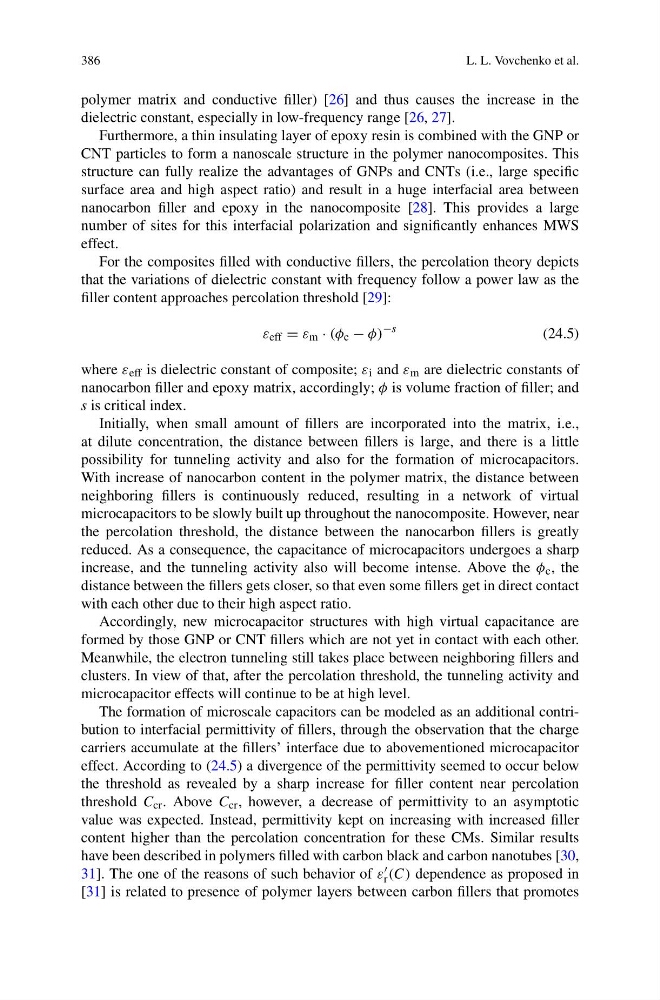
filler content approaches percolation threshold [29]:
ε eff = ε m · (φ c − φ)
−s
(24.5)
where ε eff is dielectric constant of composite; ε i and ε m are dielectric constants of
nanocarbon filler and epoxy matrix, accordingly; φ is volume fraction of filler; and
s is critical index.
Initially, when small amount of fillers are incorporated into the matrix, i.e.,
at dilute concentration, the distance between fillers is large, and there is a little
possibility for tunneling activity and also for the formation of microcapacitors.
With increase of nanocarbon content in the polymer matrix, the distance between
neighboring fillers is continuously reduced, resulting in a network of virtual
microcapacitors to be slowly built up throughout the nanocomposite. However, near
the percolation threshold, the distance between the nanocarbon fillers is greatly
reduced. As a consequence, the capacitance of microcapacitors undergoes a sharp
increase, and the tunneling activity also will become intense. Above the φ c , the
distance between the fillers gets closer, so that even some fillers get in direct contact
with each other due to their high aspect ratio.
Accordingly, new microcapacitor structures with high virtual capacitance are
formed by those GNP or CNT fillers which are not yet in contact with each other.
Meanwhile, the electron tunneling still takes place between neighboring fillers and
clusters. In view of that, after the percolation threshold, the tunneling activity and
microcapacitor effects will continue to be at high level.
The formation of microscale capacitors can be modeled as an additional contribution to interfacial permittivity of fillers, through the observation that the charge
carriers accumulate at the fillers’ interface due to abovementioned microcapacitor
effect. According to (24.5) a divergence of the permittivity seemed to occur below
the threshold as revealed by a sharp increase for filler content near percolation
threshold C cr . Above C cr , however, a decrease of permittivity to an asymptotic
value was expected. Instead, permittivity kept on increasing with increased filler
content higher than the percolation concentration for these CMs. Similar results
have been described in polymers filled with carbon black and carbon nanotubes [30,
31]. The one of the reasons of such behavior of ε
r (C) dependence as proposed in
[31] is related to presence of polymer layers between carbon fillers that promotes
L. L. Vovchenko et al.
polymer matrix and conductive filler) [26] and thus causes the increase in the
dielectric constant, especially in low-frequency range [26, 27].
Furthermore, a thin insulating layer of epoxy resin is combined with the GNP or
CNT particles to form a nanoscale structure in the polymer nanocomposites. This
structure can fully realize the advantages of GNPs and CNTs (i.e., large specific
surface area and high aspect ratio) and result in a huge interfacial area between
nanocarbon filler and epoxy in the nanocomposite [28]. This provides a large
number of sites for this interfacial polarization and significantly enhances MWS
effect.
For the composites filled with conductive fillers, the percolation theory depicts
that the variations of dielectric constant with frequency follow a power law as the
filler content approaches percolation threshold [29]:
ε eff = ε m · (φ c − φ)
−s
(24.5)
where ε eff is dielectric constant of composite; ε i and ε m are dielectric constants of
nanocarbon filler and epoxy matrix, accordingly; φ is volume fraction of filler; and
s is critical index.
Initially, when small amount of fillers are incorporated into the matrix, i.e.,
at dilute concentration, the distance between fillers is large, and there is a little
possibility for tunneling activity and also for the formation of microcapacitors.
With increase of nanocarbon content in the polymer matrix, the distance between
neighboring fillers is continuously reduced, resulting in a network of virtual
microcapacitors to be slowly built up throughout the nanocomposite. However, near
the percolation threshold, the distance between the nanocarbon fillers is greatly
reduced. As a consequence, the capacitance of microcapacitors undergoes a sharp
increase, and the tunneling activity also will become intense. Above the φ c , the
distance between the fillers gets closer, so that even some fillers get in direct contact
with each other due to their high aspect ratio.
Accordingly, new microcapacitor structures with high virtual capacitance are
formed by those GNP or CNT fillers which are not yet in contact with each other.
Meanwhile, the electron tunneling still takes place between neighboring fillers and
clusters. In view of that, after the percolation threshold, the tunneling activity and
microcapacitor effects will continue to be at high level.
The formation of microscale capacitors can be modeled as an additional contribution to interfacial permittivity of fillers, through the observation that the charge
carriers accumulate at the fillers’ interface due to abovementioned microcapacitor
effect. According to (24.5) a divergence of the permittivity seemed to occur below
the threshold as revealed by a sharp increase for filler content near percolation
threshold C cr . Above C cr , however, a decrease of permittivity to an asymptotic
value was expected. Instead, permittivity kept on increasing with increased filler
content higher than the percolation concentration for these CMs. Similar results
have been described in polymers filled with carbon black and carbon nanotubes [30,
31]. The one of the reasons of such behavior of ε
r (C) dependence as proposed in
[31] is related to presence of polymer layers between carbon fillers that promotes