

24 Dielectric Properties and AC Conductivity of Epoxy/Hybrid Nanocarbon. . .
379
composite, when a perfect conductive network is formed, continuously increasing
the content of electric conductors will lead to increased electric conductivity,
declined dielectric constant, and significantly increased dielectric loss. Therefore,
it is interesting and necessary to reveal the origin of the dielectric properties of the
multicomponent composites. So, in [15] at study of broadband dielectric/electric
properties of composites filled with 12 wt.% of CNT, onion-like carbon (OLC), and
mixed CNT/OLC composites, it was demonstrated that the dielectric and electric
properties with OLC inclusions can be substantially improved with the addition of
CNT.
The aim of this study is to investigate the influence of hybrid nanocarbon filler
on dielectric properties and AC conductivity of epoxy-based composites in the
frequency range 1 kHz–2 MHz and reveal the peculiarities of the electrical transport
in these composites.
24.2 Experimental
Multiwalled carbon nanotubes (CNTs) and graphite nanoplatelets (GNPs) were used
as filler in polymer composites. CNTs (average outer diameter 10–30 nm, length
10–30 μm, purity >90.0%) were purchased from Cheap tubes Inc., USA. Graphite
nanoplatelets (diameter 0.2–30 μm, thickness 5–65 nm) were prepared according to
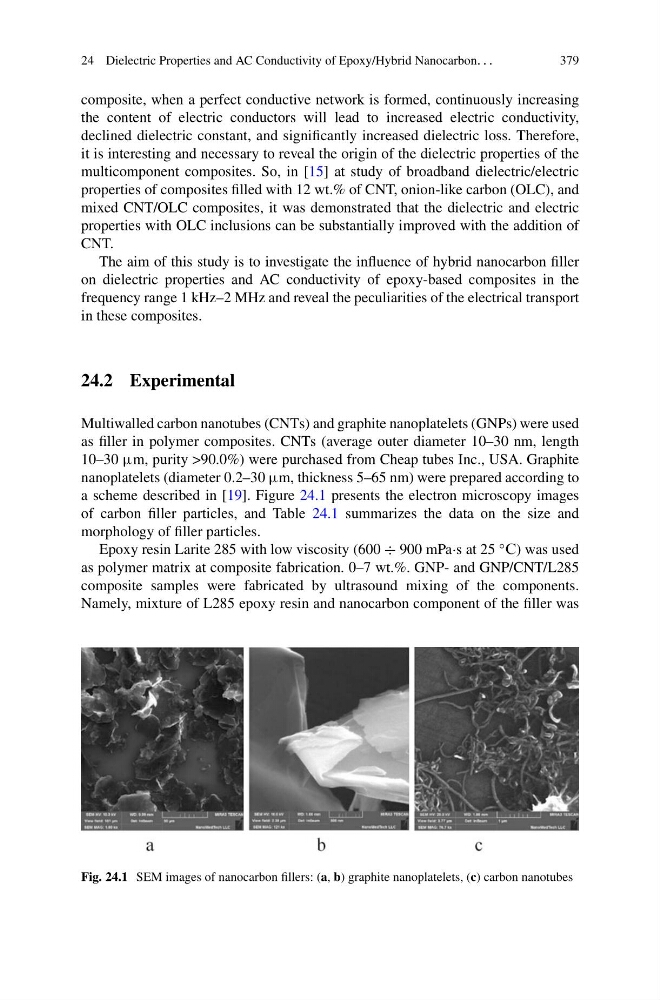
a scheme described in [19]. Figure 24.1 presents the electron microscopy images
of carbon filler particles, and Table 24.1 summarizes the data on the size and
morphology of filler particles.
Epoxy resin Larite 285 with low viscosity (600 ÷ 900 mPa·s at 25 ◦ ´) was used
as polymer matrix at composite fabrication. 0–7 wt.%. GNP- and GNP/CNT/L285
composite samples were fabricated by ultrasound mixing of the components.
Namely, mixture of L285 epoxy resin and nanocarbon component of the filler was
Fig. 24.1 SEM images of nanocarbon fillers: (a, b) graphite nanoplatelets, (c) carbon nanotubes
379
composite, when a perfect conductive network is formed, continuously increasing
the content of electric conductors will lead to increased electric conductivity,
declined dielectric constant, and significantly increased dielectric loss. Therefore,
it is interesting and necessary to reveal the origin of the dielectric properties of the
multicomponent composites. So, in [15] at study of broadband dielectric/electric
properties of composites filled with 12 wt.% of CNT, onion-like carbon (OLC), and
mixed CNT/OLC composites, it was demonstrated that the dielectric and electric
properties with OLC inclusions can be substantially improved with the addition of
CNT.
The aim of this study is to investigate the influence of hybrid nanocarbon filler
on dielectric properties and AC conductivity of epoxy-based composites in the
frequency range 1 kHz–2 MHz and reveal the peculiarities of the electrical transport
in these composites.
24.2 Experimental
Multiwalled carbon nanotubes (CNTs) and graphite nanoplatelets (GNPs) were used
as filler in polymer composites. CNTs (average outer diameter 10–30 nm, length
10–30 μm, purity >90.0%) were purchased from Cheap tubes Inc., USA. Graphite
nanoplatelets (diameter 0.2–30 μm, thickness 5–65 nm) were prepared according to
a scheme described in [19]. Figure 24.1 presents the electron microscopy images
of carbon filler particles, and Table 24.1 summarizes the data on the size and
morphology of filler particles.
Epoxy resin Larite 285 with low viscosity (600 ÷ 900 mPa·s at 25 ◦ ´) was used
as polymer matrix at composite fabrication. 0–7 wt.%. GNP- and GNP/CNT/L285
composite samples were fabricated by ultrasound mixing of the components.
Namely, mixture of L285 epoxy resin and nanocarbon component of the filler was
Fig. 24.1 SEM images of nanocarbon fillers: (a, b) graphite nanoplatelets, (c) carbon nanotubes