

346
A. Stetsko
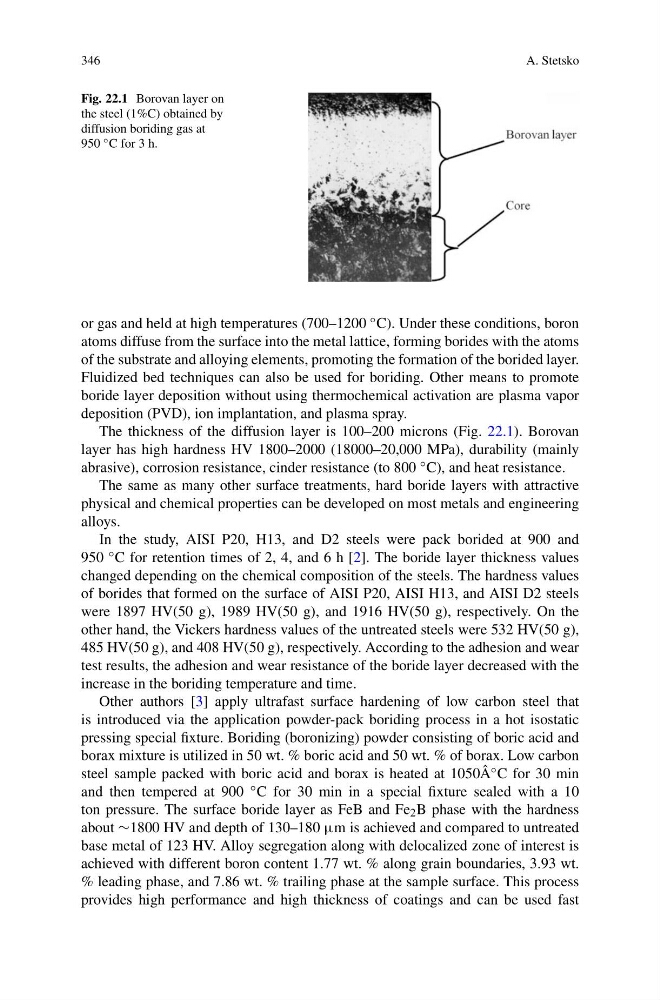
Fig. 22.1 Borovan layer on
the steel (1%C) obtained by
diffusion boriding gas at
950 ◦ C for 3 h.
or gas and held at high temperatures (700–1200 ◦ C). Under these conditions, boron
atoms diffuse from the surface into the metal lattice, forming borides with the atoms
of the substrate and alloying elements, promoting the formation of the borided layer.
Fluidized bed techniques can also be used for boriding. Other means to promote
boride layer deposition without using thermochemical activation are plasma vapor
deposition (PVD), ion implantation, and plasma spray.
The thickness of the diffusion layer is 100–200 microns (Fig. 22.1). Borovan
layer has high hardness HV 1800–2000 (18000–20,000 MPa), durability (mainly
abrasive), corrosion resistance, cinder resistance (to 800 ◦ C), and heat resistance.
The same as many other surface treatments, hard boride layers with attractive
physical and chemical properties can be developed on most metals and engineering
alloys.
In the study, AISI P20, H13, and D2 steels were pack borided at 900 and
950 ◦ C for retention times of 2, 4, and 6 h [2]. The boride layer thickness values
changed depending on the chemical composition of the steels. The hardness values
of borides that formed on the surface of AISI P20, AISI H13, and AISI D2 steels
were 1897 HV(50 g), 1989 HV(50 g), and 1916 HV(50 g), respectively. On the
other hand, the Vickers hardness values of the untreated steels were 532 HV(50 g),
485 HV(50 g), and 408 HV(50 g), respectively. According to the adhesion and wear
test results, the adhesion and wear resistance of the boride layer decreased with the
increase in the boriding temperature and time.
Other authors [3] apply ultrafast surface hardening of low carbon steel that
is introduced via the application powder-pack boriding process in a hot isostatic
pressing special fixture. Boriding (boronizing) powder consisting of boric acid and
borax mixture is utilized in 50 wt. % boric acid and 50 wt. % of borax. Low carbon
steel sample packed with boric acid and borax is heated at 1050Â ◦ C for 30 min
and then tempered at 900 ◦ C for 30 min in a special fixture sealed with a 10
ton pressure. The surface boride layer as FeB and Fe 2 B phase with the hardness
about ∼1800 HV and depth of 130–180 μm is achieved and compared to untreated
base metal of 123 HV. Alloy segregation along with delocalized zone of interest is
achieved with different boron content 1.77 wt. % along grain boundaries, 3.93 wt.
% leading phase, and 7.86 wt. % trailing phase at the sample surface. This process
provides high performance and high thickness of coatings and can be used fast
A. Stetsko
Fig. 22.1 Borovan layer on
the steel (1%C) obtained by
diffusion boriding gas at
950 ◦ C for 3 h.
or gas and held at high temperatures (700–1200 ◦ C). Under these conditions, boron
atoms diffuse from the surface into the metal lattice, forming borides with the atoms
of the substrate and alloying elements, promoting the formation of the borided layer.
Fluidized bed techniques can also be used for boriding. Other means to promote
boride layer deposition without using thermochemical activation are plasma vapor
deposition (PVD), ion implantation, and plasma spray.
The thickness of the diffusion layer is 100–200 microns (Fig. 22.1). Borovan
layer has high hardness HV 1800–2000 (18000–20,000 MPa), durability (mainly
abrasive), corrosion resistance, cinder resistance (to 800 ◦ C), and heat resistance.
The same as many other surface treatments, hard boride layers with attractive
physical and chemical properties can be developed on most metals and engineering
alloys.
In the study, AISI P20, H13, and D2 steels were pack borided at 900 and
950 ◦ C for retention times of 2, 4, and 6 h [2]. The boride layer thickness values
changed depending on the chemical composition of the steels. The hardness values
of borides that formed on the surface of AISI P20, AISI H13, and AISI D2 steels
were 1897 HV(50 g), 1989 HV(50 g), and 1916 HV(50 g), respectively. On the
other hand, the Vickers hardness values of the untreated steels were 532 HV(50 g),
485 HV(50 g), and 408 HV(50 g), respectively. According to the adhesion and wear
test results, the adhesion and wear resistance of the boride layer decreased with the
increase in the boriding temperature and time.
Other authors [3] apply ultrafast surface hardening of low carbon steel that
is introduced via the application powder-pack boriding process in a hot isostatic
pressing special fixture. Boriding (boronizing) powder consisting of boric acid and
borax mixture is utilized in 50 wt. % boric acid and 50 wt. % of borax. Low carbon
steel sample packed with boric acid and borax is heated at 1050Â ◦ C for 30 min
and then tempered at 900 ◦ C for 30 min in a special fixture sealed with a 10
ton pressure. The surface boride layer as FeB and Fe 2 B phase with the hardness
about ∼1800 HV and depth of 130–180 μm is achieved and compared to untreated
base metal of 123 HV. Alloy segregation along with delocalized zone of interest is
achieved with different boron content 1.77 wt. % along grain boundaries, 3.93 wt.
% leading phase, and 7.86 wt. % trailing phase at the sample surface. This process
provides high performance and high thickness of coatings and can be used fast