

21 Nonlinear Optical Properties of Polymer Nanocomposites. . .
335
up great possibilities for varying the composition of nanocomposite. The rare earthdoped borate nanocrystallites embedded in polyvinyl alcohol polymer matrices with
Ag NPs [35], polydiacetylene–silver nanocomposite [36], and liquid crystalline
elastomer nanocomposite with embedded Ag NPs [37] can serve as examples. The
introduction of Ag NPs in azobenzene polymer film does not only significantly
enhance the nonlinear response of the composite but also increases the reorientation
rate of azo polymer [38].
The distribution of Ag NPs in the matrix was random in all the abovementioned
nanocomposites. In our work we investigated the influence of Ag NPs ordering in
a polymer matrix on the nonlinear properties of a nanocomposite. We used the
photopolymer composite developed by us, which allows producing periodic Ag
NPs–polymer structures by holographic lithography method. The nonlinear optical
properties of the random and ordered structures were measured by the Z-scan
method using radiation with a wavelength (λ ex ) of 532 nm and a pulse duration
(τ) of 20 ns, as well as radiation with λ ex = 800 nm and τ = 180 fs.
21.2 Experimental Details
Nonlinear optical characteristics of the composites were measured by Z-scan
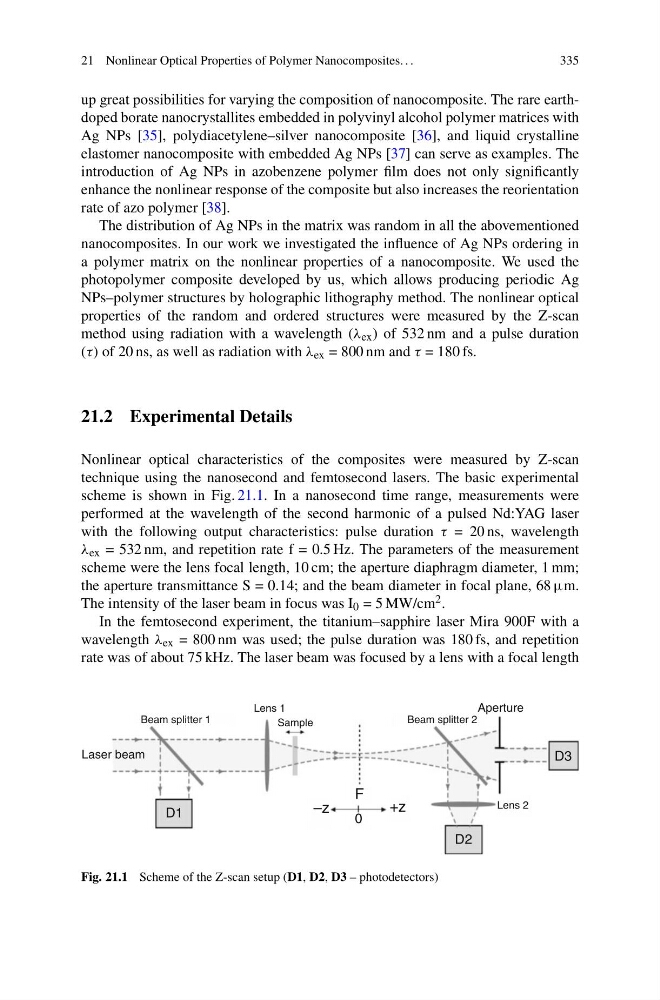
technique using the nanosecond and femtosecond lasers. The basic experimental
scheme is shown in Fig. 21.1. In a nanosecond time range, measurements were
performed at the wavelength of the second harmonic of a pulsed Nd:YAG laser
with the following output characteristics: pulse duration τ = 20 ns, wavelength
λ ex = 532 nm, and repetition rate f = 0.5 Hz. The parameters of the measurement
scheme were the lens focal length, 10 cm; the aperture diaphragm diameter, 1 mm;
the aperture transmittance S = 0.14; and the beam diameter in focal plane, 68 μm.
The intensity of the laser beam in focus was I 0 = 5 MW/cm 2 .
In the femtosecond experiment, the titanium–sapphire laser Mira 900F with a
wavelength λ ex = 800 nm was used; the pulse duration was 180 fs, and repetition
rate was of about 75 kHz. The laser beam was focused by a lens with a focal length
Laser beam
Beam splitter 1
Beam splitter 2
Lens 1
Lens 2
Aperture
Sample
D1
D2
0
F
+z
–z
D3
Fig. 21.1 Scheme of the Z-scan setup (D1, D2, D3 – photodetectors)
335
up great possibilities for varying the composition of nanocomposite. The rare earthdoped borate nanocrystallites embedded in polyvinyl alcohol polymer matrices with
Ag NPs [35], polydiacetylene–silver nanocomposite [36], and liquid crystalline
elastomer nanocomposite with embedded Ag NPs [37] can serve as examples. The
introduction of Ag NPs in azobenzene polymer film does not only significantly
enhance the nonlinear response of the composite but also increases the reorientation
rate of azo polymer [38].
The distribution of Ag NPs in the matrix was random in all the abovementioned
nanocomposites. In our work we investigated the influence of Ag NPs ordering in
a polymer matrix on the nonlinear properties of a nanocomposite. We used the
photopolymer composite developed by us, which allows producing periodic Ag
NPs–polymer structures by holographic lithography method. The nonlinear optical
properties of the random and ordered structures were measured by the Z-scan
method using radiation with a wavelength (λ ex ) of 532 nm and a pulse duration
(τ) of 20 ns, as well as radiation with λ ex = 800 nm and τ = 180 fs.
21.2 Experimental Details
Nonlinear optical characteristics of the composites were measured by Z-scan
technique using the nanosecond and femtosecond lasers. The basic experimental
scheme is shown in Fig. 21.1. In a nanosecond time range, measurements were
performed at the wavelength of the second harmonic of a pulsed Nd:YAG laser
with the following output characteristics: pulse duration τ = 20 ns, wavelength
λ ex = 532 nm, and repetition rate f = 0.5 Hz. The parameters of the measurement
scheme were the lens focal length, 10 cm; the aperture diaphragm diameter, 1 mm;
the aperture transmittance S = 0.14; and the beam diameter in focal plane, 68 μm.
The intensity of the laser beam in focus was I 0 = 5 MW/cm 2 .
In the femtosecond experiment, the titanium–sapphire laser Mira 900F with a
wavelength λ ex = 800 nm was used; the pulse duration was 180 fs, and repetition
rate was of about 75 kHz. The laser beam was focused by a lens with a focal length
Laser beam
Beam splitter 1
Beam splitter 2
Lens 1
Lens 2
Aperture
Sample
D1
D2
0
F
+z
–z
D3
Fig. 21.1 Scheme of the Z-scan setup (D1, D2, D3 – photodetectors)