

19 High-Temperature Electrochemical Synthesis of Nanopowders. . .
313
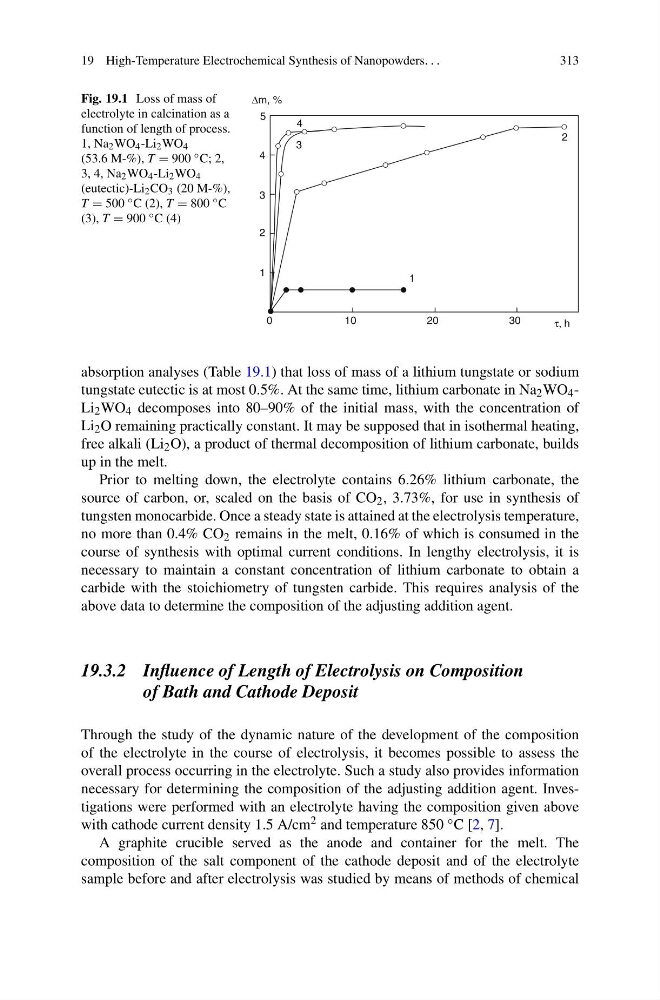
Fig. 19.1 Loss of mass of
electrolyte in calcination as a
function of length of process.
1, Na 2 WO 4 -Li 2 WO 4
(53.6 M-%), T = 900 ◦ C; 2,
3, 4, Na 2 WO 4 -Li 2 WO 4
(eutectic)-Li 2 CO 3 (20 M-%),
T = 500 ◦ C (2), T = 800 ◦ C
(3), T = 900 ◦ C (4)
5
4
3
4
3
2
1
0
1 0
2 0
3 0
2
τ, h
Δm, %
1
absorption analyses (Table 19.1) that loss of mass of a lithium tungstate or sodium
tungstate eutectic is at most 0.5%. At the same time, lithium carbonate in Na 2 WO 4 -
Li 2 WO 4 decomposes into 80–90% of the initial mass, with the concentration of
Li 2 O remaining practically constant. It may be supposed that in isothermal heating,
free alkali (Li 2 O), a product of thermal decomposition of lithium carbonate, builds
up in the melt.
Prior to melting down, the electrolyte contains 6.26% lithium carbonate, the
source of carbon, or, scaled on the basis of CO 2 , 3.73%, for use in synthesis of
tungsten monocarbide. Once a steady state is attained at the electrolysis temperature,
no more than 0.4% CO 2 remains in the melt, 0.16% of which is consumed in the
course of synthesis with optimal current conditions. In lengthy electrolysis, it is
necessary to maintain a constant concentration of lithium carbonate to obtain a
carbide with the stoichiometry of tungsten carbide. This requires analysis of the
above data to determine the composition of the adjusting addition agent.
19.3.2 Influence of Length of Electrolysis on Composition
of Bath and Cathode Deposit
Through the study of the dynamic nature of the development of the composition
of the electrolyte in the course of electrolysis, it becomes possible to assess the
overall process occurring in the electrolyte. Such a study also provides information
necessary for determining the composition of the adjusting addition agent. Investigations were performed with an electrolyte having the composition given above
with cathode current density 1.5 A/cm 2 and temperature 850 ◦ C [2, 7].
A graphite crucible served as the anode and container for the melt. The
composition of the salt component of the cathode deposit and of the electrolyte
sample before and after electrolysis was studied by means of methods of chemical
313
Fig. 19.1 Loss of mass of
electrolyte in calcination as a
function of length of process.
1, Na 2 WO 4 -Li 2 WO 4
(53.6 M-%), T = 900 ◦ C; 2,
3, 4, Na 2 WO 4 -Li 2 WO 4
(eutectic)-Li 2 CO 3 (20 M-%),
T = 500 ◦ C (2), T = 800 ◦ C
(3), T = 900 ◦ C (4)
5
4
3
4
3
2
1
0
1 0
2 0
3 0
2
τ, h
Δm, %
1
absorption analyses (Table 19.1) that loss of mass of a lithium tungstate or sodium
tungstate eutectic is at most 0.5%. At the same time, lithium carbonate in Na 2 WO 4 -
Li 2 WO 4 decomposes into 80–90% of the initial mass, with the concentration of
Li 2 O remaining practically constant. It may be supposed that in isothermal heating,
free alkali (Li 2 O), a product of thermal decomposition of lithium carbonate, builds
up in the melt.
Prior to melting down, the electrolyte contains 6.26% lithium carbonate, the
source of carbon, or, scaled on the basis of CO 2 , 3.73%, for use in synthesis of
tungsten monocarbide. Once a steady state is attained at the electrolysis temperature,
no more than 0.4% CO 2 remains in the melt, 0.16% of which is consumed in the
course of synthesis with optimal current conditions. In lengthy electrolysis, it is
necessary to maintain a constant concentration of lithium carbonate to obtain a
carbide with the stoichiometry of tungsten carbide. This requires analysis of the
above data to determine the composition of the adjusting addition agent.
19.3.2 Influence of Length of Electrolysis on Composition
of Bath and Cathode Deposit
Through the study of the dynamic nature of the development of the composition
of the electrolyte in the course of electrolysis, it becomes possible to assess the
overall process occurring in the electrolyte. Such a study also provides information
necessary for determining the composition of the adjusting addition agent. Investigations were performed with an electrolyte having the composition given above
with cathode current density 1.5 A/cm 2 and temperature 850 ◦ C [2, 7].
A graphite crucible served as the anode and container for the melt. The
composition of the salt component of the cathode deposit and of the electrolyte
sample before and after electrolysis was studied by means of methods of chemical