

18 The Ultrasonic Treatment as a Promising Method of Nanosized Oxide. . .
299
where β represents the constant of FWHM, λ is the wavelength of the Cu Kα
radiation, K is the constant parameter connecter with crystal form and is 0.9, and
is the diffraction angle.
FT-IR spectra (4500–400 cm −1 ) of the prepared samples were recorded on
a “Spectrum-One” (Perkin-Elmer Instruments) spectrometer to use powder KBr
(mass ratio sample/KBr = 1:20). EPR spectra were obtained on a Bruker Elexsys
E580 FT/C at room temperature at a frequency of 9.2–9.9 GHz. Nitrogen physisorption experiments were carried out in a NOVA-2200 Gas Sorption Analyzer by
Quantachrome. The measurement was performed at the boiling point of liquid
N 2 (77 K). The surface area was calculated according to the BET equation.
Scanning electron microscopy was performed to use of Jeol JSM-6490 instrument
in conjunction with an energy-dispersive spectrometer after deposition on a gold
monolayer. TEM images were obtained with JEM-1230 (JEOL) high-resolution
transmission electron microscope with an 80 kV accelerating voltage. Catalytic
activity of the samples in the ethanol oxidation was tested in a flow fixed-bed
stainless microreactor at atmospheric pressure in the temperature range of 25–
300 ◦ C. The catalyst (V = 0.5 cm 3 with fraction 0.25–0.50 mm) was loaded into
a reactor. Gas mixture containing 1 vol % C 2 H 5 OH in air was passed through the
reactor at a total flow rate of 20 cm 3 /min. Initial components and reaction products
have been analyzed by online gas chromatography, with flame ionization (FID) and
thermal conductivity detectors (TCD). The reaction of ethanol partial oxidation to
acetaldehyde occurs to the equation:
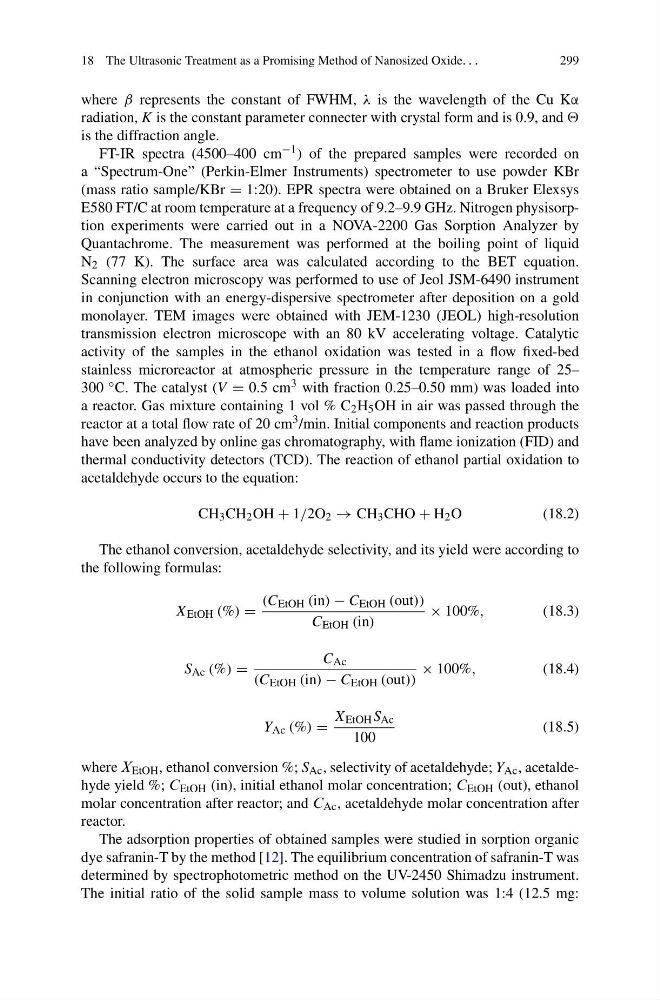
CH 3 CH 2 OH + 1/2O 2 → CH 3 CHO + H 2 O
(18.2)
The ethanol conversion, acetaldehyde selectivity, and its yield were according to
the following formulas:
X EtOH (%) =
(C EtOH (in) − C EtOH (out))
C EtOH (in)
× 100%,
(18.3)
S Ac (%) =
C Ac
(C EtOH (in) − C EtOH (out))
× 100%,
(18.4)
Y Ac (%) =
X EtOH S Ac
100
(18.5)
where ¸ EtOH , ethanol conversion %; S Ac , selectivity of acetaldehyde; Y Ac , acetaldehyde yield %; ´ EtOH (in), initial ethanol molar concentration; ´ EtOH (out), ethanol
molar concentration after reactor; and ´ Ac , acetaldehyde molar concentration after
reactor.
The adsorption properties of obtained samples were studied in sorption organic
dye safranin-T by the method [12]. The equilibrium concentration of safranin-T was
determined by spectrophotometric method on the UV-2450 Shimadzu instrument.
The initial ratio of the solid sample mass to volume solution was 1:4 (12.5 mg:
299
where β represents the constant of FWHM, λ is the wavelength of the Cu Kα
radiation, K is the constant parameter connecter with crystal form and is 0.9, and
is the diffraction angle.
FT-IR spectra (4500–400 cm −1 ) of the prepared samples were recorded on
a “Spectrum-One” (Perkin-Elmer Instruments) spectrometer to use powder KBr
(mass ratio sample/KBr = 1:20). EPR spectra were obtained on a Bruker Elexsys
E580 FT/C at room temperature at a frequency of 9.2–9.9 GHz. Nitrogen physisorption experiments were carried out in a NOVA-2200 Gas Sorption Analyzer by
Quantachrome. The measurement was performed at the boiling point of liquid
N 2 (77 K). The surface area was calculated according to the BET equation.
Scanning electron microscopy was performed to use of Jeol JSM-6490 instrument
in conjunction with an energy-dispersive spectrometer after deposition on a gold
monolayer. TEM images were obtained with JEM-1230 (JEOL) high-resolution
transmission electron microscope with an 80 kV accelerating voltage. Catalytic
activity of the samples in the ethanol oxidation was tested in a flow fixed-bed
stainless microreactor at atmospheric pressure in the temperature range of 25–
300 ◦ C. The catalyst (V = 0.5 cm 3 with fraction 0.25–0.50 mm) was loaded into
a reactor. Gas mixture containing 1 vol % C 2 H 5 OH in air was passed through the
reactor at a total flow rate of 20 cm 3 /min. Initial components and reaction products
have been analyzed by online gas chromatography, with flame ionization (FID) and
thermal conductivity detectors (TCD). The reaction of ethanol partial oxidation to
acetaldehyde occurs to the equation:
CH 3 CH 2 OH + 1/2O 2 → CH 3 CHO + H 2 O
(18.2)
The ethanol conversion, acetaldehyde selectivity, and its yield were according to
the following formulas:
X EtOH (%) =
(C EtOH (in) − C EtOH (out))
C EtOH (in)
× 100%,
(18.3)
S Ac (%) =
C Ac
(C EtOH (in) − C EtOH (out))
× 100%,
(18.4)
Y Ac (%) =
X EtOH S Ac
100
(18.5)
where ¸ EtOH , ethanol conversion %; S Ac , selectivity of acetaldehyde; Y Ac , acetaldehyde yield %; ´ EtOH (in), initial ethanol molar concentration; ´ EtOH (out), ethanol
molar concentration after reactor; and ´ Ac , acetaldehyde molar concentration after
reactor.
The adsorption properties of obtained samples were studied in sorption organic
dye safranin-T by the method [12]. The equilibrium concentration of safranin-T was
determined by spectrophotometric method on the UV-2450 Shimadzu instrument.
The initial ratio of the solid sample mass to volume solution was 1:4 (12.5 mg: