

270
S. G. Nedilko
450
500
550
600
650
700
0,0
0,5
1,0
2
1
b
a
c
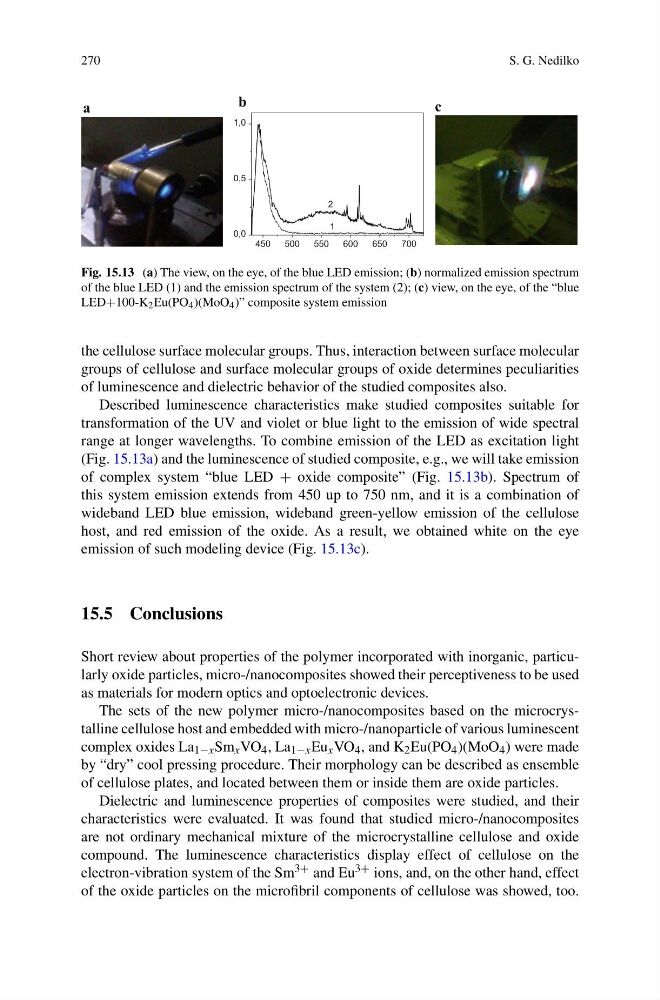
Fig. 15.13 (a) The view, on the eye, of the blue LED emission; (b) normalized emission spectrum
of the blue LED (1) and the emission spectrum of the system (2); (c) view, on the eye, of the “blue
LED+100-K 2 Eu(PO 4 )(MoO 4 )” composite system emission
the cellulose surface molecular groups. Thus, interaction between surface molecular
groups of cellulose and surface molecular groups of oxide determines peculiarities
of luminescence and dielectric behavior of the studied composites also.
Described luminescence characteristics make studied composites suitable for
transformation of the UV and violet or blue light to the emission of wide spectral
range at longer wavelengths. To combine emission of the LED as excitation light
(Fig. 15.13a) and the luminescence of studied composite, e.g., we will take emission
of complex system “blue LED + oxide composite” (Fig. 15.13b). Spectrum of
this system emission extends from 450 up to 750 nm, and it is a combination of
wideband LED blue emission, wideband green-yellow emission of the cellulose
host, and red emission of the oxide. As a result, we obtained white on the eye
emission of such modeling device (Fig. 15.13c).
15.5 Conclusions
Short review about properties of the polymer incorporated with inorganic, particularly oxide particles, micro-/nanocomposites showed their perceptiveness to be used
as materials for modern optics and optoelectronic devices.
The sets of the new polymer micro-/nanocomposites based on the microcrystalline cellulose host and embedded with micro-/nanoparticle of various luminescent
complex oxides La 1−x Sm x VO 4 , La 1−x Eu x VO 4 , and K 2 Eu(PO 4 )(MoO 4 ) were made
by “dry” cool pressing procedure. Their morphology can be described as ensemble
of cellulose plates, and located between them or inside them are oxide particles.
Dielectric and luminescence properties of composites were studied, and their
characteristics were evaluated. It was found that studied micro-/nanocomposites
are not ordinary mechanical mixture of the microcrystalline cellulose and oxide
compound. The luminescence characteristics display effect of cellulose on the
electron-vibration system of the Sm 3+ and Eu 3+ ions, and, on the other hand, effect
of the oxide particles on the microfibril components of cellulose was showed, too.
S. G. Nedilko
450
500
550
600
650
700
0,0
0,5
1,0
2
1
b
a
c
Fig. 15.13 (a) The view, on the eye, of the blue LED emission; (b) normalized emission spectrum
of the blue LED (1) and the emission spectrum of the system (2); (c) view, on the eye, of the “blue
LED+100-K 2 Eu(PO 4 )(MoO 4 )” composite system emission
the cellulose surface molecular groups. Thus, interaction between surface molecular
groups of cellulose and surface molecular groups of oxide determines peculiarities
of luminescence and dielectric behavior of the studied composites also.
Described luminescence characteristics make studied composites suitable for
transformation of the UV and violet or blue light to the emission of wide spectral
range at longer wavelengths. To combine emission of the LED as excitation light
(Fig. 15.13a) and the luminescence of studied composite, e.g., we will take emission
of complex system “blue LED + oxide composite” (Fig. 15.13b). Spectrum of
this system emission extends from 450 up to 750 nm, and it is a combination of
wideband LED blue emission, wideband green-yellow emission of the cellulose
host, and red emission of the oxide. As a result, we obtained white on the eye
emission of such modeling device (Fig. 15.13c).
15.5 Conclusions
Short review about properties of the polymer incorporated with inorganic, particularly oxide particles, micro-/nanocomposites showed their perceptiveness to be used
as materials for modern optics and optoelectronic devices.
The sets of the new polymer micro-/nanocomposites based on the microcrystalline cellulose host and embedded with micro-/nanoparticle of various luminescent
complex oxides La 1−x Sm x VO 4 , La 1−x Eu x VO 4 , and K 2 Eu(PO 4 )(MoO 4 ) were made
by “dry” cool pressing procedure. Their morphology can be described as ensemble
of cellulose plates, and located between them or inside them are oxide particles.
Dielectric and luminescence properties of composites were studied, and their
characteristics were evaluated. It was found that studied micro-/nanocomposites
are not ordinary mechanical mixture of the microcrystalline cellulose and oxide
compound. The luminescence characteristics display effect of cellulose on the
electron-vibration system of the Sm 3+ and Eu 3+ ions, and, on the other hand, effect
of the oxide particles on the microfibril components of cellulose was showed, too.