

250
S. G. Nedilko
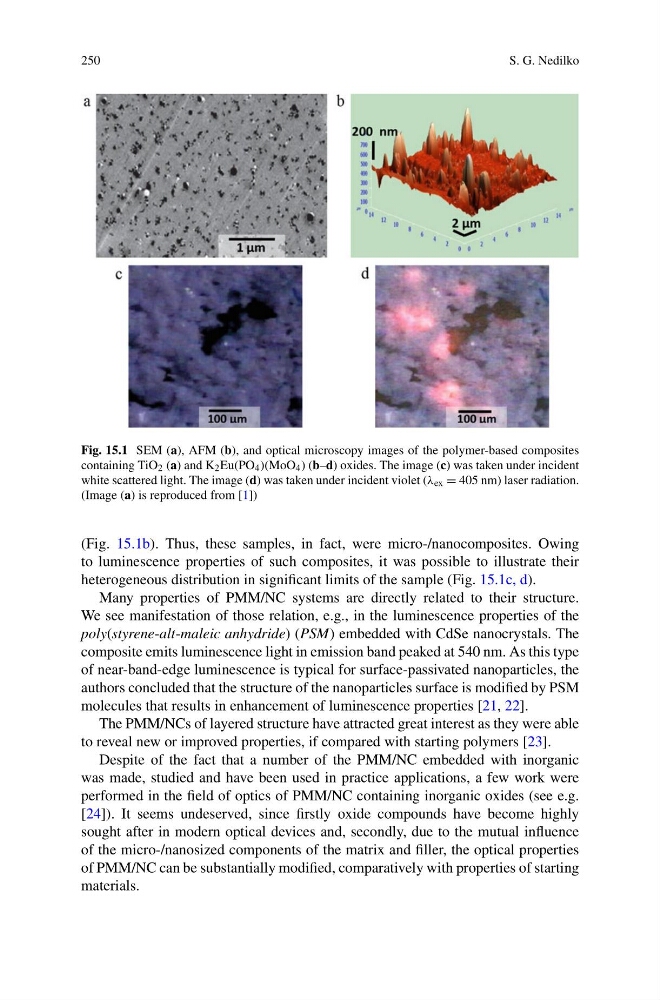
Fig. 15.1 SEM (a), AFM (b), and optical microscopy images of the polymer-based composites
containing TiO 2 (a) and K 2 Eu(PO 4 )(MoO 4 ) (b–d) oxides. The image (c) was taken under incident
white scattered light. The image (d) was taken under incident violet (λ ex = 405 nm) laser radiation.
(Image (a) is reproduced from [1])
(Fig. 15.1b). Thus, these samples, in fact, were micro-/nanocomposites. Owing
to luminescence properties of such composites, it was possible to illustrate their
heterogeneous distribution in significant limits of the sample (Fig. 15.1c, d).
Many properties of PMM/NC systems are directly related to their structure.
We see manifestation of those relation, e.g., in the luminescence properties of the
poly(styrene-alt-maleic anhydride) (PSM) embedded with CdSe nanocrystals. The
composite emits luminescence light in emission band peaked at 540 nm. As this type
of near-band-edge luminescence is typical for surface-passivated nanoparticles, the
authors concluded that the structure of the nanoparticles surface is modified by PSM
molecules that results in enhancement of luminescence properties [21, 22].
The PMM/NCs of layered structure have attracted great interest as they were able
to reveal new or improved properties, if compared with starting polymers [23].
Despite of the fact that a number of the PMM/NC embedded with inorganic
was made, studied and have been used in practice applications, a few work were
performed in the field of optics of PMM/NC containing inorganic oxides (see e.g.
[24]). It seems undeserved, since firstly oxide compounds have become highly
sought after in modern optical devices and, secondly, due to the mutual influence
of the micro-/nanosized components of the matrix and filler, the optical properties
of PMM/NC can be substantially modified, comparatively with properties of starting
materials.
S. G. Nedilko
Fig. 15.1 SEM (a), AFM (b), and optical microscopy images of the polymer-based composites
containing TiO 2 (a) and K 2 Eu(PO 4 )(MoO 4 ) (b–d) oxides. The image (c) was taken under incident
white scattered light. The image (d) was taken under incident violet (λ ex = 405 nm) laser radiation.
(Image (a) is reproduced from [1])
(Fig. 15.1b). Thus, these samples, in fact, were micro-/nanocomposites. Owing
to luminescence properties of such composites, it was possible to illustrate their
heterogeneous distribution in significant limits of the sample (Fig. 15.1c, d).
Many properties of PMM/NC systems are directly related to their structure.
We see manifestation of those relation, e.g., in the luminescence properties of the
poly(styrene-alt-maleic anhydride) (PSM) embedded with CdSe nanocrystals. The
composite emits luminescence light in emission band peaked at 540 nm. As this type
of near-band-edge luminescence is typical for surface-passivated nanoparticles, the
authors concluded that the structure of the nanoparticles surface is modified by PSM
molecules that results in enhancement of luminescence properties [21, 22].
The PMM/NCs of layered structure have attracted great interest as they were able
to reveal new or improved properties, if compared with starting polymers [23].
Despite of the fact that a number of the PMM/NC embedded with inorganic
was made, studied and have been used in practice applications, a few work were
performed in the field of optics of PMM/NC containing inorganic oxides (see e.g.
[24]). It seems undeserved, since firstly oxide compounds have become highly
sought after in modern optical devices and, secondly, due to the mutual influence
of the micro-/nanosized components of the matrix and filler, the optical properties
of PMM/NC can be substantially modified, comparatively with properties of starting
materials.