

13 Nanostructural and Nanochemical Processes in Peloid Sediments Aided. . .
227
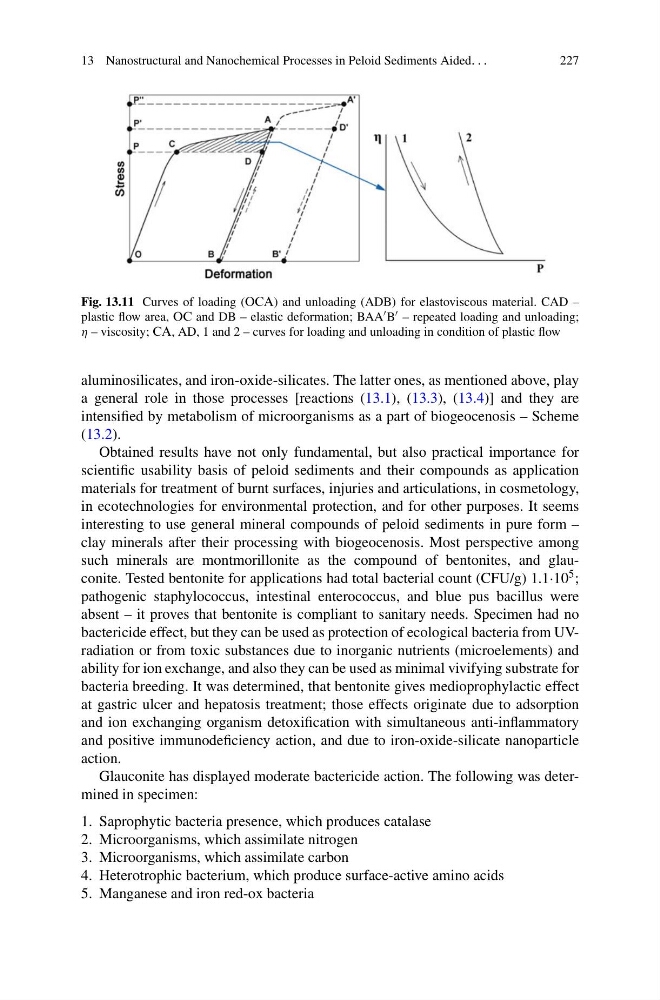
Fig. 13.11 Curves of loading (±´£) and unloading (ADB) for elastoviscous material. CAD –
plastic flow area, ±´ and DB – elastic deformation; BAA B – repeated loading and unloading;
η – viscosity; ´£, AD, 1 and 2 – curves for loading and unloading in condition of plastic flow
aluminosilicates, and iron-oxide-silicates. The latter ones, as mentioned above, play
a general role in those processes [reactions (13.1), (13.3), (13.4)] and they are
intensified by metabolism of microorganisms as a part of biogeocenosis – Scheme
(13.2).
Obtained results have not only fundamental, but also practical importance for
scientific usability basis of peloid sediments and their compounds as application
materials for treatment of burnt surfaces, injuries and articulations, in cosmetology,
in ecotechnologies for environmental protection, and for other purposes. It seems
interesting to use general mineral compounds of peloid sediments in pure form –
clay minerals after their processing with biogeocenosis. Most perspective among
such minerals are montmorillonite as the compound of bentonites, and glauconite. Tested bentonite for applications had total bacterial count (CFU/g) 1.1·10 5 ;
pathogenic staphylococcus, intestinal enterococcus, and blue pus bacillus were
absent – it proves that bentonite is compliant to sanitary needs. Specimen had no
bactericide effect, but they can be used as protection of ecological bacteria from UVradiation or from toxic substances due to inorganic nutrients (microelements) and
ability for ion exchange, and also they can be used as minimal vivifying substrate for
bacteria breeding. It was determined, that bentonite gives medioprophylactic effect
at gastric ulcer and hepatosis treatment; those effects originate due to adsorption
and ion exchanging organism detoxification with simultaneous anti-inflammatory
and positive immunodeficiency action, and due to iron-oxide-silicate nanoparticle
action.
Glauconite has displayed moderate bactericide action. The following was determined in specimen:
1. Saprophytic bacteria presence, which produces catalase
2. Microorganisms, which assimilate nitrogen
3. Microorganisms, which assimilate carbon
4. Heterotrophic bacterium, which produce surface-active amino acids
5. Manganese and iron red-ox bacteria
227
Fig. 13.11 Curves of loading (±´£) and unloading (ADB) for elastoviscous material. CAD –
plastic flow area, ±´ and DB – elastic deformation; BAA B – repeated loading and unloading;
η – viscosity; ´£, AD, 1 and 2 – curves for loading and unloading in condition of plastic flow
aluminosilicates, and iron-oxide-silicates. The latter ones, as mentioned above, play
a general role in those processes [reactions (13.1), (13.3), (13.4)] and they are
intensified by metabolism of microorganisms as a part of biogeocenosis – Scheme
(13.2).
Obtained results have not only fundamental, but also practical importance for
scientific usability basis of peloid sediments and their compounds as application
materials for treatment of burnt surfaces, injuries and articulations, in cosmetology,
in ecotechnologies for environmental protection, and for other purposes. It seems
interesting to use general mineral compounds of peloid sediments in pure form –
clay minerals after their processing with biogeocenosis. Most perspective among
such minerals are montmorillonite as the compound of bentonites, and glauconite. Tested bentonite for applications had total bacterial count (CFU/g) 1.1·10 5 ;
pathogenic staphylococcus, intestinal enterococcus, and blue pus bacillus were
absent – it proves that bentonite is compliant to sanitary needs. Specimen had no
bactericide effect, but they can be used as protection of ecological bacteria from UVradiation or from toxic substances due to inorganic nutrients (microelements) and
ability for ion exchange, and also they can be used as minimal vivifying substrate for
bacteria breeding. It was determined, that bentonite gives medioprophylactic effect
at gastric ulcer and hepatosis treatment; those effects originate due to adsorption
and ion exchanging organism detoxification with simultaneous anti-inflammatory
and positive immunodeficiency action, and due to iron-oxide-silicate nanoparticle
action.
Glauconite has displayed moderate bactericide action. The following was determined in specimen:
1. Saprophytic bacteria presence, which produces catalase
2. Microorganisms, which assimilate nitrogen
3. Microorganisms, which assimilate carbon
4. Heterotrophic bacterium, which produce surface-active amino acids
5. Manganese and iron red-ox bacteria