

11 Structure and Electrical/Dielectric Properties of Ion-Conductive Polymer. . .
185
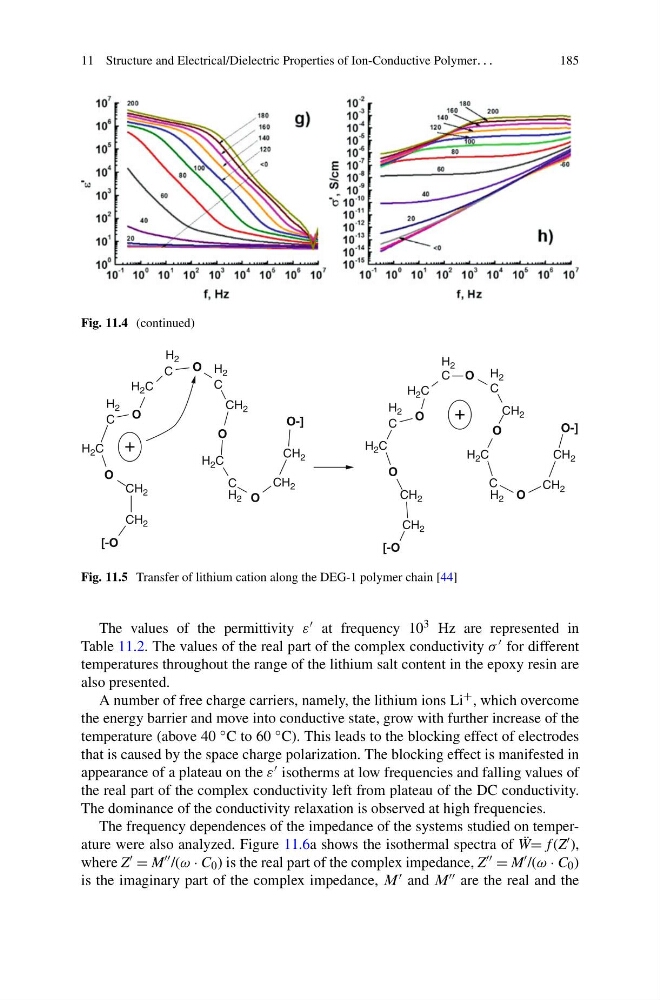
Fig. 11.4 (continued)
H 2
H 2
H 2
H 2
H 2
H 2
H 2
H 2 C
C
C
O
O
O
O
O
O
O
O
O
O
+
+
O-]
O-]
[-O
[-O
C
C
C
C
C
C
H 2 C
H 2 C
H 2 C
H 2 C
H 2 C
CH 2
CH 2
CH 2
CH 2
CH 2
CH 2
CH 2
CH 2
CH 2
CH 2
H 2
Fig. 11.5 Transfer of lithium cation along the DEG-1 polymer chain [44]
The values of the permittivity ε at frequency 10 3 Hz are represented in
Table 11.2. The values of the real part of the complex conductivity σ for different
temperatures throughout the range of the lithium salt content in the epoxy resin are
also presented.
A number of free charge carriers, namely, the lithium ions Li + , which overcome
the energy barrier and move into conductive state, grow with further increase of the
temperature (above 40 ◦ C to 60 ◦ C). This leads to the blocking effect of electrodes
that is caused by the space charge polarization. The blocking effect is manifested in
appearance of a plateau on the ε isotherms at low frequencies and falling values of
the real part of the complex conductivity left from plateau of the DC conductivity.
The dominance of the conductivity relaxation is observed at high frequencies.
The frequency dependences of the impedance of the systems studied on temperature were also analyzed. Figure 11.6a shows the isothermal spectra of ¨
W= f (Z ),
where Z = M /(ω · C 0 ) is the real part of the complex impedance, Z = M /(ω · C 0 )
is the imaginary part of the complex impedance, ¯ and ¯ are the real and the
185
Fig. 11.4 (continued)
H 2
H 2
H 2
H 2
H 2
H 2
H 2
H 2 C
C
C
O
O
O
O
O
O
O
O
O
O
+
+
O-]
O-]
[-O
[-O
C
C
C
C
C
C
H 2 C
H 2 C
H 2 C
H 2 C
H 2 C
CH 2
CH 2
CH 2
CH 2
CH 2
CH 2
CH 2
CH 2
CH 2
CH 2
H 2
Fig. 11.5 Transfer of lithium cation along the DEG-1 polymer chain [44]
The values of the permittivity ε at frequency 10 3 Hz are represented in
Table 11.2. The values of the real part of the complex conductivity σ for different
temperatures throughout the range of the lithium salt content in the epoxy resin are
also presented.
A number of free charge carriers, namely, the lithium ions Li + , which overcome
the energy barrier and move into conductive state, grow with further increase of the
temperature (above 40 ◦ C to 60 ◦ C). This leads to the blocking effect of electrodes
that is caused by the space charge polarization. The blocking effect is manifested in
appearance of a plateau on the ε isotherms at low frequencies and falling values of
the real part of the complex conductivity left from plateau of the DC conductivity.
The dominance of the conductivity relaxation is observed at high frequencies.
The frequency dependences of the impedance of the systems studied on temperature were also analyzed. Figure 11.6a shows the isothermal spectra of ¨
W= f (Z ),
where Z = M /(ω · C 0 ) is the real part of the complex impedance, Z = M /(ω · C 0 )
is the imaginary part of the complex impedance, ¯ and ¯ are the real and the