

11 Structure and Electrical/Dielectric Properties of Ion-Conductive Polymer. . .
179
High ionic conductivity can be achieved by increasing the salt concentration in
polymer [6]; however the authors [9] have shown that conductivity of the composites
based on PEO is limited by certain value of a salt concentration. At higher salt
concentration conductivity decreases because of formation of the ion complexes,
which, in turn, cause reduction of the ionic mobility and the number of charge
carriers [10].
For application as electrolytes, polymers should have certain properties, such as
amorphousness, the presence of ether oxygen in their structure, low glass transition
temperature, high dimensional stability, mechanical strength, and the ability to form
thin films [9, 18].
Thermosetting polymers such as epoxy resins are materials for extensive use
in the aerospace industry, in automobile and marine applications, and in microelectronics and food-packaging industries [24–26]. Properties of epoxy resins
depend on specific combination of the used type of epoxy resins and curing
agents [27]. Epoxy resins are important thermoset materials due to their excellent
thermomechanical, barrier, chemical, and electrical properties, low shrinkage upon
cure, and outstanding adhesion to various substrates [25, 26, 28–30]. They are
highly used as matrix in conducting polymer composites [29]. Versatility is one of
the strong features of epoxy polymers [25]. Molecular structure of epoxy resin can
be easily modified for various applications considering its versatile properties [31].
Polymer blending technique is a quick and economic alternative, which has been
widely used for obtaining materials with optimized properties and potentially can
offer easy control of physical properties by compositional change for a wide variety
of application prospects [32, 33]. Adding a more flexible aliphatic epoxy oligomer
while mixing allows changing of thermal and mechanical properties [34].
One of the suitable materials that satisfies these requirements is aliphatic epoxy
oligomer, namely, the diglycide aliphatic ester of polyethylene glycol (DEG-1).
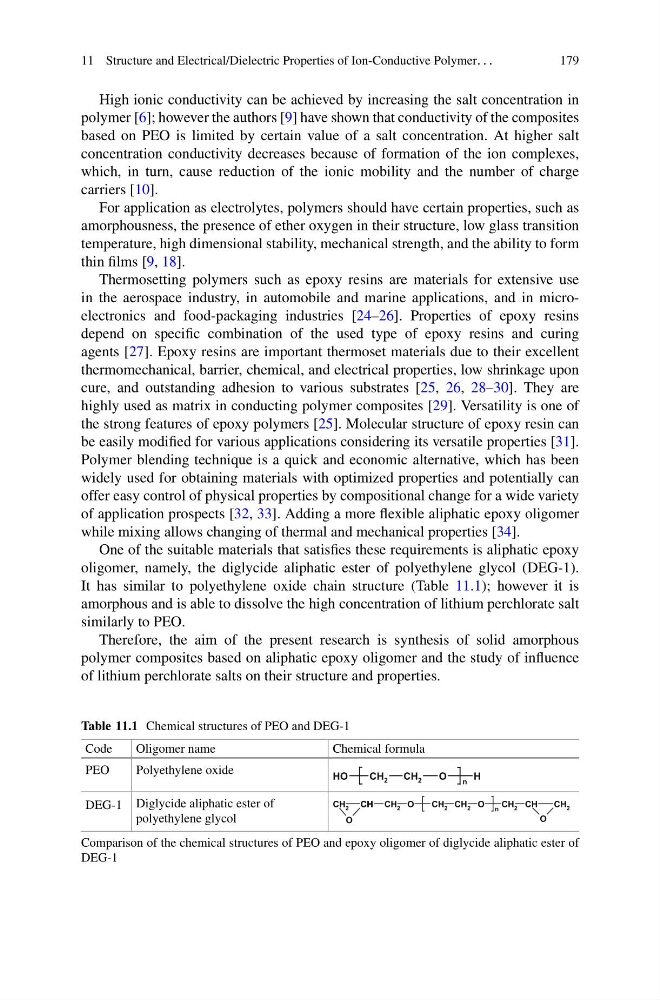
It has similar to polyethylene oxide chain structure (Table 11.1); however it is
amorphous and is able to dissolve the high concentration of lithium perchlorate salt
similarly to PEO.
Therefore, the aim of the present research is synthesis of solid amorphous
polymer composites based on aliphatic epoxy oligomer and the study of influence
of lithium perchlorate salts on their structure and properties.
Table 11.1 Chemical structures of PEO and DEG-1
Code
Oligomer name
Chemical formula
PEO
Polyethylene oxide
HO
CH 2
O
CH 2
n
H
DEG-1 Diglycide aliphatic ester of
polyethylene glycol
CH
O
O
CH 2
CH CH 2
CH 2
CH 2
O
CH
CH 2
O
CH 2
n
Comparison of the chemical structures of PEO and epoxy oligomer of diglycide aliphatic ester of
DEG-1
179
High ionic conductivity can be achieved by increasing the salt concentration in
polymer [6]; however the authors [9] have shown that conductivity of the composites
based on PEO is limited by certain value of a salt concentration. At higher salt
concentration conductivity decreases because of formation of the ion complexes,
which, in turn, cause reduction of the ionic mobility and the number of charge
carriers [10].
For application as electrolytes, polymers should have certain properties, such as
amorphousness, the presence of ether oxygen in their structure, low glass transition
temperature, high dimensional stability, mechanical strength, and the ability to form
thin films [9, 18].
Thermosetting polymers such as epoxy resins are materials for extensive use
in the aerospace industry, in automobile and marine applications, and in microelectronics and food-packaging industries [24–26]. Properties of epoxy resins
depend on specific combination of the used type of epoxy resins and curing
agents [27]. Epoxy resins are important thermoset materials due to their excellent
thermomechanical, barrier, chemical, and electrical properties, low shrinkage upon
cure, and outstanding adhesion to various substrates [25, 26, 28–30]. They are
highly used as matrix in conducting polymer composites [29]. Versatility is one of
the strong features of epoxy polymers [25]. Molecular structure of epoxy resin can
be easily modified for various applications considering its versatile properties [31].
Polymer blending technique is a quick and economic alternative, which has been
widely used for obtaining materials with optimized properties and potentially can
offer easy control of physical properties by compositional change for a wide variety
of application prospects [32, 33]. Adding a more flexible aliphatic epoxy oligomer
while mixing allows changing of thermal and mechanical properties [34].
One of the suitable materials that satisfies these requirements is aliphatic epoxy
oligomer, namely, the diglycide aliphatic ester of polyethylene glycol (DEG-1).
It has similar to polyethylene oxide chain structure (Table 11.1); however it is
amorphous and is able to dissolve the high concentration of lithium perchlorate salt
similarly to PEO.
Therefore, the aim of the present research is synthesis of solid amorphous
polymer composites based on aliphatic epoxy oligomer and the study of influence
of lithium perchlorate salts on their structure and properties.
Table 11.1 Chemical structures of PEO and DEG-1
Code
Oligomer name
Chemical formula
PEO
Polyethylene oxide
HO
CH 2
O
CH 2
n
H
DEG-1 Diglycide aliphatic ester of
polyethylene glycol
CH
O
O
CH 2
CH CH 2
CH 2
CH 2
O
CH
CH 2
O
CH 2
n
Comparison of the chemical structures of PEO and epoxy oligomer of diglycide aliphatic ester of
DEG-1