

138
L. V. Karabanova et al.
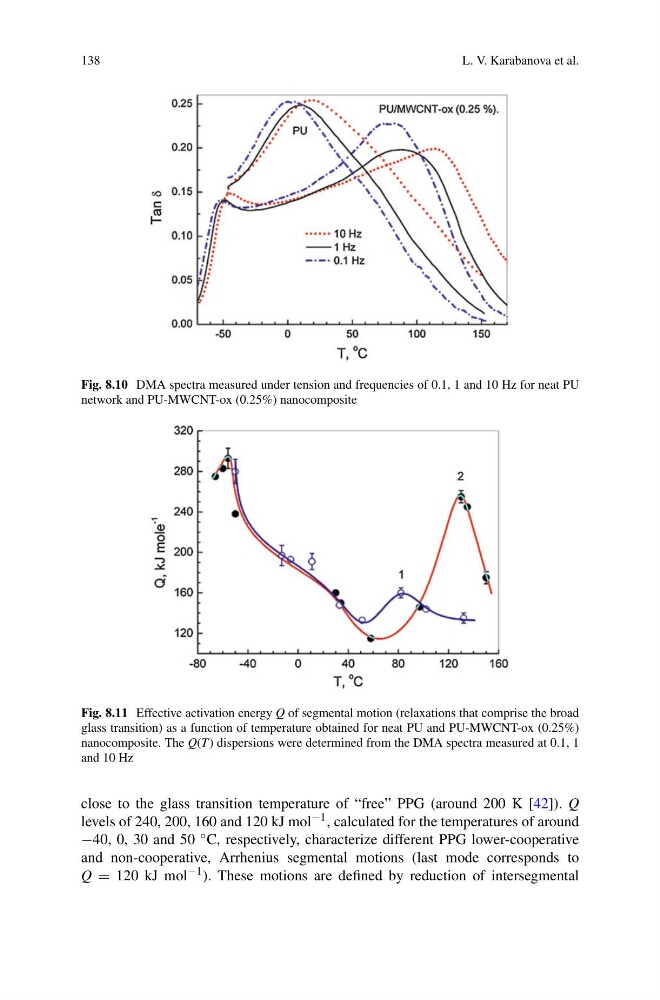
Fig. 8.10 DMA spectra measured under tension and frequencies of 0.1, 1 and 10 Hz for neat PU
network and PU-MWCNT-ox (0.25%) nanocomposite
Fig. 8.11 Effective activation energy Q of segmental motion (relaxations that comprise the broad
glass transition) as a function of temperature obtained for neat PU and PU-MWCNT-ox (0.25%)
nanocomposite. The Q(T) dispersions were determined from the DMA spectra measured at 0.1, 1
and 10 Hz
close to the glass transition temperature of “free” PPG (around 200 K [42]). Q
levels of 240, 200, 160 and 120 kJ mol −1 , calculated for the temperatures of around
−40, 0, 30 and 50 ◦ C, respectively, characterize different PPG lower-cooperative
and non-cooperative, Arrhenius segmental motions (last mode corresponds to
Q = 120 kJ mol −1 ). These motions are defined by reduction of intersegmental
L. V. Karabanova et al.
Fig. 8.10 DMA spectra measured under tension and frequencies of 0.1, 1 and 10 Hz for neat PU
network and PU-MWCNT-ox (0.25%) nanocomposite
Fig. 8.11 Effective activation energy Q of segmental motion (relaxations that comprise the broad
glass transition) as a function of temperature obtained for neat PU and PU-MWCNT-ox (0.25%)
nanocomposite. The Q(T) dispersions were determined from the DMA spectra measured at 0.1, 1
and 10 Hz
close to the glass transition temperature of “free” PPG (around 200 K [42]). Q
levels of 240, 200, 160 and 120 kJ mol −1 , calculated for the temperatures of around
−40, 0, 30 and 50 ◦ C, respectively, characterize different PPG lower-cooperative
and non-cooperative, Arrhenius segmental motions (last mode corresponds to
Q = 120 kJ mol −1 ). These motions are defined by reduction of intersegmental