

8 Nanocomposites Based on Thermosetting Polyurethane Matrix. . .
129
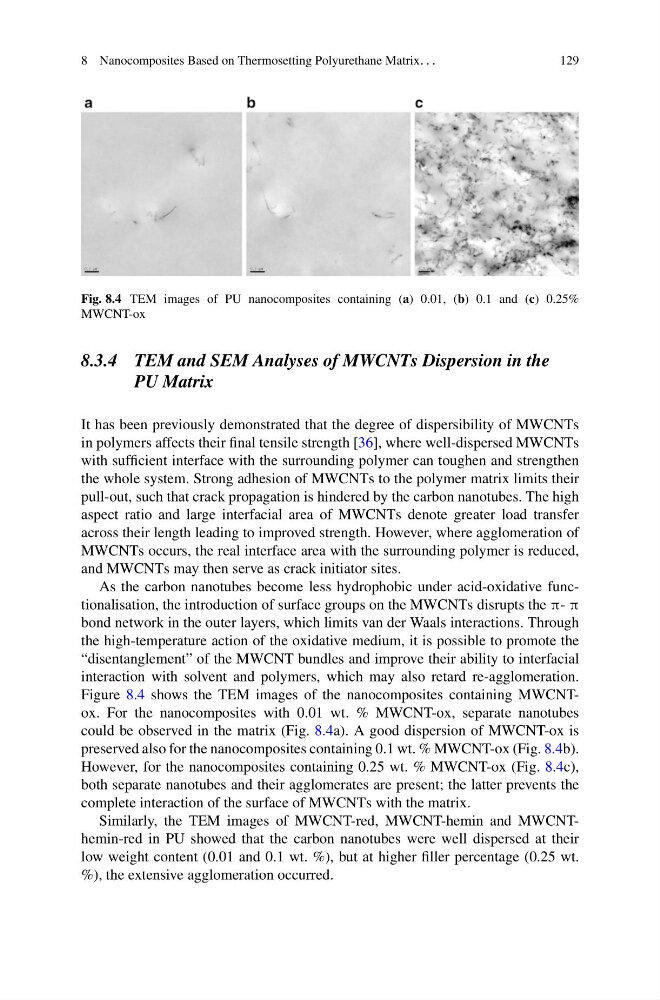
Fig. 8.4 TEM images of PU nanocomposites containing (a) 0.01, (b) 0.1 and (c) 0.25%
MWCNT-ox
8.3.4 TEM and SEM Analyses of MWCNTs Dispersion in the
PU Matrix
It has been previously demonstrated that the degree of dispersibility of MWCNTs
in polymers affects their final tensile strength [36], where well-dispersed MWCNTs
with sufficient interface with the surrounding polymer can toughen and strengthen
the whole system. Strong adhesion of MWCNTs to the polymer matrix limits their
pull-out, such that crack propagation is hindered by the carbon nanotubes. The high
aspect ratio and large interfacial area of MWCNTs denote greater load transfer
across their length leading to improved strength. However, where agglomeration of
MWCNTs occurs, the real interface area with the surrounding polymer is reduced,
and MWCNTs may then serve as crack initiator sites.
As the carbon nanotubes become less hydrophobic under acid-oxidative functionalisation, the introduction of surface groups on the MWCNTs disrupts the π- π
bond network in the outer layers, which limits van der Waals interactions. Through
the high-temperature action of the oxidative medium, it is possible to promote the
“disentanglement” of the MWCNT bundles and improve their ability to interfacial
interaction with solvent and polymers, which may also retard re-agglomeration.
Figure 8.4 shows the TEM images of the nanocomposites containing MWCNTox. For the nanocomposites with 0.01 wt. % MWCNT-ox, separate nanotubes
could be observed in the matrix (Fig. 8.4a). A good dispersion of MWCNT-ox is
preserved also for the nanocomposites containing 0.1 wt. % MWCNT-ox (Fig. 8.4b).
However, for the nanocomposites containing 0.25 wt. % MWCNT-ox (Fig. 8.4c),
both separate nanotubes and their agglomerates are present; the latter prevents the
complete interaction of the surface of MWCNTs with the matrix.
Similarly, the TEM images of MWCNT-red, MWCNT-hemin and MWCNThemin-red in PU showed that the carbon nanotubes were well dispersed at their
low weight content (0.01 and 0.1 wt. %), but at higher filler percentage (0.25 wt.
%), the extensive agglomeration occurred.
129
Fig. 8.4 TEM images of PU nanocomposites containing (a) 0.01, (b) 0.1 and (c) 0.25%
MWCNT-ox
8.3.4 TEM and SEM Analyses of MWCNTs Dispersion in the
PU Matrix
It has been previously demonstrated that the degree of dispersibility of MWCNTs
in polymers affects their final tensile strength [36], where well-dispersed MWCNTs
with sufficient interface with the surrounding polymer can toughen and strengthen
the whole system. Strong adhesion of MWCNTs to the polymer matrix limits their
pull-out, such that crack propagation is hindered by the carbon nanotubes. The high
aspect ratio and large interfacial area of MWCNTs denote greater load transfer
across their length leading to improved strength. However, where agglomeration of
MWCNTs occurs, the real interface area with the surrounding polymer is reduced,
and MWCNTs may then serve as crack initiator sites.
As the carbon nanotubes become less hydrophobic under acid-oxidative functionalisation, the introduction of surface groups on the MWCNTs disrupts the π- π
bond network in the outer layers, which limits van der Waals interactions. Through
the high-temperature action of the oxidative medium, it is possible to promote the
“disentanglement” of the MWCNT bundles and improve their ability to interfacial
interaction with solvent and polymers, which may also retard re-agglomeration.
Figure 8.4 shows the TEM images of the nanocomposites containing MWCNTox. For the nanocomposites with 0.01 wt. % MWCNT-ox, separate nanotubes
could be observed in the matrix (Fig. 8.4a). A good dispersion of MWCNT-ox is
preserved also for the nanocomposites containing 0.1 wt. % MWCNT-ox (Fig. 8.4b).
However, for the nanocomposites containing 0.25 wt. % MWCNT-ox (Fig. 8.4c),
both separate nanotubes and their agglomerates are present; the latter prevents the
complete interaction of the surface of MWCNTs with the matrix.
Similarly, the TEM images of MWCNT-red, MWCNT-hemin and MWCNThemin-red in PU showed that the carbon nanotubes were well dispersed at their
low weight content (0.01 and 0.1 wt. %), but at higher filler percentage (0.25 wt.
%), the extensive agglomeration occurred.