

8 Nanocomposites Based on Thermosetting Polyurethane Matrix. . .
125
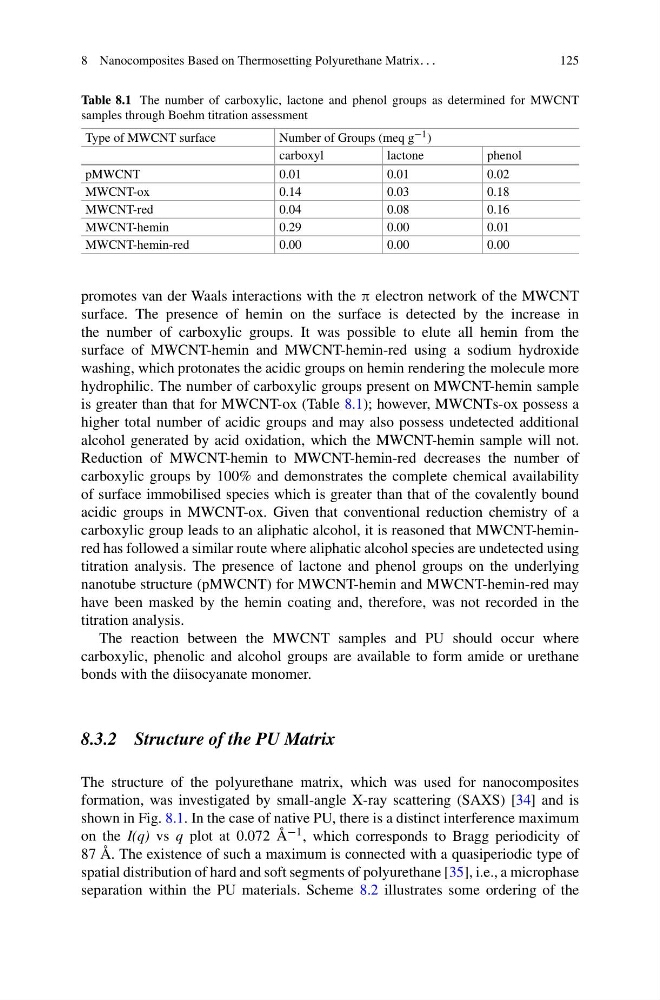
Table 8.1 The number of carboxylic, lactone and phenol groups as determined for MWCNT
samples through Boehm titration assessment
Type of MWCNT surface
Number of Groups (meq g −1 )
carboxyl
lactone
phenol
pMWCNT
0.01
0.01
0.02
MWCNT-ox
0.14
0.03
0.18
MWCNT-red
0.04
0.08
0.16
MWCNT-hemin
0.29
0.00
0.01
MWCNT-hemin-red
0.00
0.00
0.00
promotes van der Waals interactions with the π electron network of the MWCNT
surface. The presence of hemin on the surface is detected by the increase in
the number of carboxylic groups. It was possible to elute all hemin from the
surface of MWCNT-hemin and MWCNT-hemin-red using a sodium hydroxide
washing, which protonates the acidic groups on hemin rendering the molecule more
hydrophilic. The number of carboxylic groups present on MWCNT-hemin sample
is greater than that for MWCNT-ox (Table 8.1); however, MWCNTs-ox possess a
higher total number of acidic groups and may also possess undetected additional
alcohol generated by acid oxidation, which the MWCNT-hemin sample will not.
Reduction of MWCNT-hemin to MWCNT-hemin-red decreases the number of
carboxylic groups by 100% and demonstrates the complete chemical availability
of surface immobilised species which is greater than that of the covalently bound
acidic groups in MWCNT-ox. Given that conventional reduction chemistry of a
carboxylic group leads to an aliphatic alcohol, it is reasoned that MWCNT-heminred has followed a similar route where aliphatic alcohol species are undetected using
titration analysis. The presence of lactone and phenol groups on the underlying
nanotube structure (pMWCNT) for MWCNT-hemin and MWCNT-hemin-red may
have been masked by the hemin coating and, therefore, was not recorded in the
titration analysis.
The reaction between the MWCNT samples and PU should occur where
carboxylic, phenolic and alcohol groups are available to form amide or urethane
bonds with the diisocyanate monomer.
8.3.2 Structure of the PU Matrix
The structure of the polyurethane matrix, which was used for nanocomposites
formation, was investigated by small-angle X-ray scattering (SAXS) [34] and is
shown in Fig. 8.1. In the case of native PU, there is a distinct interference maximum
on the I(q) vs q plot at 0.072 Å −1 , which corresponds to Bragg periodicity of
87 Å. The existence of such a maximum is connected with a quasiperiodic type of
spatial distribution of hard and soft segments of polyurethane [35], i.e., a microphase
separation within the PU materials. Scheme 8.2 illustrates some ordering of the
125
Table 8.1 The number of carboxylic, lactone and phenol groups as determined for MWCNT
samples through Boehm titration assessment
Type of MWCNT surface
Number of Groups (meq g −1 )
carboxyl
lactone
phenol
pMWCNT
0.01
0.01
0.02
MWCNT-ox
0.14
0.03
0.18
MWCNT-red
0.04
0.08
0.16
MWCNT-hemin
0.29
0.00
0.01
MWCNT-hemin-red
0.00
0.00
0.00
promotes van der Waals interactions with the π electron network of the MWCNT
surface. The presence of hemin on the surface is detected by the increase in
the number of carboxylic groups. It was possible to elute all hemin from the
surface of MWCNT-hemin and MWCNT-hemin-red using a sodium hydroxide
washing, which protonates the acidic groups on hemin rendering the molecule more
hydrophilic. The number of carboxylic groups present on MWCNT-hemin sample
is greater than that for MWCNT-ox (Table 8.1); however, MWCNTs-ox possess a
higher total number of acidic groups and may also possess undetected additional
alcohol generated by acid oxidation, which the MWCNT-hemin sample will not.
Reduction of MWCNT-hemin to MWCNT-hemin-red decreases the number of
carboxylic groups by 100% and demonstrates the complete chemical availability
of surface immobilised species which is greater than that of the covalently bound
acidic groups in MWCNT-ox. Given that conventional reduction chemistry of a
carboxylic group leads to an aliphatic alcohol, it is reasoned that MWCNT-heminred has followed a similar route where aliphatic alcohol species are undetected using
titration analysis. The presence of lactone and phenol groups on the underlying
nanotube structure (pMWCNT) for MWCNT-hemin and MWCNT-hemin-red may
have been masked by the hemin coating and, therefore, was not recorded in the
titration analysis.
The reaction between the MWCNT samples and PU should occur where
carboxylic, phenolic and alcohol groups are available to form amide or urethane
bonds with the diisocyanate monomer.
8.3.2 Structure of the PU Matrix
The structure of the polyurethane matrix, which was used for nanocomposites
formation, was investigated by small-angle X-ray scattering (SAXS) [34] and is
shown in Fig. 8.1. In the case of native PU, there is a distinct interference maximum
on the I(q) vs q plot at 0.072 Å −1 , which corresponds to Bragg periodicity of
87 Å. The existence of such a maximum is connected with a quasiperiodic type of
spatial distribution of hard and soft segments of polyurethane [35], i.e., a microphase
separation within the PU materials. Scheme 8.2 illustrates some ordering of the