

8 Nanocomposites Based on Thermosetting Polyurethane Matrix. . .
123
2-cm working length were used. The creep rate spectra were measured over the
temperature range from −100 to +140 ◦ C at the tensile stress of 0.3 MPa. A stress
was chosen in the preliminary experiments as capable of inducing sufficient creep
rates to be measured, whilst maintaining also a high spectral resolution, without
smoothing out and distortion of a spectral contour. At heating with the rate V = 1 ◦ C
min −1 , every 5 ◦ C the sample was loaded, and an interferogram was recorded 10 s
after loading. Then the sample was unloaded, heated to a temperature 5
◦ higher and
loaded again with the same stress; again the interferogram was registered, and the
sample was unloaded and so on. The instrumental error in measuring creep rates
does not exceed 1%, but scattering in the peak height and temperature location may
change by up to 20% and 3–5 ◦ C, respectively, when measuring identical samples
[29]. The correlative frequency of the CRS experiments ν corr = 10 −3 –10 −2 Hz.
8.3 Results and Discussion
8.3.1 MWCNT Surface Chemistry for Interaction with PU
A single batch of MWCNTs was used from the supplier to ensure consistency across
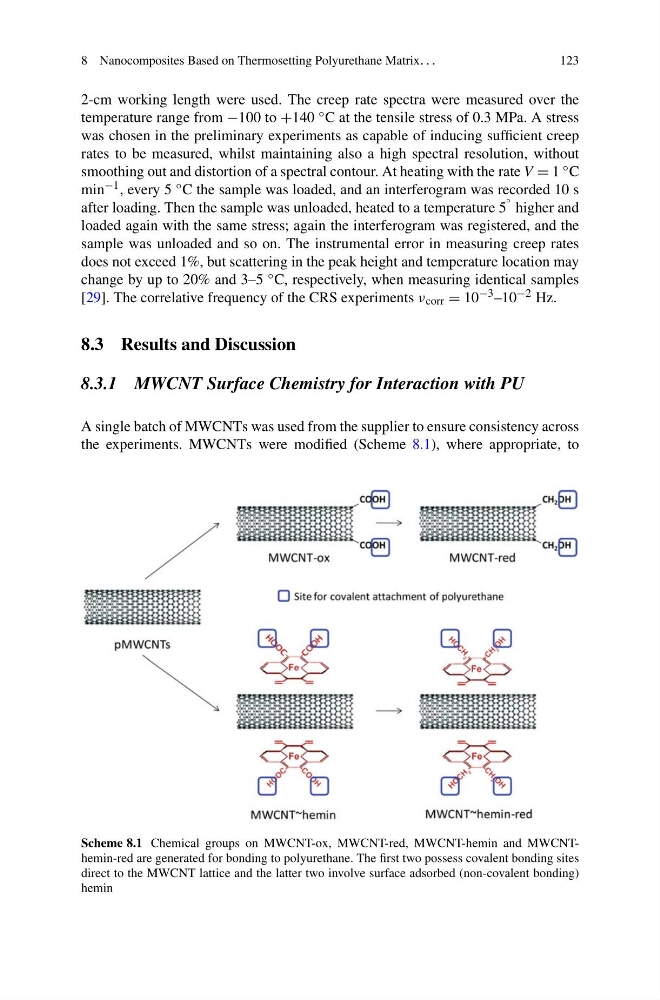
the experiments. MWCNTs were modified (Scheme 8.1), where appropriate, to
Scheme 8.1 Chemical groups on MWCNT-ox, MWCNT-red, MWCNT-hemin and MWCNThemin-red are generated for bonding to polyurethane. The first two possess covalent bonding sites
direct to the MWCNT lattice and the latter two involve surface adsorbed (non-covalent bonding)
hemin
123
2-cm working length were used. The creep rate spectra were measured over the
temperature range from −100 to +140 ◦ C at the tensile stress of 0.3 MPa. A stress
was chosen in the preliminary experiments as capable of inducing sufficient creep
rates to be measured, whilst maintaining also a high spectral resolution, without
smoothing out and distortion of a spectral contour. At heating with the rate V = 1 ◦ C
min −1 , every 5 ◦ C the sample was loaded, and an interferogram was recorded 10 s
after loading. Then the sample was unloaded, heated to a temperature 5
◦ higher and
loaded again with the same stress; again the interferogram was registered, and the
sample was unloaded and so on. The instrumental error in measuring creep rates
does not exceed 1%, but scattering in the peak height and temperature location may
change by up to 20% and 3–5 ◦ C, respectively, when measuring identical samples
[29]. The correlative frequency of the CRS experiments ν corr = 10 −3 –10 −2 Hz.
8.3 Results and Discussion
8.3.1 MWCNT Surface Chemistry for Interaction with PU
A single batch of MWCNTs was used from the supplier to ensure consistency across
the experiments. MWCNTs were modified (Scheme 8.1), where appropriate, to
Scheme 8.1 Chemical groups on MWCNT-ox, MWCNT-red, MWCNT-hemin and MWCNThemin-red are generated for bonding to polyurethane. The first two possess covalent bonding sites
direct to the MWCNT lattice and the latter two involve surface adsorbed (non-covalent bonding)
hemin