

120
L. V. Karabanova et al.
MWCNT-hemin, MWCNT-ox, MWCNT-hemin-red or MWCNT-red (0.01, 0.1 or
0.25 wt. %), were mixed with the PPG and adduct prior to polyurethane synthesis.
The prepared films with 1 mm thickness were post-cured for 2 h at 100 ◦ C and then
were held for 36 h at 80 ◦ C in vacuum 10 −5 Pa to ensure the removal of any trace
gas from the polymer composite.
8.2.2 Testing Methods
8.2.2.1 Vapour Sorption and Thermodynamic Calculations
The dichloromethane vapour sorption by PU samples and by nanocomposite’s
samples was studied using a vacuum installation and a McBain balance [9]. The
changes in partial free energy of dichloromethane by sorption (dissolution) μ 1
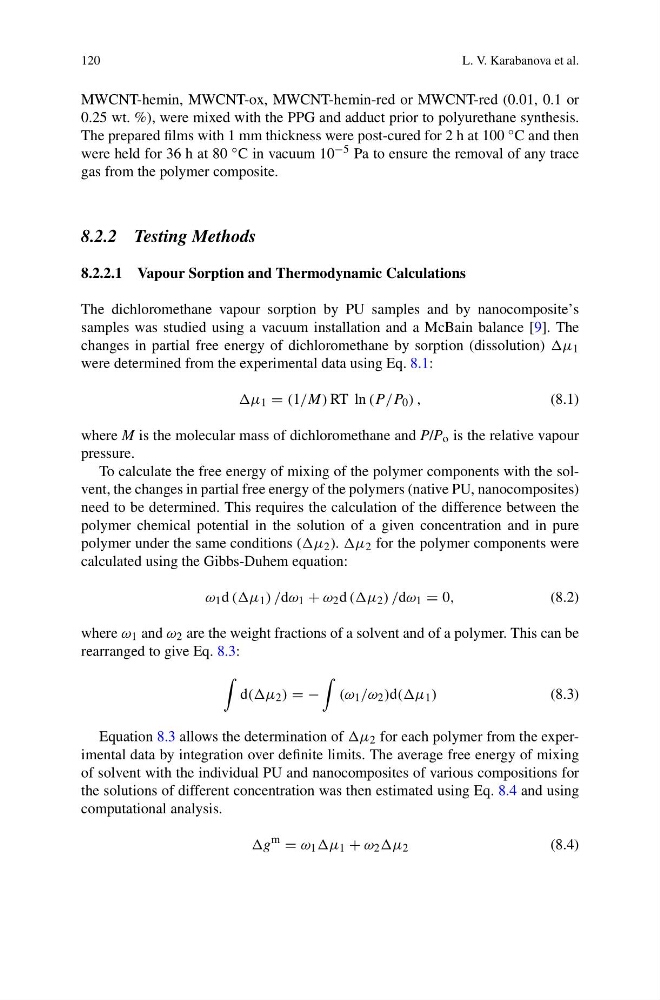
were determined from the experimental data using Eq. 8.1:
μ 1 = (1/M) RT ln (P /P 0 ) ,
(8.1)
where M is the molecular mass of dichloromethane and P/P o is the relative vapour
pressure.
To calculate the free energy of mixing of the polymer components with the solvent, the changes in partial free energy of the polymers (native PU, nanocomposites)
need to be determined. This requires the calculation of the difference between the
polymer chemical potential in the solution of a given concentration and in pure
polymer under the same conditions (μ 2 ). μ 2 for the polymer components were
calculated using the Gibbs-Duhem equation:
ω 1 d (μ 1 ) /dω 1 + ω 2 d (μ 2 ) /dω 1 = 0,
(8.2)
where ω 1 and ω 2 are the weight fractions of a solvent and of a polymer. This can be
rearranged to give Eq. 8.3:
d(μ 2 ) = −
(ω 1 /ω 2 )d(μ 1 )
(8.3)
Equation 8.3 allows the determination of μ 2 for each polymer from the experimental data by integration over definite limits. The average free energy of mixing
of solvent with the individual PU and nanocomposites of various compositions for
the solutions of different concentration was then estimated using Eq. 8.4 and using
computational analysis.
g
m
= ω 1 μ 1 + ω 2 μ 2
(8.4)
L. V. Karabanova et al.
MWCNT-hemin, MWCNT-ox, MWCNT-hemin-red or MWCNT-red (0.01, 0.1 or
0.25 wt. %), were mixed with the PPG and adduct prior to polyurethane synthesis.
The prepared films with 1 mm thickness were post-cured for 2 h at 100 ◦ C and then
were held for 36 h at 80 ◦ C in vacuum 10 −5 Pa to ensure the removal of any trace
gas from the polymer composite.
8.2.2 Testing Methods
8.2.2.1 Vapour Sorption and Thermodynamic Calculations
The dichloromethane vapour sorption by PU samples and by nanocomposite’s
samples was studied using a vacuum installation and a McBain balance [9]. The
changes in partial free energy of dichloromethane by sorption (dissolution) μ 1
were determined from the experimental data using Eq. 8.1:
μ 1 = (1/M) RT ln (P /P 0 ) ,
(8.1)
where M is the molecular mass of dichloromethane and P/P o is the relative vapour
pressure.
To calculate the free energy of mixing of the polymer components with the solvent, the changes in partial free energy of the polymers (native PU, nanocomposites)
need to be determined. This requires the calculation of the difference between the
polymer chemical potential in the solution of a given concentration and in pure
polymer under the same conditions (μ 2 ). μ 2 for the polymer components were
calculated using the Gibbs-Duhem equation:
ω 1 d (μ 1 ) /dω 1 + ω 2 d (μ 2 ) /dω 1 = 0,
(8.2)
where ω 1 and ω 2 are the weight fractions of a solvent and of a polymer. This can be
rearranged to give Eq. 8.3:
d(μ 2 ) = −
(ω 1 /ω 2 )d(μ 1 )
(8.3)
Equation 8.3 allows the determination of μ 2 for each polymer from the experimental data by integration over definite limits. The average free energy of mixing
of solvent with the individual PU and nanocomposites of various compositions for
the solutions of different concentration was then estimated using Eq. 8.4 and using
computational analysis.
g
m
= ω 1 μ 1 + ω 2 μ 2
(8.4)