

7 Applications Perspectives of Nanodispersed Chalcogenides of Transition. . .
101
H 2 O ads + h
+
→ OH –
ads + H
+
;
(7.2)
OH –
ads + h
+
→ OH
•
ads .
(7.3)
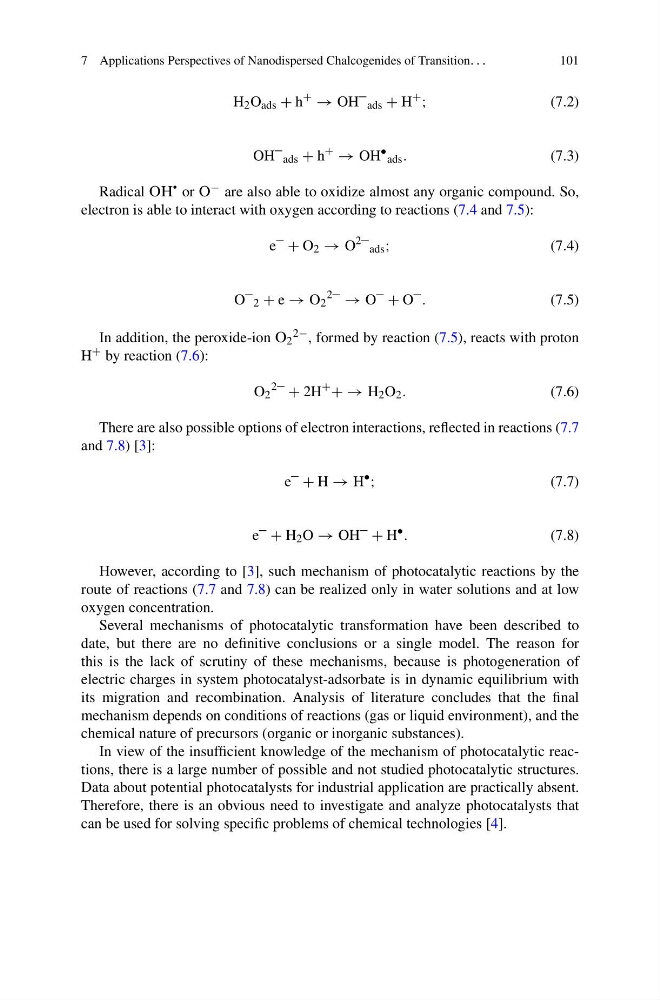
Radical ±° • or ± − are also able to oxidize almost any organic compound. So,
electron is able to interact with oxygen according to reactions (7.4 and 7.5):
e – + O 2 → O
2–
ads ;
(7.4)
O –
2 + e → O 2
2–
→ O – + O – .
(7.5)
In addition, the peroxide-ion ± 2
2− , formed by reaction (7.5), reacts with proton
H + by reaction (7.6):
O 2
2–
+ 2H
+
+ → H 2 O 2 .
(7.6)
There are also possible options of electron interactions, reflected in reactions (7.7
and 7.8) [3]:
e – + H → H
•
;
(7.7)
e – + H 2 O → OH – + H
• .
(7.8)
However, according to [3], such mechanism of photocatalytic reactions by the
route of reactions (7.7 and 7.8) can be realized only in water solutions and at low
oxygen concentration.
Several mechanisms of photocatalytic transformation have been described to
date, but there are no definitive conclusions or a single model. The reason for
this is the lack of scrutiny of these mechanisms, because is photogeneration of
electric charges in system photocatalyst-adsorbate is in dynamic equilibrium with
its migration and recombination. Analysis of literature concludes that the final
mechanism depends on conditions of reactions (gas or liquid environment), and the
chemical nature of precursors (organic or inorganic substances).
In view of the insufficient knowledge of the mechanism of photocatalytic reactions, there is a large number of possible and not studied photocatalytic structures.
Data about potential photocatalysts for industrial application are practically absent.
Therefore, there is an obvious need to investigate and analyze photocatalysts that
can be used for solving specific problems of chemical technologies [4].
101
H 2 O ads + h
+
→ OH –
ads + H
+
;
(7.2)
OH –
ads + h
+
→ OH
•
ads .
(7.3)
Radical ±° • or ± − are also able to oxidize almost any organic compound. So,
electron is able to interact with oxygen according to reactions (7.4 and 7.5):
e – + O 2 → O
2–
ads ;
(7.4)
O –
2 + e → O 2
2–
→ O – + O – .
(7.5)
In addition, the peroxide-ion ± 2
2− , formed by reaction (7.5), reacts with proton
H + by reaction (7.6):
O 2
2–
+ 2H
+
+ → H 2 O 2 .
(7.6)
There are also possible options of electron interactions, reflected in reactions (7.7
and 7.8) [3]:
e – + H → H
•
;
(7.7)
e – + H 2 O → OH – + H
• .
(7.8)
However, according to [3], such mechanism of photocatalytic reactions by the
route of reactions (7.7 and 7.8) can be realized only in water solutions and at low
oxygen concentration.
Several mechanisms of photocatalytic transformation have been described to
date, but there are no definitive conclusions or a single model. The reason for
this is the lack of scrutiny of these mechanisms, because is photogeneration of
electric charges in system photocatalyst-adsorbate is in dynamic equilibrium with
its migration and recombination. Analysis of literature concludes that the final
mechanism depends on conditions of reactions (gas or liquid environment), and the
chemical nature of precursors (organic or inorganic substances).
In view of the insufficient knowledge of the mechanism of photocatalytic reactions, there is a large number of possible and not studied photocatalytic structures.
Data about potential photocatalysts for industrial application are practically absent.
Therefore, there is an obvious need to investigate and analyze photocatalysts that
can be used for solving specific problems of chemical technologies [4].