

30
Biologically Inspired Robotics
1
2
3
4
5
6
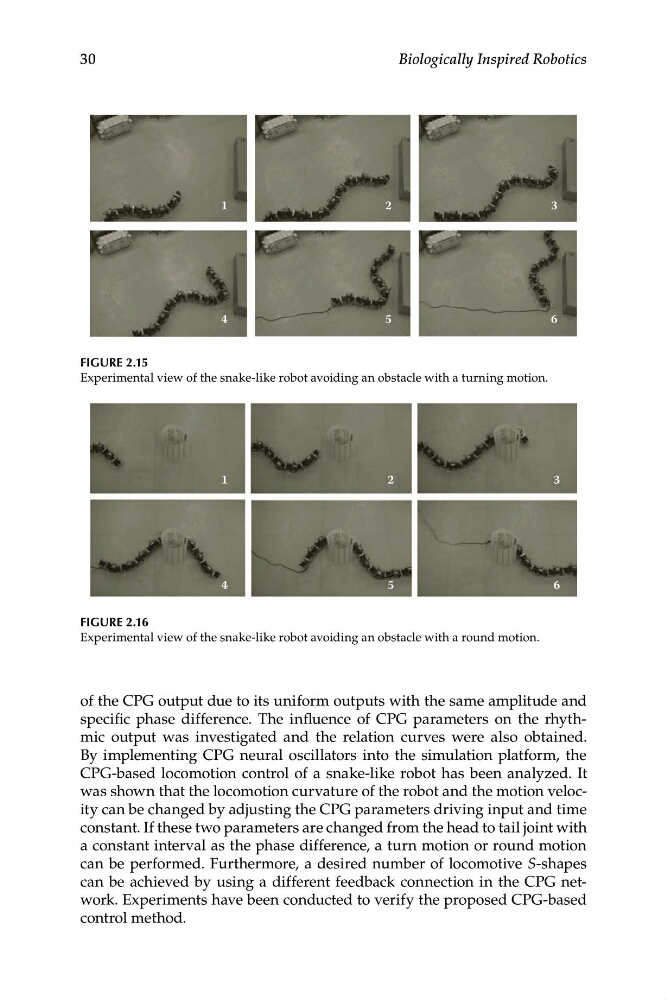
FIGURE 2.15
Experimental view of the snake-like robot avoiding an obstacle with a turning motion.
1
2
3
4
5
6
FIGURE 2.16
Experimental view of the snake-like robot avoiding an obstacle with a round motion.
of the CPG output due to its uniform outputs with the same amplitude and
specific phase difference. The influence of CPG parameters on the rhythmic output was investigated and the relation curves were also obtained.
By implementing CPG neural oscillators into the simulation platform, the
CPG-based locomotion control of a snake-like robot has been analyzed. It
was shown that the locomotion curvature of the robot and the motion velocity can be changed by adjusting the CPG parameters driving input and time
constant. If these two parameters are changed from the head to tail joint with
a constant interval as the phase difference, a turn motion or round motion
can be performed. Furthermore, a desired number of locomotive S-shapes
can be achieved by using a different feedback connection in the CPG network. Experiments have been conducted to verify the proposed CPG-based
control method.
Biologically Inspired Robotics
1
2
3
4
5
6
FIGURE 2.15
Experimental view of the snake-like robot avoiding an obstacle with a turning motion.
1
2
3
4
5
6
FIGURE 2.16
Experimental view of the snake-like robot avoiding an obstacle with a round motion.
of the CPG output due to its uniform outputs with the same amplitude and
specific phase difference. The influence of CPG parameters on the rhythmic output was investigated and the relation curves were also obtained.
By implementing CPG neural oscillators into the simulation platform, the
CPG-based locomotion control of a snake-like robot has been analyzed. It
was shown that the locomotion curvature of the robot and the motion velocity can be changed by adjusting the CPG parameters driving input and time
constant. If these two parameters are changed from the head to tail joint with
a constant interval as the phase difference, a turn motion or round motion
can be performed. Furthermore, a desired number of locomotive S-shapes
can be achieved by using a different feedback connection in the CPG network. Experiments have been conducted to verify the proposed CPG-based
control method.