

25
CPG-Based Control of Serpentine Locomotion of a Snake-Like Robot
two S-shapes, shown in Figure 2.8b. The same results can also be obtained
from Equation (2.7) where n = 13 and r = 12 and 6, respectively.
2.4.4 Control of the Turning Motion
A common behavior of most robots when they meet an obstacle in the forward direction is to turn left or right to avoid the barrier. The snake-like
robot can also perform a turn motion to avoid the obstacles. However, due
to the characteristics of the creep motion of the snake-like robot generated
by swinging the joints from side to side, the mechanism for performing a
turn motion is totally different from that in wheeled drive robots (Wu and
Ma 2009).
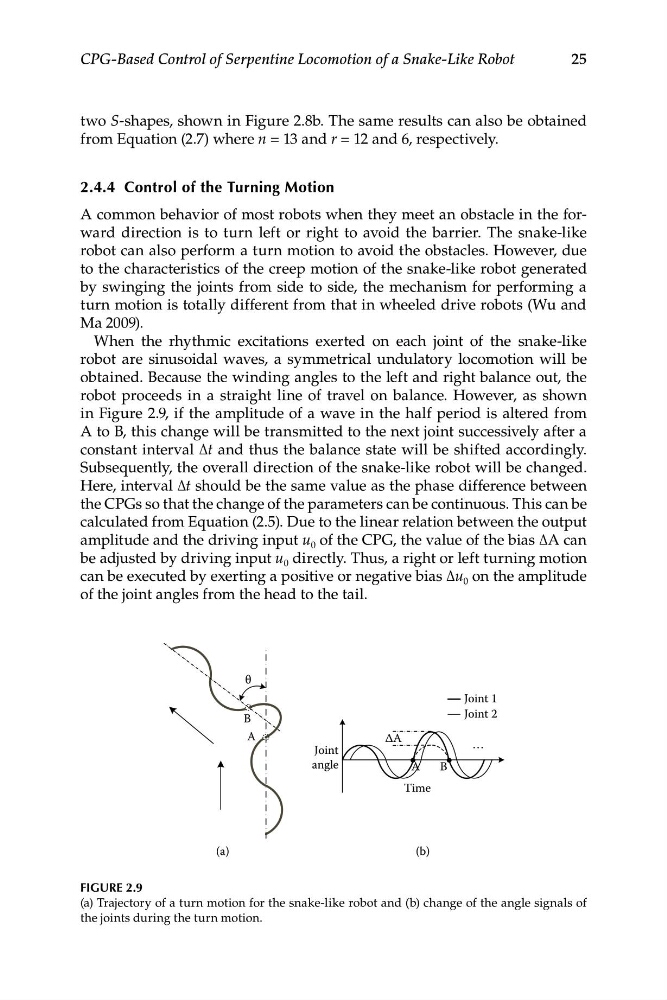
When the rhythmic excitations exerted on each joint of the snake-like
robot are sinusoidal waves, a symmetrical undulatory locomotion will be
obtained. Because the winding angles to the left and right balance out, the
robot proceeds in a straight line of travel on balance. However, as shown
in Figure 2.9, if the amplitude of a wave in the half period is altered from
A to B, this change will be transmitted to the next joint successively after a
constant interval Δt and thus the balance state will be shifted accordingly.
Subsequently, the overall direction of the snake-like robot will be changed.
Here, interval Δt should be the same value as the phase difference between
the CPGs so that the change of the parameters can be continuous. This can be
calculated from Equation (2.5). Due to the linear relation between the output
amplitude and the driving input u 0 of the CPG, the value of the bias ΔA can
be adjusted by driving input u 0 directly. Thus, a right or left turning motion
can be executed by exerting a positive or negative bias Δu 0 on the amplitude
of the joint angles from the head to the tail.
A
B
ΔA
Joint
angle
Time
A
B
θ
Joint 1
Joint 2
…
(a)
(b)
FIGURE 2.9
(a) Trajectory of a turn motion for the snake-like robot and (b) change of the angle signals of
the joints during the turn motion.
CPG-Based Control of Serpentine Locomotion of a Snake-Like Robot
two S-shapes, shown in Figure 2.8b. The same results can also be obtained
from Equation (2.7) where n = 13 and r = 12 and 6, respectively.
2.4.4 Control of the Turning Motion
A common behavior of most robots when they meet an obstacle in the forward direction is to turn left or right to avoid the barrier. The snake-like
robot can also perform a turn motion to avoid the obstacles. However, due
to the characteristics of the creep motion of the snake-like robot generated
by swinging the joints from side to side, the mechanism for performing a
turn motion is totally different from that in wheeled drive robots (Wu and
Ma 2009).
When the rhythmic excitations exerted on each joint of the snake-like
robot are sinusoidal waves, a symmetrical undulatory locomotion will be
obtained. Because the winding angles to the left and right balance out, the
robot proceeds in a straight line of travel on balance. However, as shown
in Figure 2.9, if the amplitude of a wave in the half period is altered from
A to B, this change will be transmitted to the next joint successively after a
constant interval Δt and thus the balance state will be shifted accordingly.
Subsequently, the overall direction of the snake-like robot will be changed.
Here, interval Δt should be the same value as the phase difference between
the CPGs so that the change of the parameters can be continuous. This can be
calculated from Equation (2.5). Due to the linear relation between the output
amplitude and the driving input u 0 of the CPG, the value of the bias ΔA can
be adjusted by driving input u 0 directly. Thus, a right or left turning motion
can be executed by exerting a positive or negative bias Δu 0 on the amplitude
of the joint angles from the head to the tail.
A
B
ΔA
Joint
angle
Time
A
B
θ
Joint 1
Joint 2
…
(a)
(b)
FIGURE 2.9
(a) Trajectory of a turn motion for the snake-like robot and (b) change of the angle signals of
the joints during the turn motion.